When Everything Feels Like a Catastrophe
You watch your child fall apart over something that seems small. It might be the wrong coloured cup, a dropped biscuit, or a friend who chose to play with someone else today. You wonder: is this normal? Why does everything feel so huge to them? And quietly, underneath the worry, you ask yourself: will they be okay when life gets really hard?
These are some of the most important questions a parent can ask. For almost all children, the answer is that they can build the resilience they need. But resilience does not grow from lectures. It does not grow from telling children to “toughen up”, or from removing every difficulty from their path. It grows through something far more natural: play.
What Resilience Actually Is (And What It Is Not)
Many people think resilience means being tough. They picture a child who does not cry, does not struggle, and bounces back fast without complaint. That is not resilience. That is suppression. The feelings have not gone anywhere. They have just gone underground.
In developmental research, resilience is the capacity to adapt positively when facing adversity, trauma or significant stress (Luthar et al., 2000). It is not the absence of difficulty or distress. It is the ability to move through difficulty. A resilient child can feel the hard feeling, be overwhelmed for a while, and then find a way back.
Resilience is a process, not a personality trait. Children are not born resilient or fragile. They build it through their experiences. The most useful experiences stretch them just enough, within relationships that feel safe enough.
This matters for parents. You are not searching for the “resilient type” in your child. You are building conditions. And play is one of the most useful conditions there is.
What Growing Children Need
To see why play can build resilience, it helps to ask what a growing child needs. Research points to three central ingredients: secure relationships, predictability and mastery experiences (Brooks & Goldstein, 2001).
Secure relationships. When children have steady, loving relationships, they form what attachment researchers call a “secure base”. This is a felt sense that the world is safe enough to explore, that adults can be relied on, and that they are worth caring for. Resilience is built on this base.
Predictability. Children in chaotic or unpredictable settings spend a lot of energy on staying alert for danger. That leaves less for growing and learning. When routines and responses are steady, a child’s nervous system can relax and get on with development.
Mastery experiences. When a child tries something hard, struggles, and eventually manages it, they build what psychologist Robert Brooks calls “islands of competence”. These are areas where the child knows they are capable (Brooks & Goldstein, 2001). A child can draw on those islands when things go wrong somewhere else.
All three ingredients are naturally present in therapeutic play. That is a big reason play is used as a way of working on resilience.
How Play Builds Resilience
Children do not build resilience by being told about it. They build it by living it. Play gives them that practice in its most natural form.
Frustration tolerance is one of the earliest resilience skills, and play exercises it all the time. A tower falls. A puzzle piece does not fit. A friend takes the toy they wanted. These are the small setbacks of childhood. In a safe, supported play space, a child learns to stay with the frustration rather than run from it. They learn that hard feelings do not last forever. You can read more about this in our guide to building emotional resilience in children and frustration tolerance.
Problem-solving grows naturally too. In open-ended play, children come up with ideas, test them, see what works, and try again. This is more than a thinking skill. It is practice at meeting a challenge and finding a way through.
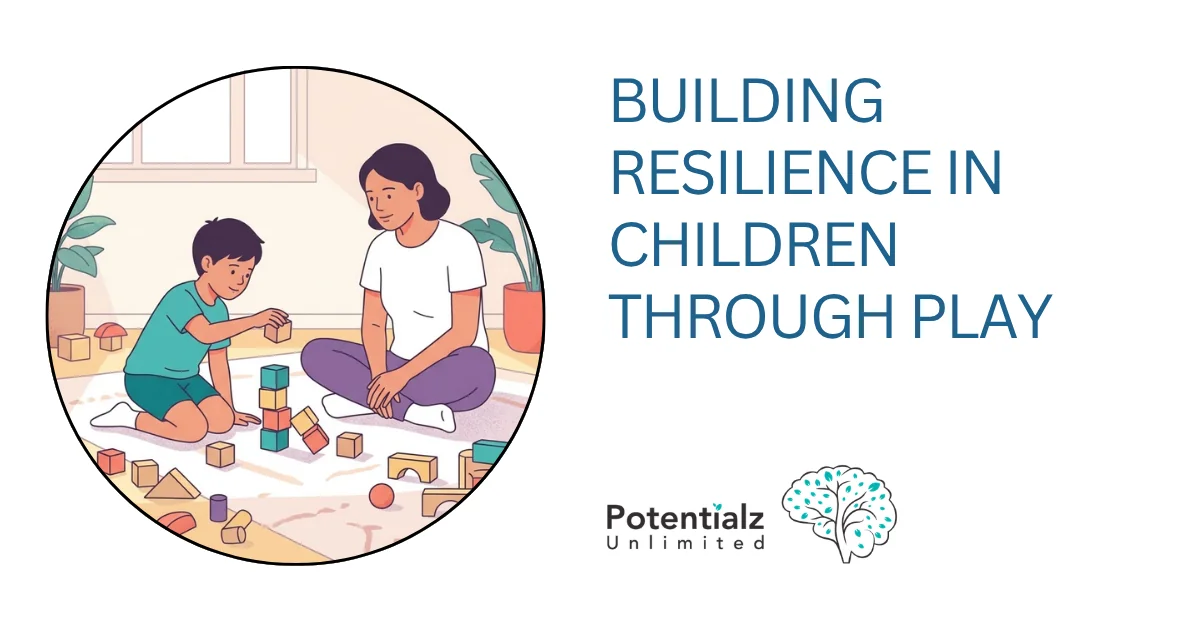
Trying again after failure is perhaps the clearest sign of resilience. Children practise it thousands of times in play before they meet serious adversity. The child who builds a block tower, watches it fall and starts again is learning something important about effort and keeping going.
Our practitioners use structured play to help children build a different relationship with difficulty. The aim is for a child to start seeing challenges as something that can be solved rather than something frightening. That shift, from “I can’t” to “I haven’t yet”, sits at the heart of what resilience means.
Synergetic Play Therapy and the Body’s Stress Response
Not every child can reach their resilience skills in ordinary moments. Some children have lived through trauma, loss, long-term stress or early difficulty in their closest relationships. For them, the nervous system is often stuck in survival mode. Trying new things, coping with frustration and recovering from upsets are all much harder.
Synergetic Play Therapy (SPT) is a model developed by Lisa Dion (2018). It is a trauma-informed approach that draws together attachment theory, neuroscience and mindfulness within the play relationship. Rather than focusing mainly on behaviour or social skills, SPT focuses on regulation. That means helping a child’s nervous system learn to move from “switched on” towards calm, and from overwhelm towards settling. You can learn more in our guide to what Synergetic Play Therapy is.
In an SPT session, the practitioner stays fully present with the child’s feelings. They do not try to fix or redirect them. Instead, they help the child settle alongside them. Over time, children can take in this skill for themselves. A child who can settle their own big feelings is better placed to meet difficulty without being flooded by it.
This work is quiet. A parent watching from outside may not see anything dramatic. But regulation is the base the other skills rest on. Without it, frustration tolerance, problem-solving and persistence are harder to build.
Parent-Child Attachment Play: Building the Secure Base
Therapeutic play alone is not enough if a child’s closest relationships feel unsafe or unreliable. This is why Parent-Child Attachment Play is central to the resilience work we do with families at Potentialz Unlimited.
The bond between parent and child is the original source of resilience. Research links secure attachment to at least one caregiver with stronger coping across a person’s life (Sroufe, 2005). A securely attached child knows they are not alone with their troubles. There is a safe, reliable person to come back to.
Parent-Child Attachment Play uses specific, playful activities to strengthen the felt connection between parent and child. Sessions usually begin with just the parent and the practitioner. Together they explore what the child’s behaviour might be saying and what the parent can do to build a sense of safety. Then parent-and-child sessions bring the activities into the relationship itself.
The goal is not to hand parents a set of techniques. It is to help parent and child feel connected in a new way, through laughter, gentle play, warm eye contact and playful challenge. A child who feels safer with their parent is more able to take risks, try new things and get back up after a setback. Our guide to Parent-Child Attachment Play explains more.
What Resilience-Building Looks Like in Practice
Parents often ask what changes they will see, and when. The honest answer is that it depends on the child, and it takes time.
In the early stages of therapeutic play, some parents notice their child becomes more unsettled at home for a while. This is common. When children begin to feel safe enough to show what they have been holding inside, it can be loud before it quietens. If this happens, your practitioner wants to hear about it.
Over weeks and months, parents often describe smaller shifts. A child who used to melt down completely may take a breath before the tears. A child who gave up straight away may try one more time before asking for help. A child who clung and cried at school drop-off may start to wave goodbye. Our post on starting school and school transitions looks at that last example more closely.
These are small steps, not dramatic changes. Each one points to a growing inner skill for meeting hard things. Every child is different, and results cannot be promised.
Parents are involved throughout. There is an initial parent consultation at the start. After that, parent review sessions happen about every six weeks, so that what happens in the therapy room stays connected to home. Understanding what your child’s behaviour is saying can change how you respond, and how you respond matters a great deal.
How many sessions? This varies from child to child. In this kind of work, 12 sessions is a common starting point. Children with deeper patterns of dysregulation or early relational difficulty often continue for longer, sometimes 35 to 40 sessions over time. These numbers describe what is typical in the approach. They are not a promise of what your child will need, and the plan is reviewed with you along the way.
Key Takeaways
- Resilience is not toughness. It is the capacity to move through difficulty and adapt, built through experience and safe relationships.
- Three key ingredients are secure relationships, predictability and mastery experiences. All three are naturally part of therapeutic play.
- Play builds frustration tolerance, problem-solving and the habit of trying again.
- Synergetic Play Therapy works on regulation, which underlies other resilience skills.
- Parent-Child Attachment Play strengthens the bond that resilience grows from.
- Change is gradual. It can include a rougher patch at home early on before things settle.
- Session numbers vary. Twelve is a typical starting point, and some children continue for longer.
Support for Children in Bella Vista and the Hills District
At Potentialz Unlimited in Bella Vista, our practitioners work with children aged 3 to 12 and their families. We support families across the Hills District, including Norwest, Castle Hill, Kellyville, Baulkham Hills and Rouse Hill. Every child is assessed individually. The approach is chosen to suit that child. It might be Synergetic Play Therapy to support regulation, LEGO® Based Therapy to build specific skills, or Parent-Child Attachment Play to strengthen the secure base at home.
You can explore our play therapy services in Bella Vista, or read how play therapy differs from talk therapy. If you are wondering whether your child might benefit from therapeutic play, or you are simply worried and want to talk it through, we warmly invite you to reach out.
Book a session online: live.potentialz.com.au Visit us: Unit 608, 8 Elizabeth Macarthur Drive, Bella Vista NSW 2153 Telehealth: available by phone or Zoom
References
Brooks, R., & Goldstein, S. (2001). Raising resilient children: Fostering strength, hope, and optimism in your child. Contemporary Books.
Dion, L. (2018). Aggression in play therapy: A neurobiological approach for integrating intensity. W. W. Norton & Company.
Landreth, G. L. (2012). Play therapy: The art of the relationship (3rd ed.). Routledge.
Luthar, S. S., Cicchetti, D., & Becker, B. (2000). The construct of resilience: A critical evaluation and guidelines for future work. Child Development, 71(3), 543–562. https://doi.org/10.1111/1467-8624.00164
Sroufe, L. A. (2005). Attachment and development: A prospective, longitudinal study from birth to adulthood. Attachment and Human Development, 7(4), 349–367. https://doi.org/10.1080/14616730500365928
Disclaimer
This information is general in nature. Please consult a qualified health professional for individual advice.
Crisis and Support Resources
If you or someone you know needs support, please contact Lifeline on 13 11 14, Beyond Blue on 1300 22 4636, or Kids Helpline on 1800 55 1800.
Knowledge Check Quiz
Test what you have just read. Choose your answer for each question, then submit to reveal the answers and your score.
Need Professional Support?
If you're experiencing mental health concerns, our team is here to help.