The Dinner That Nobody Enjoyed
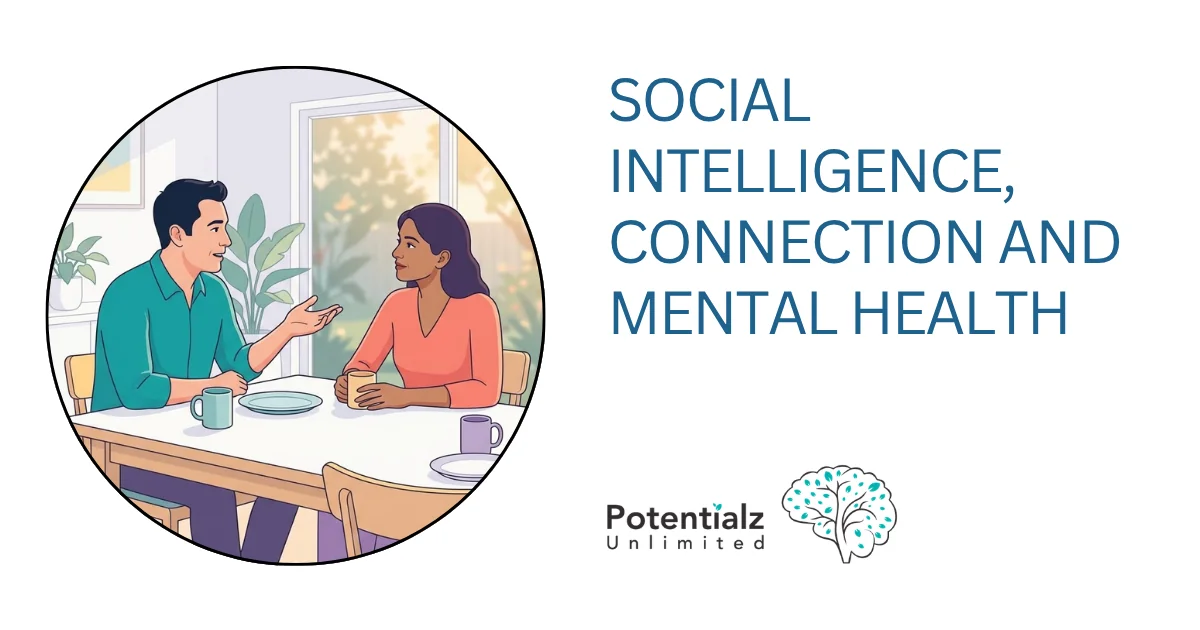
It is 8:36pm on a Saturday. Seven people sit around the table. You are one of them. The food is fine. The conversation is fine. Inside your chest is the same quiet static you have felt most Saturdays this year. You speak when spoken to. You laugh at the right moments. By every measure you are present. Yet you are also not really there. It feels like you are watching the evening through a pane of glass.
On the drive home, your partner chats happily about the night. You nod in the right places. You wonder, again, whether something is wrong with you. You have friends. You have a good marriage. Your colleagues like you. And still you feel lonely in a way you cannot point to.
If any of this sounds familiar, please read on. Social intelligence and real connection are learnable skills, and they matter for mental health. This article, from our psychologists in Bella Vista, is a plain map of what the research says and what can help.
What Social Intelligence Actually Is
Social intelligence is the set of abilities we use to understand and handle situations with other people. It is close to emotional intelligence, but not the same. Emotional intelligence focuses on feelings, in yourself and others. Social intelligence focuses on what is happening between people. The two overlap a lot, and researchers still debate where one ends and the other begins. For the emotion side, see our guide to emotional intelligence in adult relationships and work.
The abilities usually grouped under social intelligence include:
- Social perception. Reading faces, tone of voice, body language and the setting.
- Perspective-taking. Working out what another person thinks, feels or wants, without assuming they feel what you feel.
- Empathy. Tuning in to another person’s experience, in thought and in feeling.
- Interpersonal problem-solving. Seeing what is going on between people and choosing a useful next move.
- Conflict management. Staying calm and effective when a conversation gets tense.
- Building rapport and trust. The slower work of becoming someone others feel safe with.
Research on social cognition (how the brain makes sense of other minds) supports all of this. Baron-Cohen and colleagues (2001) developed a well-known test of reading emotions from the eyes. Social intelligence is the everyday, practical side of that research.
What Social Intelligence Is Not
Three mix-ups cause a lot of needless self-criticism. Keeping them apart is the key idea in this article.
Social intelligence is an ability. It is not extroversion. Extroversion is a personality trait. It describes how much social company you seek and how you recharge. Social intelligence is a skill. Many quiet people read a room well, choose their words with care and are trusted by those who know them. Many outgoing people talk a lot and read the room poorly. Popular self-help often mixes the two up, and that does harm.
Social intelligence is an ability. It is not popularity. Popularity is an outcome. It is shaped by status, looks, timing and situation. A person can be popular in a shallow way. Another can be deeply socially skilled and have a small circle of close, long friendships.
Social intelligence is an ability. It is not social performance. Some of the most worn-out people are those with a polished social act and no sense that anyone really knows them. Performance is a coping strategy. Real social intelligence includes being willing to be seen.
Connection and Mental Health: What the Evidence Says
The link between social connection and mental health is one of the more solid findings in the field. Meta-analyses (studies that pool many other studies) by Holt-Lunstad and colleagues (2010, 2015) found that poor social relationships, loneliness and social isolation are associated with substantially increased mortality risk. This is an association found across large groups. It does not mean loneliness causes any one person’s death, and it should not be quoted as a simple catchy comparison.
Beyond that, chronic loneliness is linked with depression, anxiety, cognitive decline and heart disease (Hawkley & Cacioppo, 2010). Cacioppo and Cacioppo (2018) describe loneliness as a bit like hunger. It is a signal that pushes us to reconnect. It becomes a problem when it lasts a long time. To read more on this, see our article on social isolation, loneliness and mental health.
For a psychologist, this matters. When we take a history, whether a person has steady, meaningful connection is not a small lifestyle detail. It is a risk factor that shapes how we plan therapy.
Common Patterns Psychologists See
Trouble with relationships shows up in patterns. Five of the most common are below. Most people are a mix.
- Social anxiety. The person reads others well, often better than average, but avoids using that skill because they fear being judged. The anxiety, not the ability, is the main problem. Our guide to social anxiety disorder and CBT explains this in more detail.
- Attachment-driven patterns. Our earliest relationships shape how we read closeness as adults (Mikulincer & Shaver, 2016). Anxious attachment tends to read distance as abandonment. Avoidant attachment tends to read closeness as a threat. Disorganised attachment can do both, under stress.
- Schema-driven patterns. A schema is a deep, long-held belief about yourself and others, such as “I am defective” or “people can’t be trusted” (Young et al., 2003). These beliefs shape adult relationships in ways that are hard to see from the inside.
- Repeating conflict cycles. The same argument returns across years and partners, because the pattern is being re-lived rather than resolved.
- Loneliness in a crowd. The person has a full calendar and no felt connection. This can stay hidden, even from themselves, for years.
Recognising your own pattern is the first step in the work.
Cultural Code-Switching: Modulation Is Not Inauthenticity
Many adults in the Hills District move between cultures every day. They might be at work in the morning, at a family gathering in the evening, and in community life on the weekend. In each place the “rules” are different. Some rooms are formal and some are relaxed. Some value direct talk and others value tact. Some are hierarchical and some are flat.
Reading which register a room is in, and adjusting how you act, is called cultural code-switching. It is a real social-intelligence skill. Adults who grew up between cultures often develop it early and do it well. Some also find it tiring and need help sharing out the load.
A common Western idea says that “being your authentic self” means acting the same way everywhere. That misreads what culturally skilled adults are doing. Modulation is not inauthenticity. Speaking differently to your grandmother, your manager and your friends does not make you fake. It shows skill, because you are paying attention to the people in front of you while still being yourself.
In our Bella Vista practice this is a common theme for many South Asian, East Asian, Middle Eastern and other culturally mixed adults. The extra work they do each day, and the tiredness that comes with it, is often the first thing named once there is space to talk about it.
Skills Training or Deeper Work?
Not all relationship difficulty needs the same kind of help. A useful way to think about it:
Skill-focused work. Sometimes a skill is missing or under-practised. Examples are asking clearly, saying no, giving feedback, repairing after a fight, or holding a boundary without hostility. Targeted skills training, such as DBT interpersonal effectiveness or CBT-based assertiveness work, is designed for this. Our article on how psychotherapy supports assertiveness and communication gives more detail.
Attachment and schema work. Sometimes the pattern was laid down early. A person may read closeness as danger, or read a normal disagreement as being left. This work is slower and goes deeper. Schema therapy (Young et al., 2003) is one route. EMDR can be added where specific memories keep the pattern alive.
Anxiety-focused work. Sometimes the ability is there, but fear stops the person using it. Treatment then centres on the anxiety and the avoidance. As the fear eases, the skills that were always there become easier to use.
Most adults need a blend of the three.
Practical Skills You Can Start Today
If you are working on this outside therapy, a few small skills are worth practising.
- Try real perspective-taking. Before you reply in a hard conversation, picture the situation from the other person’s side. Think about their history, pressures and feelings. Say it back to them before you say your own piece.
- Slow the reply. A two-second pause before answering a loaded message can help a conversation settle instead of flare. Practise it first in low-stakes moments.
- Name what is happening. You might say, “Something shifted in the last few minutes and I want to understand it before we go on.” Naming the process makes it feel less personal.
- Repair after a bump. No one gets every moment right. People with strong social skills go back and repair, briefly and specifically. For example: “I was short with you earlier. That was not about you. I am sorry.”
- Use DEAR MAN for hard requests. This is a DBT skill (Linehan, 2015). Describe the situation. Express your feeling. Assert what you want. Reinforce the benefit. Stay Mindful. Appear confident. Negotiate. It gives you a script for the requests many people find hardest. Our guide to the four DBT skill modules shows where this skill fits.
- Protect time with your people. Regular, unhurried time with people who matter is a simple way to support your mental health.
Rebuilding Connection When It Has Thinned
For many lonely adults, the story is not “I never had friends”. It is that connection faded over years of moves, new jobs, small children and the slow drift that adult life brings. Rebuilding is possible, and it is more practical than it sounds.
- Name the drift honestly. Many people say “I have friends” when they really have contacts. Naming the difference, without shame, is a start.
- Choose depth over breadth. Two or three close, ongoing relationships support wellbeing more than a wide circle of acquaintances. Pick the people you want to invest in.
- Put it in the diary. Adult friendship rarely survives on spontaneity. A monthly walk, a standing coffee or a weekly call gives a friendship room to exist.
- Show up a little less polished. Being slightly more honest with one person about one thing this week is a real step. Connection needs you to be partly seen.
- Reach out to old friends carefully. A kind message to someone you drifted from is often welcomed more than you fear. It is not always, but often enough to try.
- Join something with a task. Friendships tend to grow around shared activity, such as a class, a volunteer role, a sport or a community project. The task takes the pressure off.
None of this replaces professional help when a clinical picture is present. But for many adults, long-term disconnection is easier to work on than it feels from the inside.
When Professional Help Is Worth Considering
Self-help skills can go a long way. It may be time to see a psychologist if:
- Relationship difficulties are causing real problems at home, at work or in parenting.
- Social anxiety is limiting your life.
- Loneliness has not eased after changes you have already tried.
- The same relationship pattern keeps appearing with partners, friends or workplaces.
- You can see attachment or schema patterns in yourself but cannot shift them alone.
- Anxiety, depression, ADHD, autism or trauma is sitting alongside the social difficulties.
- The load of code-switching between cultures is adding to burnout.
A good first step is to see your GP, who can talk through your options and arrange a GP Mental Health Care Plan.
If you are ever in acute distress or having thoughts of not wanting to be here, please reach out for urgent support now. Call Lifeline on 13 11 14, contact Beyond Blue on 1300 22 4636, or in an emergency call 000.
How We Work With Social Intelligence
In our Bella Vista practice, this work is rarely a stand-alone course. It sits inside wider therapy, with relationships as one of the main threads.
Early sessions focus on formulation. This means building a shared picture of the person’s pattern, where it came from, what their cultural and family context adds, and what a more connected life would look like to them. If social anxiety is leading, we begin there. If a skill is missing, we build the skill. If attachment or schema patterns are driving things, the work is slower and more relational.
DBT’s interpersonal effectiveness module (Linehan, 2015) is a core tool, including DEAR MAN. You can read about DBT at our Bella Vista clinic. CBT is used where thinking patterns distort how social situations are read. ACT (Acceptance and Commitment Therapy) can help a person act towards the relationships they value even when anxiety is loud. EMDR may be added where particular memories keep a pattern going.
The therapy room itself is also practice. A missed cue, a moment when the psychologist gets it wrong, or the way a person softens or braces can all be used openly. For relationship work, this is a large part of how it works.
Progress is not a straight line. Old patterns can return under stress. That is not failure. It is how new skills settle in.
Support in Bella Vista and the Hills District
Potentialz Unlimited is a clinical psychology practice based in Bella Vista, NSW, supporting adults across the Hills District, including Norwest, Castle Hill, Kellyville, Baulkham Hills, Rouse Hill and Glenhaven.
Dr Gurprit Ganda is a Clinical Psychologist with over 25 years of experience. She works with adults on interpersonal skills, social anxiety, repeating conflict cycles, loneliness, and the attachment and schema patterns that sit underneath. Her approach draws on CBT, DBT interpersonal-effectiveness skills, ACT, schema-informed work and EMDR where relevant. Sessions are available in English, Hindi, Punjabi and Urdu. Medicare rebates are available with a GP Mental Health Care Plan. You can contact the clinic or book directly at live.potentialz.com.au.
References
Baron-Cohen, S., Wheelwright, S., Hill, J., Raste, Y., & Plumb, I. (2001). The “Reading the Mind in the Eyes” test revised version: A study with normal adults, and adults with Asperger syndrome or high-functioning autism. Journal of Child Psychology and Psychiatry, 42(2), 241–251. https://doi.org/10.1111/1469-7610.00715
Cacioppo, J. T., & Cacioppo, S. (2018). The growing problem of loneliness. The Lancet, 391(10119), 426. https://doi.org/10.1016/S0140-6736(18)30142-9
Hawkley, L. C., & Cacioppo, J. T. (2010). Loneliness matters: A theoretical and empirical review of consequences and mechanisms. Annals of Behavioral Medicine, 40(2), 218–227. https://doi.org/10.1007/s12160-010-9210-8
Holt-Lunstad, J., Smith, T. B., Baker, M., Harris, T., & Stephenson, D. (2015). Loneliness and social isolation as risk factors for mortality: A meta-analytic review. Perspectives on Psychological Science, 10(2), 227–237. https://doi.org/10.1177/1745691614568352
Holt-Lunstad, J., Smith, T. B., & Layton, J. B. (2010). Social relationships and mortality risk: A meta-analytic review. PLoS Medicine, 7(7), e1000316. https://doi.org/10.1371/journal.pmed.1000316
Linehan, M. M. (2015). DBT skills training manual (2nd ed.). Guilford Press.
Mikulincer, M., & Shaver, P. R. (2016). Attachment in adulthood: Structure, dynamics, and change (2nd ed.). Guilford Press.
Young, J. E., Klosko, J. S., & Weishaar, M. E. (2003). Schema therapy: A practitioner’s guide. Guilford Press.
Knowledge Check Quiz
Test what you have just read. Choose your answer for each question, then submit to reveal the answers and your score.
Need Professional Support?
If you're experiencing mental health concerns, our team is here to help.