The Bathroom Door You Closed Again on Tuesday
It happened again on Tuesday night. You had planned so carefully — a controlled breakfast, no lunch because you were “not hungry”, a green tea in the afternoon. Then you got home from work at 6:40pm, and by 7:15pm you were standing in the pantry eating the second sleeve of biscuits, and by 8:00pm the plates were in the sink and you were closing the bathroom door.
Afterwards, on the couch, the same tape ran that has run for years. That was the last time. Tomorrow I start again. Nobody can know. You brushed your teeth. You went to bed. You woke up on Wednesday morning tired, dehydrated, ashamed, and quietly determined that this time you would get it right.
If any of this is familiar, you are not alone, you are not weak, and you are not beyond help. Bulimia nervosa is a serious clinical eating disorder that affects hundreds of thousands of Australians, with strong evidence-based treatments and genuinely high recovery rates when treatment is accessed. The single hardest step is almost always the first one — telling someone.
What Bulimia Nervosa Actually Is
Bulimia nervosa is defined in the DSM-5 by three core features:
- Recurrent binge eating — eating, in a discrete period (usually less than two hours), an amount of food that is definitively larger than most people would eat in similar circumstances, accompanied by a felt sense of loss of control.
- Recurrent compensatory behaviours — self-induced vomiting, laxative or diuretic misuse, fasting, or excessive exercise, aimed at preventing weight gain.
- The binge-purge pattern occurs, on average, at least once a week for three months, and self-evaluation is unduly influenced by body shape and weight.
Bulimia occurs across the weight spectrum. Most people with bulimia are in the healthy or above-healthy weight range — a fact that has kept it under-diagnosed for decades because it does not fit the stereotype. Bulimia affects men and women, adolescents and adults, and people from every cultural background. Onset is often in adolescence or early adulthood, but many adults present for treatment in midlife having lived with the pattern for ten or twenty years.
Bulimia is distinct from anorexia nervosa (where restriction dominates and low weight is a feature) and from binge eating disorder (where binges occur without compensatory behaviours). These distinctions matter for treatment planning, though the psychological work overlaps substantially.
The Cycle That Traps You
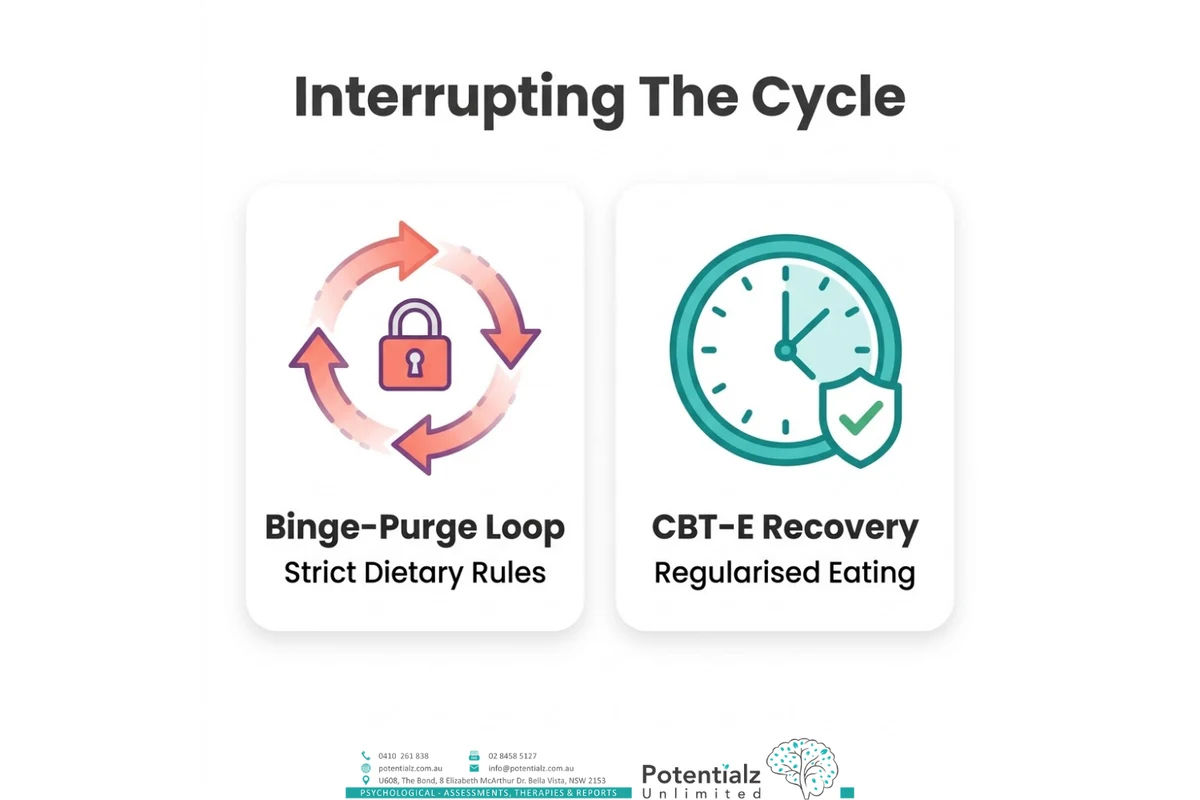
The Fairburn maintenance model (Fairburn, 2008) — which underpins the current gold-standard treatment — describes bulimia not as a series of random loss-of-control episodes but as a self-perpetuating cycle. Understanding the cycle is the first therapeutic move because it makes the pattern legible rather than mysterious.
At the top of the cycle sits over-evaluation of weight and shape. Weight, shape, and their control become the primary yardstick by which the person judges their worth. Everything else — work, relationships, achievements — is filtered through this lens.
From this over-evaluation flows strict dietary rules — a lengthy, rigid list of what can and cannot be eaten, in what quantities, at what times, on what days. The rules are usually impossible to keep. When they break — even minimally — the person interprets the break as total failure (“all-or-nothing thinking”) and reasons that if today is already a failure, they may as well eat everything and start again tomorrow.
This sets up the binge. Biologically, the restriction of previous hours or days has produced hunger, blood-sugar volatility, and depleted willpower. Psychologically, the “may as well” reasoning has removed the internal brake. The binge is often experienced dissociatively — the person may describe it as being on autopilot, or watching from outside themselves.
The binge produces shame, fear of weight gain, and physical discomfort, which triggers compensatory behaviour — vomiting, laxatives, fasting, or excessive exercise. The compensatory behaviour temporarily reduces the shame and the fear, which reinforces it. It also usually leads to redoubled restriction the following day, which sets up the next binge.
Interrupting this cycle at any point weakens the whole. The core mechanism of CBT-E is precisely this — introducing regular, adequate eating that reduces the biological pressure to binge, and challenging the over-evaluation of weight and shape that drives the rules.
The Medical Seriousness of Purging
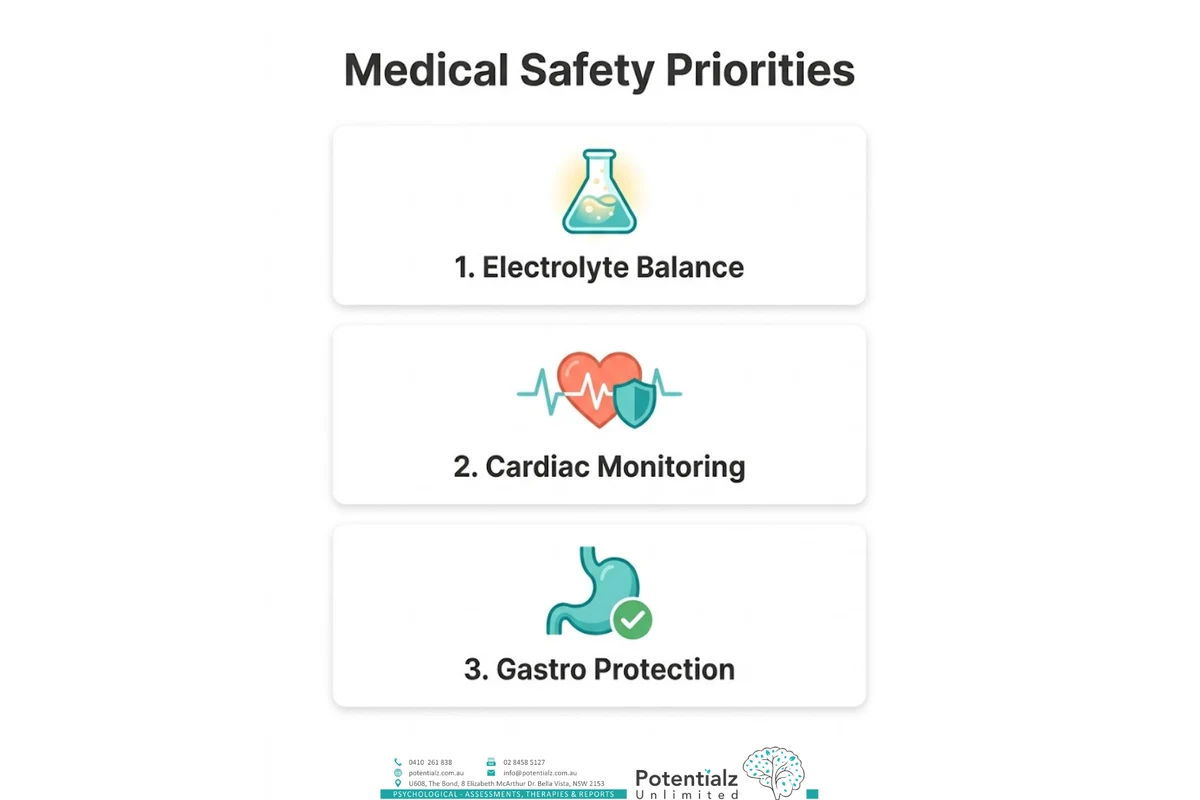
One of the reasons bulimia requires GP involvement is that the compensatory behaviours produce real physical harm, sometimes urgently so.
- Electrolyte disturbances — repeated vomiting and laxative use deplete potassium, sodium, and chloride. Hypokalaemia (low potassium) can trigger cardiac arrhythmias, and in severe cases sudden cardiac death.
- Cardiac effects — arrhythmias, prolonged QT interval, and rare cases of cardiomyopathy from ipecac misuse.
- Dental erosion — repeated exposure of the enamel to gastric acid causes irreversible erosion, tooth sensitivity, and eventual tooth loss.
- Salivary gland enlargement — chronic vomiting causes swelling of the parotid glands, giving a “chipmunk cheek” appearance that can be socially distressing.
- Gastro-oesophageal damage — reflux, oesophagitis, and in rare cases oesophageal tears (Mallory-Weiss syndrome) or rupture (Boerhaave syndrome).
- Endocrine disruption — menstrual irregularity, thyroid changes, and altered stress hormone patterns.
- Bowel dysfunction — long-term laxative misuse can cause laxative dependence and bowel dysfunction that persists even after the laxatives are stopped.
None of this is written to frighten. It is written because many people with bulimia have received the message from popular culture that bulimia is a “less serious” eating disorder than anorexia. It is not. Regular GP review, including bloods and ECG where indicated, is a foundational part of treatment.
Why Shame Keeps People Silent
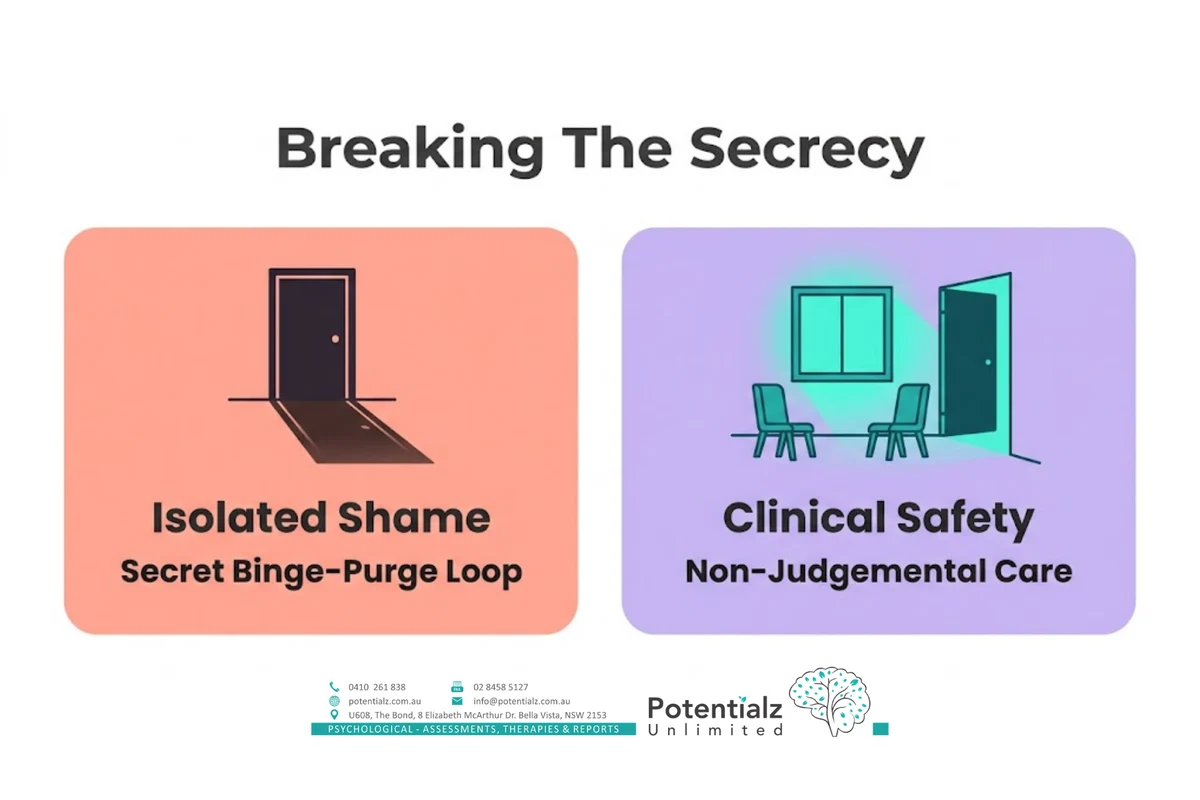
In my clinical practice in Bella Vista, the average length of time people have been living with bulimia before their first appointment is often ten years or more. This delay is almost never because the person did not know something was wrong. It is because the shame around binging and purging is uniquely intense.
Shame in bulimia has several dimensions. There is the shame of the loss of control during binges. There is the shame of the deception involved in purging — the wrappers hidden, the money spent, the bathrooms used, the story told to the housemate. There is the shame of a diagnosis that carries stigma. And there is, for many people, a specific shame about having a “less legitimate” eating disorder than anorexia — as if their normal or above-normal weight means they do not deserve help.
Naming this shame in the room — early, gently, and repeatedly — is often the single most therapeutic thing that happens in the first month of treatment. The person is not weak. They have not brought this on themselves. They are living with a clinical illness that has a well-mapped maintenance cycle and a well-mapped treatment. Being able to tell someone the full truth of a binge, and receive it without judgement, is often the point at which the disorder begins to lose its grip.
Team-Based Care Is Non-Negotiable
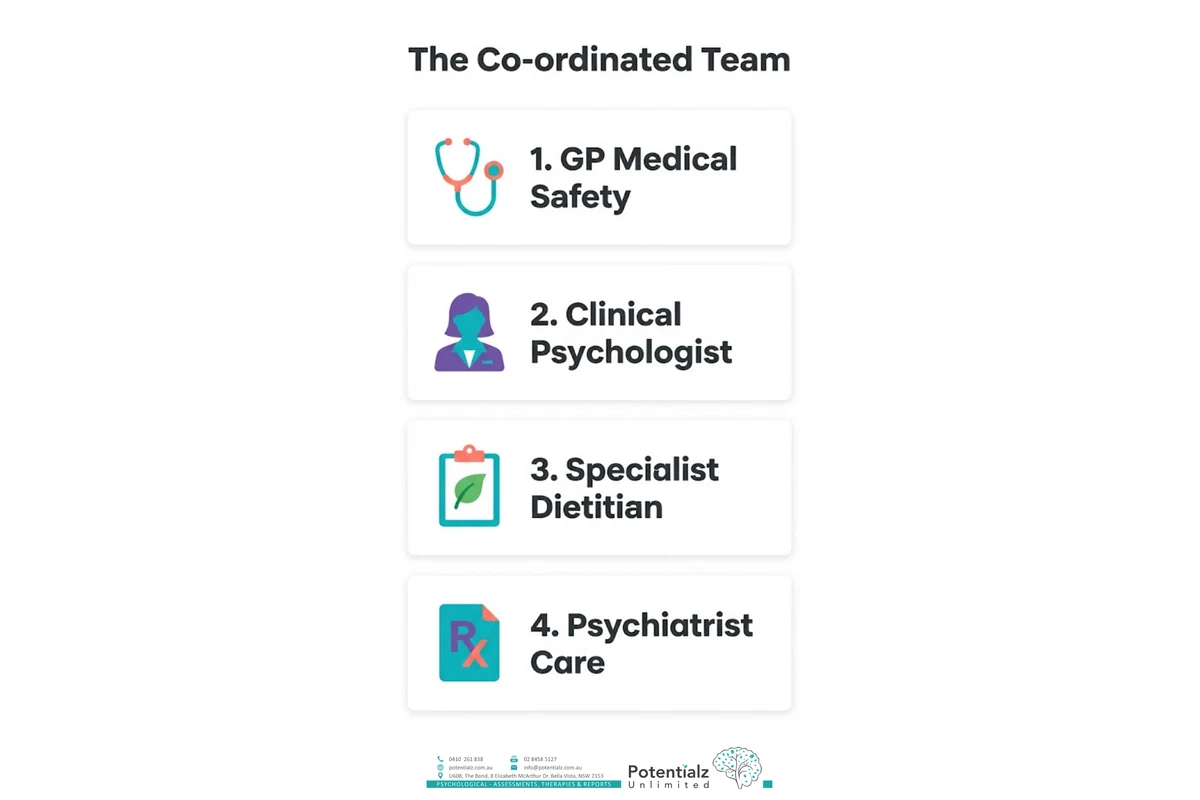
Bulimia treatment involves at minimum:
- GP — physical monitoring including bloods, weight, ECG where indicated, and medical safety oversight
- Psychologist — evidence-based psychological therapy (typically CBT-E, sometimes with DBT-informed skills)
- Accredited Practising Dietitian — with eating-disorder-specific training; nutritional rehabilitation, meal-planning, and challenging food-rule work
- Psychiatrist — where medication (typically fluoxetine, the only medication with a specific indication for bulimia) or complex comorbidity requires it
The team model matters because bulimia recovery involves both psychological and physical restoration, and no single clinician safely covers both.
The Evidence-Based Psychological Treatments
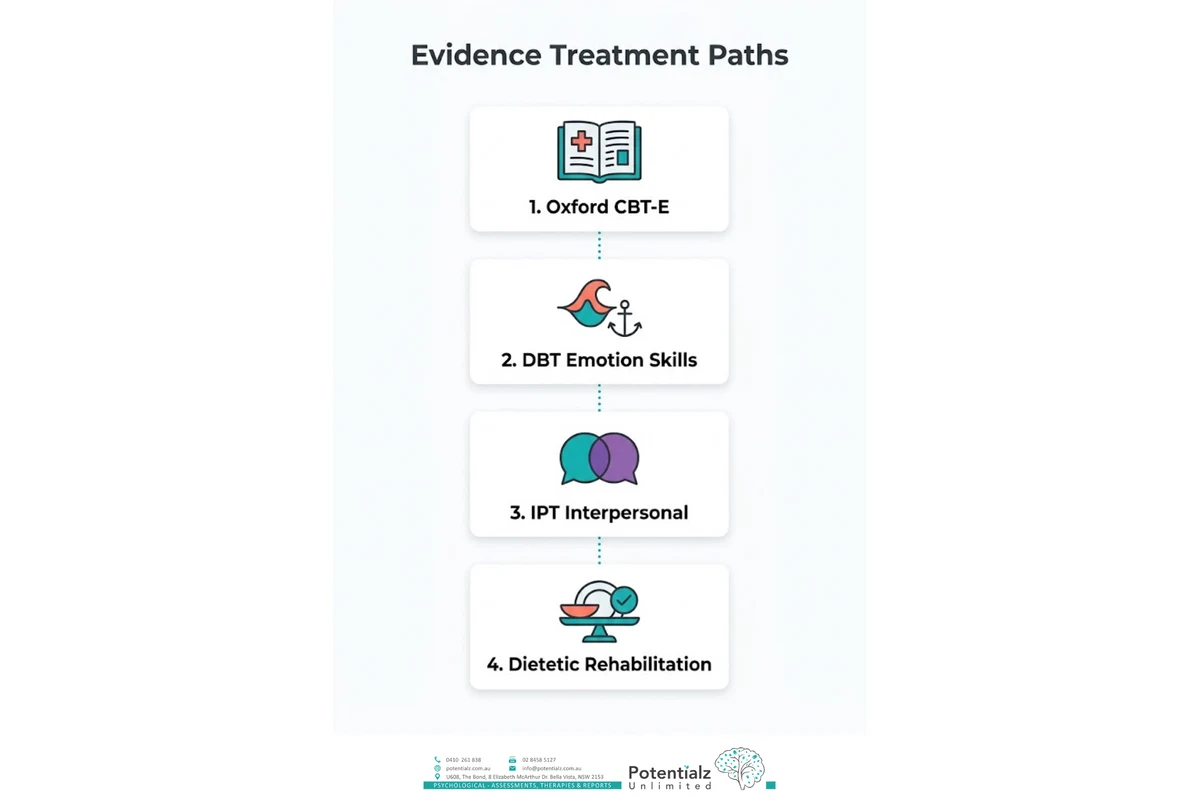
Several structured protocols have strong evidence for bulimia nervosa.
CBT-E (Enhanced Cognitive Behaviour Therapy). Developed by Christopher Fairburn at Oxford, CBT-E is the current first-line psychological treatment for adults with bulimia (Fairburn, 2008; NICE, 2017). Treatment is structured across approximately 20 sessions, delivered weekly. Core components include: establishing regular eating (usually the first and most powerful intervention), self-monitoring, addressing dietary restraint and rules, challenging over-evaluation of weight and shape, and relapse prevention. Roughly half of patients reach full remission during CBT-E; a substantial further proportion achieve major improvement.
DBT-BN (DBT adapted for bulimia). Where emotion dysregulation is a dominant driver of binges — particularly where binges reliably follow interpersonal distress, anger, or shame — DBT skills (Safer et al., 2009) target the affective triggers directly. Distress tolerance skills (TIPP, self-soothing, radical acceptance), emotion regulation skills (opposite action, checking the facts), and mindfulness skills are commonly integrated into CBT-E in real-world clinical practice.
IPT (Interpersonal Psychotherapy) for bulimia. IPT (Wilson et al., 2010) works on the interpersonal difficulties that maintain the disorder rather than on the eating directly. It has slower onset than CBT-E but comparable long-term outcomes. It is a reasonable second-line option for people who do not respond to CBT-E or prefer an interpersonal focus.
Medication. Fluoxetine (typically at 60mg, higher than standard antidepressant dosing) is the only medication with a specific indication for bulimia nervosa and can reduce binge-purge frequency. It is usually most effective when combined with psychological therapy, and is prescribed by a GP or psychiatrist.
How I Work with Bulimia Nervosa
In my Bella Vista practice, I usually begin CBT-E-based treatment once GP monitoring and, in most cases, a dietitian are in place. Early sessions focus on formulation, self-monitoring, and the establishment of regular eating — three meals plus two to three planned snacks across the day. This one intervention often reduces binge frequency substantially within the first month, because it removes the biological driver of most binges.
Middle sessions work on the over-evaluation of weight and shape, dietary rules, and the “avoided foods” hierarchy — the specific foods that have been ruled out and whose reintroduction, in tolerable doses, gradually reduces the binge-vulnerability those rules create. Where trauma or chronic emotion dysregulation is a driver, DBT skills are woven in, and where trauma processing is indicated, EMDR may be added once eating stability is established.
Late sessions consolidate change and build a relapse-prevention plan — recognising early warning signs, distinguishing a lapse from a relapse, and knowing when and how to re-engage support.
Alongside the eating-disorder-specific work, treatment addresses the common companion presentations — anxiety, depression, trauma, perfectionism, and self-criticism. Where the shame of bulimia has quietly shaped identity and relationships for years, ACT contributes throughout — building willingness, values-based living, and a workable relationship with the feelings the disorder used to numb.
Multicultural context matters. In many South Asian and other cultural backgrounds, food is deeply tied to family, hospitality, and love. Bulimia in these contexts often carries additional complexity around family meals, comment on bodies, and the secrecy required to sustain the disorder within a communal food culture. Being able to work with a clinician who understands both the clinical picture and the cultural context often removes barriers that have kept treatment inaccessible for years.
If You Are in Crisis Right Now
Bulimia can become acutely dangerous — particularly around electrolyte disturbance, cardiac symptoms, or suicidal thoughts. If you are struggling, please reach out for specialist support today: the Butterfly Foundation National Helpline on 1800 33 4673 provides free, confidential support for anyone affected by eating disorders and body image issues, available seven days a week. For urgent mental health support, contact Lifeline on 13 11 14 or Beyond Blue on 1300 22 4636. If you are experiencing chest pain, an irregular heartbeat, fainting, seizures, blood in vomit, or thoughts of ending your life, call 000 or go to your nearest emergency department immediately.
Common Companion Conditions
Bulimia rarely arrives alone. In my practice, I most often see it alongside:
- Depression — often reactive to years of the binge-purge cycle
- Anxiety disorders — particularly generalised anxiety, social anxiety, and OCD
- Trauma — childhood adversity is a well-documented risk factor
- Substance use — alcohol misuse in particular is common
- Personality-level features — impulsivity in some, perfectionism in others
- ADHD — the impulsivity dimension can contribute to binge patterns
Good bulimia treatment holds these companion presentations together rather than sending the person from specialist to specialist.
What Recovery Actually Looks Like
Recovery from bulimia is not the absence of every food-related thought. It is the interruption of the binge-purge cycle, the restoration of regular eating, the loosening of over-evaluation of weight and shape, and the return of energy and mental space for the things that matter. In practice, recovery often looks like:
- Eating regularly across the day without rigid rules
- Bingeing rarely or not at all; when a slip occurs, recovering from it without spiralling
- No compensatory behaviours
- Physical health markers (electrolytes, dental, cardiac) stabilised
- Weight and shape no longer the primary yardstick of self-worth
- Emotion regulation skills that do not depend on food
- The capacity to eat socially without hours of anticipatory dread or later compensation
Long-term follow-up (Eddy et al., 2017) shows the majority of people with bulimia reach full recovery over time. The disorder is genuinely treatable.
Practical First Steps While You Book
- Book your GP — for a physical review (bloods, ECG where indicated) and a Mental Health Care Plan or Eating Disorder Plan referral. Under the Medicare Eating Disorder Plan, eligible people can access up to 40 psychological sessions and 20 dietetic sessions per 12-month period.
- Begin regular eating — three meals plus two to three snacks across the day, in modest portions. This alone often reduces binge frequency before formal treatment begins.
- Tell one trusted person — the secrecy of bulimia is one of its most powerful maintaining factors. Naming it to one person is often the pivotal first step.
- Contact the Butterfly Foundation — free confidential support and information while you organise formal care.
- Reduce diet-culture inputs — unfollow accounts and unsubscribe from content that intensifies food, weight, or body comparison.
- Approach your body with basic care — sleep, hydration, warmth. These sound trivial. They are foundational.
How Potentialz Unlimited Can Help
Potentialz Unlimited is a clinical psychology practice based in Bella Vista, NSW, supporting adults across the Hills District — Norwest, Castle Hill, Kellyville, Baulkham Hills, Rouse Hill, and Glenhaven.
I am Dr Gurprit Ganda, a Clinical Psychologist with over 25 years of experience. I offer assessment and evidence-based psychological treatment for bulimia nervosa — CBT-E as first-line, DBT-derived skills where emotion dysregulation is a driver, and coordinated care with your GP and dietitian. Where trauma sits underneath the eating disorder, EMDR may be integrated once eating stability is established. Sessions available in English, Hindi, Punjabi, and Urdu. Medicare rebates are available with a GP Mental Health Care Plan or Eating Disorder Plan. You can contact the clinic or book directly at live.potentialz.com.au.
References
Agras, W. S., Walsh, B. T., Fairburn, C. G., Wilson, G. T., & Kraemer, H. C. (2000). A multicenter comparison of cognitive-behavioral therapy and interpersonal psychotherapy for bulimia nervosa. Archives of General Psychiatry, 57(5), 459–466. https://doi.org/10.1001/archpsyc.57.5.459
Arcelus, J., Mitchell, A. J., Wales, J., & Nielsen, S. (2011). Mortality rates in patients with anorexia nervosa and other eating disorders: A meta-analysis of 36 studies. Archives of General Psychiatry, 68(7), 724–731. https://doi.org/10.1001/archgenpsychiatry.2011.74
Eddy, K. T., Tabri, N., Thomas, J. J., Murray, H. B., Keshaviah, A., Hastings, E., Edkins, K., Krishna, M., Herzog, D. B., Keel, P. K., & Franko, D. L. (2017). Recovery from anorexia nervosa and bulimia nervosa at 22-year follow-up. Journal of Clinical Psychiatry, 78(2), 184–189. https://doi.org/10.4088/JCP.15m10393
Fairburn, C. G. (2008). Cognitive behavior therapy and eating disorders. Guilford Press.
Fairburn, C. G., Bailey-Straebler, S., Basden, S., Doll, H. A., Jones, R., Murphy, R., O’Connor, M. E., & Cooper, Z. (2015). A transdiagnostic comparison of enhanced cognitive behaviour therapy (CBT-E) and interpersonal psychotherapy in the treatment of eating disorders. Behaviour Research and Therapy, 70, 64–71. https://doi.org/10.1016/j.brat.2015.04.010
Hay, P. (2020). Current approach to eating disorders: A clinical update. Internal Medicine Journal, 50(1), 24–29. https://doi.org/10.1111/imj.14691
Linehan, M. M. (2015). DBT skills training manual (2nd ed.). Guilford Press.
National Institute for Health and Care Excellence. (2017). Eating disorders: Recognition and treatment (NICE guideline NG69). NICE. https://www.nice.org.uk/guidance/ng69
Royal Australian and New Zealand College of Psychiatrists. (2014). Clinical practice guidelines for the treatment of eating disorders. Australian & New Zealand Journal of Psychiatry, 48(11), 977–1008. https://doi.org/10.1177/0004867414555814
Safer, D. L., Telch, C. F., & Chen, E. Y. (2009). Dialectical behavior therapy for binge eating and bulimia. Guilford Press.
Treasure, J., Duarte, T. A., & Schmidt, U. (2020). Eating disorders. The Lancet, 395(10227), 899–911. https://doi.org/10.1016/S0140-6736(20)30059-3
Wilson, G. T., Wilfley, D. E., Agras, W. S., & Bryson, S. W. (2010). Psychological treatments of binge eating disorder. Archives of General Psychiatry, 67(1), 94–101. https://doi.org/10.1001/archgenpsychiatry.2009.170
If this is affecting you or someone close to you, you can speak with an eating disorder psychologist in Bella Vista.
Knowledge Check Quiz
Test what you have just read. Choose your answer for each question, then submit to reveal the answers and your score.
Need Professional Support?
If you're experiencing mental health concerns, our team is here to help.