Two Search Tabs and One Big Question
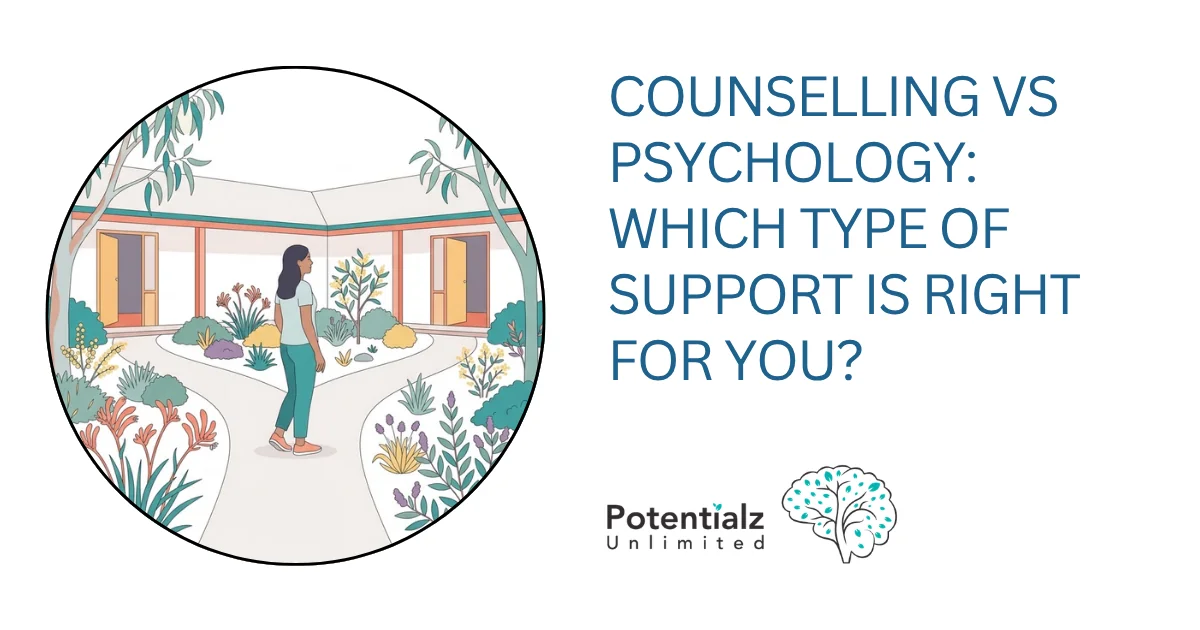
It is late on a Sunday night in Bella Vista. Priya has two browser tabs open. One says “counsellor”. The other says “psychologist”. She has been feeling flat and overwhelmed for months, and she wants to book something. But she cannot tell which tab is the right one, and she is worried about picking wrong.
If that sounds familiar, you are not alone. “Should I see a counsellor or a psychologist?” is one of the most common questions people ask before they reach out for support.
The honest answer is that it depends on what you are dealing with, what kind of support feels right, and whether Medicare access matters to you. Neither option is better. They are different. Knowing how they differ helps you choose with more confidence.
This post explains what a registered psychologist is, what a counsellor or psychotherapist is, where the two overlap, and how to think about your choice. It is general information only. It does not rank either profession.
What Is a Registered Psychologist in Australia?
A registered psychologist has completed at least six years of accredited university training. That is usually a four-year undergraduate degree in psychology, followed by two years of postgraduate study. Psychologists must be registered with the Australian Health Practitioner Regulation Agency (AHPRA). They are bound by its code of conduct.
Assessment, diagnosis and treatment of mental health conditions are within a psychologist’s scope of practice. Psychologists use therapies such as Cognitive Behavioural Therapy (CBT), Acceptance and Commitment Therapy (ACT) and Dialectical Behaviour Therapy (DBT). Clinical psychologists have an extra endorsed specialisation. They often work with more complex presentations, such as personality disorders, severe depression, eating disorders and trauma.
Medicare rebates. A GP can prepare a Mental Health Care Plan (MHCP). With that plan, a person can claim Medicare rebates for up to 10 individual sessions per calendar year with a psychologist. This can make psychology more affordable for many people.
You can read about one structured approach psychologists use on our CBT psychology page.
What Is a Counsellor or Psychotherapist in Australia?
A counsellor or psychotherapist has completed accredited training in counselling or psychotherapy. Training ranges from diploma level to Graduate Diploma and Master’s level. The main professional body is the Psychotherapy and Counselling Federation of Australia (PACFA). Members are recognised on the Australian Register of Counsellors and Psychotherapists (ARCAP). The Australian Counselling Association (ACA) is another professional body.
At Potentialz Unlimited, our counselling is provided by a PACFA Clinical Registrant, a Clinical Counsellor and Psychotherapist. She holds an MS in Psychology (Counselling Specialisation) and an MA in Science of Living, Yoga and Meditation. She has more than 20 years of experience with individuals, couples and families across Australia and internationally.
The counselling profession is not registered under AHPRA (as of 2026). That does not mean it is unregulated. PACFA and the ACA set standards for accreditation, ongoing professional development, ethics and supervision.
Counsellors and psychotherapists often work with:
- Life transitions and personal growth, such as career changes, relationship shifts and identity questions
- Grief, loss and bereavement
- Relationship and communication difficulties
- Stress, burnout and work-life balance
- Anxiety and low mood that is mild to moderate
- Trauma, within the counsellor’s scope of practice
- Cultural adjustment and identity
Medicare and costs. Counselling is not eligible for Medicare rebates under a Mental Health Care Plan. Some private health funds do provide rebates for counselling, so check your policy. Fees for counselling and psychology sessions differ between practices, so it is worth asking before you book. You can see our pricing page for current fees.
Where Do They Overlap?
There is a lot of overlap in what counsellors and psychologists do day to day. Both:
- Listen without judgement and create a safe space to talk
- Use recognised techniques to support emotional wellbeing
- Work with anxiety, low mood, relationship difficulties and stress
- Keep strict ethical and confidentiality standards
- Take part in ongoing supervision and professional development
Many approaches are used by both professions. These include mindfulness-based cognitive therapy, narrative therapy, solution-focused therapy and person-centred approaches. The main differences are the training pathway, the registration body and the scope of practice.
Here is what the research indicates. The quality of the relationship between a person and their therapist is one of the strongest predictors of how therapy goes. It matters more than which technique is used (Norcross & Wampold, 2019). Trust, warmth and understanding are not owned by any one profession.
Comparing the Two Pathways
This table sets out facts only. It is not a ranking, and no column is “ahead” of the other.
| Registered psychologist | Counsellor / psychotherapist | |
|---|---|---|
| Registration or membership body | AHPRA | PACFA or ACA |
| Training pathway | At least 6 years of accredited university study | Accredited training, diploma to Master’s level |
| Medicare rebate under a Mental Health Care Plan | Available | Not available (check your private health fund) |
| Diagnosis of mental health conditions | Within scope | Outside scope |
| Formal psychological assessment | Within scope | Outside scope |
| Main focus of the work | Assessment, diagnosis and treatment | Support, personal growth, relationships and integrative work |
| Often chosen for | Diagnosed or suspected conditions, assessment, Medicare access | Life challenges, grief, growth and whole-person support |
| Typical style | Often structured and manual-based | Often relational and integrative |
When People Often Choose a Psychologist
Some people choose a registered psychologist when:
- They have a diagnosed or suspected mental health condition, such as an anxiety disorder, major depression, OCD, PTSD or a personality disorder
- They want to use Medicare rebates through a GP’s Mental Health Care Plan
- Their situation is complex, or earlier support did not feel like enough
- They need a formal psychological assessment, for example for ADHD or cognitive function
- They want a clinical psychologist for specialist treatment, such as trauma-focused CBT or schema therapy
You can explore our CBT-focused options to see what structured therapy involves. If the assessment part is what you are unsure about, our guide to how cognitive assessments help evaluate mental strengths explains what that process actually involves.
When People Often Choose a Counsellor or Psychotherapist
Some people choose a counsellor or psychotherapist when:
- They are working through a life challenge, a transition or a relationship difficulty
- They want a warm, relational approach that looks at the whole person
- They are dealing with grief, loss, burnout or questions about identity
- They would like to bring mindfulness, body awareness or spiritual values into their sessions
- They are not looking for a diagnosis right now
- Medicare is not their main concern, or their private health fund covers counselling
- They value cultural understanding and being able to speak in their own language
If you would like to understand this whole-person style in more detail, our guide to what holistic counselling involves is a good place to start. If grief is part of what brings you in, see our page on grief counselling in Bella Vista.
The Integrative Counselling Approach at Potentialz
At Potentialz Unlimited in Bella Vista, our counselling is provided by an accredited Clinical Counsellor and Psychotherapist with over 20 years of global experience. She holds an MS in Psychology (Counselling Specialisation) and an MA in Science of Living, Yoga and Meditation. Her training spans traditional counselling approaches, including person-centred therapy, psychodynamic approaches and CBT. It also spans holistic practices, including yoga therapy, breathwork, meditation and mindfulness-based work.
Her training includes classical yogic philosophy through an MA in Science of Living, Yoga and Meditation. When breathwork or yoga therapy is part of a session, it draws on that training.
Our counsellors work with individuals, couples and families. They have a particular interest in supporting people from culturally and linguistically diverse (CALD) communities. Counselling sessions are available in English, Hindi, Punjabi, Bengali, Tamil and Urdu, so people can speak in the language that feels most natural. Language availability depends on the practitioner, so please ask when you book.
The Potentialz idea is simple: one size does not fit all. Each person brings their own history, values and way of making sense of the world. Our counsellors draw on the approaches that suit that person’s needs and goals. Our registered psychologists work alongside them when assessment or psychological treatment is needed.
You can see the full range of support on our services page.
How Potentialz Can Help
Whether you are going through a hard period, working on a relationship, or just trying to work out what kind of support you need, we are happy to talk it through.
Potentialz Unlimited offers counselling, psychotherapy and psychology at Unit 608, 8 Elizabeth Macarthur Drive, Bella Vista NSW 2153. Sessions run Monday to Friday, 10am to 7pm, with Saturday and after-hours appointments also available. Telehealth by phone or Zoom is offered for people who prefer to connect from home. You can read about online therapy and telehealth psychology before you book.
You do not need a referral or a Mental Health Care Plan to see a counsellor. You can simply reach out.
To book or ask a question:
- Book online: live.potentialz.com.au
- Call: 0410 261 838
- Visit: potentialz.com.au
Potentialz Unlimited | Unit 608, 8 Elizabeth Macarthur Drive, Bella Vista NSW 2153 Languages: English, Hindi, Punjabi, Bengali, Tamil, Urdu
Disclaimer
This post is general information. It is not a substitute for individual professional advice. The counsellor and psychotherapist described here is not a registered psychologist under AHPRA. If you are in crisis, contact your GP, call Lifeline on 13 11 14, or go to your nearest emergency department.
References
American Psychological Association. (2020). Publication manual of the American Psychological Association (7th ed.). https://doi.org/10.1037/0000165-000
Australian Health Practitioner Regulation Agency. (2025). Psychology: About the profession. https://www.psychologyboard.gov.au/
Psychotherapy and Counselling Federation of Australia. (2024). What is counselling and psychotherapy? https://pacfa.org.au/Portal/Prac-Res/Resources/CPDefinitions.aspx
Norcross, J. C., & Wampold, B. E. (2019). Relationships and responsiveness in the psychological treatment of trauma: The tragedy of the APA Clinical Practice Guideline. Psychotherapy, 56(3), 391–399. https://doi.org/10.1037/pst0000228
Australian Institute of Health and Welfare. (2023). Mental health services in Australia. https://www.aihw.gov.au/reports/mental-health-services/mental-health-services-in-australia
Knowledge Check Quiz
Test what you have just read. Choose your answer for each question, then submit to reveal the answers and your score.
Need Professional Support?
If you're experiencing mental health concerns, our team is here to help.