Key Takeaways
- Family relationships can break down for many reasons. These include parent-teen conflict, divorce, grief, estrangement, blended family tension, and gaps between generations or cultures.
- Family counselling is different from one-on-one therapy. It looks at the whole family as a group. Each person both shapes, and is shaped by, the family around them.
- No one person is called “the problem.” The focus is on patterns between people, not on blame.
- The approach at Potentialz Unlimited pays close attention to culture. This matters for CALD (culturally and linguistically diverse) families, including South Asian and other migrant families.
- Family counselling is not always the right fit. Safety, willingness to take part, and the type of problem all matter.
Introduction
Think about the last time you sat at a dinner table with your family. Something tipped. A comment. A silence. A look that said everything. Suddenly you were somewhere else — somewhere old, familiar, and painful.
That’s families. They are the closest bond most of us will ever have. They are where we first learn what love looks like. They are where we first learn if we are safe, if we belong, if our feelings matter.
They are also often where our deepest hurts live.
Something can break in a family. A parent and adult child stop speaking. A teenager shuts down completely. Siblings take sides. Divorce splits everything apart. When this happens, the pain doesn’t stay in one room. It follows you. It shows up in how you sleep. It shows up in how you work. It shows up in how you treat other people you love.
Family counselling is not about deciding who was right. It is about making a safe space. In this space, people who love each other — or who used to — can finally speak. They can say what they could not say before. And something new becomes possible.
At Potentialz in Bella Vista, our counsellors have sat with families going through all kinds of pain. What we see, again and again, is this: most families don’t want to stay broken. They just need some help finding their way back.
Common Reasons Families Seek Counselling
Families come to counselling carrying many different kinds of hurt. Here are the ones our counsellors see most often.
Parent-Teenager Conflict
Teenage years are, by nature, a time of pulling away. Your teenager is working out who they are. Part of that means pushing against you. That’s not defiance. That’s normal growth.
But knowing that doesn’t make it easy to live through. Parents often say they feel rejected, confused, or shut out by someone they thought they knew well. Teenagers often say they feel unheard, controlled, or like nothing they say is okay at home.
Common triggers include not wanting to go to school, and pulling away from friends. Others are conflict about cultural or religious expectations, and questions about gender identity. Sometimes it’s just a simple breakdown in talking, where everyone feels misunderstood. Our guide to integrative counselling for teenagers explores this in more depth.
Separation and Divorce
Separation reshapes the whole family. Even when both parents try their best, children still carry a heavy load. They did not choose this big change. They may feel guilty for loving both parents. They may feel they have to pick a side, even if no one asked them to.
Family counselling helps parents find a new way to talk as co-parents. It helps children make sense of what is happening. It also deals with the loyalty conflicts that almost always come up when a family splits.
Grief and Loss
A death in the family doesn’t just take one person. It changes the shape of everything. Here’s something that often surprises people: each family member grieves in their own way. One person goes quiet. Another becomes angry. Someone else tries to keep things looking normal. These differences can push people apart, right when they need each other most.
Family counselling gives grief a space to be seen together. Not fixed — seen. That matters a lot.
Estrangement
Estrangement between an adult child and a parent is more common than most people realise. It carries deep pain on both sides. It might grow from years of built-up hurt. It might come from one event, cultural conflict, or a partner’s influence. When everyone is willing to try, counselling can open a door. A door that private talks could not.
Blended Family Challenges
Blended families come with extra layers. Step-parents. Step-siblings. Different house rules. Different ideas about who belongs where. Children can feel like outsiders in their own home. Adults can feel torn between loyalties.
Family counselling helps blended families build something new together. No one has to lose their sense of who they are, or where they belong.
Intergenerational and Cultural Differences
At Potentialz Unlimited, we work with many CALD families — especially families from South Asia, Southeast Asia, and the Middle East. For these families, the gap between generations is often also a gap between cultures. Children raised in Australia can pick up different values. These values can feel very far from what their parents grew up with.
Neither generation is wrong. But the gap between them is real. It creates a kind of pain that needs a counsellor who truly understands both worlds. Our counsellors have lived through these same tensions themselves. This shapes how they sit with families in this situation — with understanding, not judgement. Our guide to mental health counselling in the South Indian community explores this further.
You can explore the relationship and family support at Potentialz on our couples therapy page and across the therapies offered.
How Family Counselling Differs from Individual Therapy
In one-on-one therapy, we look inward. We look at one person’s inner world, their history, their own experience.
In family counselling, we look at the space between people. We look at the patterns in how they talk to each other. We look at the roles everyone has quietly agreed to play. We look at the shared history that shaped how this family works.
This matters a lot. Many family problems don’t live inside just one person. They live in the space between people. You can’t fully see that, or change it, when you’re working alone.
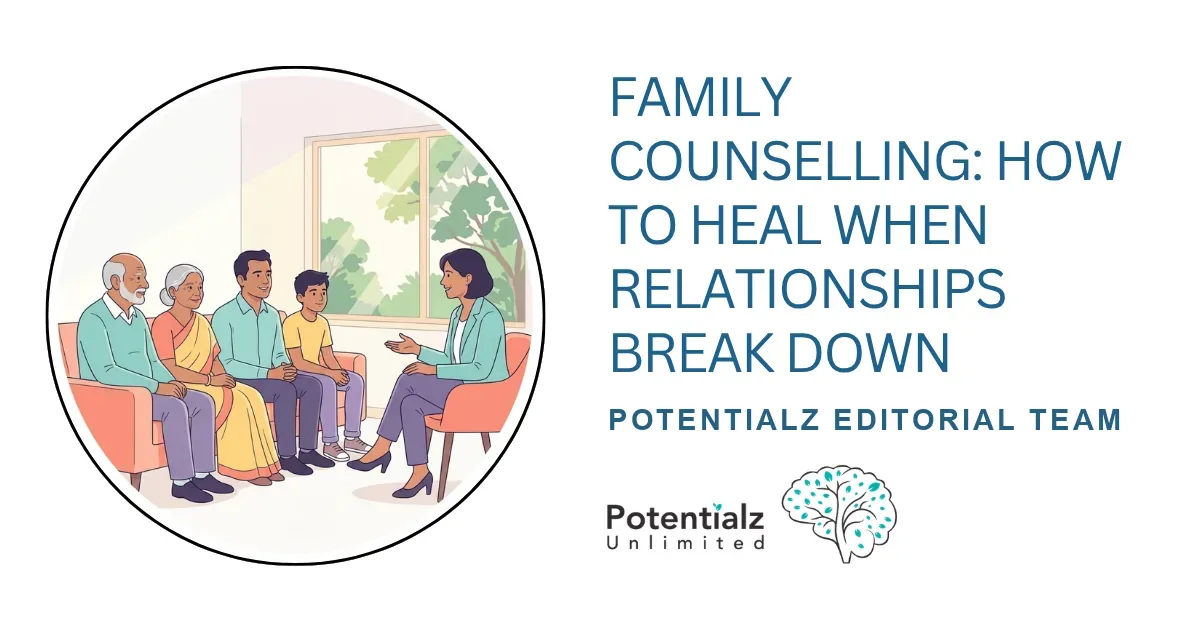
Family counselling can involve everyone together, or smaller groups, or one-on-one sessions mixed in as needed. The counsellor’s job is to guide, not to judge. They are not a referee. They are not on anyone’s side against anyone else.
For one-on-one support, our services page has information on the individual counselling and psychology services at Potentialz.
The Systemic Perspective: No One Is “the Problem”
Families work like systems. What hurts one person ripples out to everyone else. When a parent is struggling, the children feel it, even if no one says a word. When siblings are fighting, the parents carry that weight too. This isn’t just theory. It’s what every family actually lives through.
This idea sits at the heart of family counselling. When a teenager is “acting out,” that behaviour doesn’t happen in isolation. It’s often a sign of something the whole family is carrying. When a parent pulls away or becomes controlling, that has a reason too. It is often shaped by what’s going on in the family around them.
This doesn’t erase anyone’s own responsibility. And it doesn’t excuse harm when harm has been done. But it changes the question we ask. Instead of “who is wrong here?” we ask, “what pattern has grown between us, and how do we change it?”
That shift, from blame to curiosity, is often the first moment a family feels a little relief. Suddenly no one is the enemy. There’s just something to understand, together.
An Integrative Approach to Family Counselling
The Potentialz approach to family counselling draws on systemic theory, person-centred values, and a mix of tools — including mindfulness, body awareness, and Nonviolent Communication (NVC).
Creating Safety First
Before anything useful can happen, everyone in the room needs to feel safe. Safe enough to be honest. This means the counsellor guides the session closely. No one voice is allowed to drown out another. Being open and vulnerable is protected, not used against you. And the counsellor genuinely does not take sides.
Our counsellors are trained in the Science of Living, which focuses on awareness and non-violence. This training runs deep in how they work. Our counsellors hold the tension between family members with calm, steady attention. That steady presence is what makes room for something new to happen.
Attending to Cultural Context
For CALD families, culture is not background noise. It is central to the story.
A South Indian family caught between arranged marriage expectations and a young person’s wish to choose their own partner. A first-generation migrant parent whose Australian-raised child seems embarrassed by their heritage. An eldest son carrying the weight of a whole family’s expectations, in a country that prizes individual freedom.
These are real, everyday tensions. Our counsellors speak Hindi, Tamil, Kannada, Urdu, and English. They also have lived experience of South Asian and CALD family life. This means families can bring these parts of their story into the counselling room. Nothing gets lost in translation. Nothing gets misunderstood.
Working with Silence and the Unspoken
In many families, especially those shaped by cultures where showing emotion openly is discouraged, the most important things are the ones nobody says out loud. The fear hiding under the anger. The grief that has driven an estrangement for years. The love that got buried under too many arguments.
Family counselling at Potentialz makes space for these unspoken things. They can come up gently, at a pace that feels safe, not scary. Sometimes that means noticing what happens in the body when someone speaks. Sometimes it means finding words for something that has stayed wordless for years.
What to Expect in Family Counselling Sessions
Family counselling at Potentialz is not a court case, where someone decides who is right. It is a team effort — structured, warm, and kept within clear, safe boundaries. Here is what you can usually expect:
First session: Each family member gets a chance to share their view. They also share what they hope to get from the process. The counsellor explains how the work will go, and what family counselling can and can’t do.
Getting to know you: Over the first few sessions, the counsellor learns about the family’s history. They also learn about the specific problems and the patterns between family members.
Building skills: Sessions include practical skill-building. This means learning ways to talk and manage strong feelings. Sessions also include a deeper look at what’s under the conflict.
Moving forward: As the work goes on, the focus shifts. The family learns to handle future challenges on its own, without needing the counsellor in the room.
Sessions are available in person at Bella Vista. Telehealth (phone or Zoom) is available too, for families who can’t all be in one place.
When Family Counselling Is — and Isn’t — Appropriate
Family counselling works well when:
- Everyone is willing to attend and take part honestly.
- The conflict is mostly about relationships, not a mental illness.
- There is a real wish to understand each other and get better, even if it feels fragile.
- The safety of every family member can be assured during sessions.
Family counselling is usually not right, or needs careful care, when:
- There is active family violence or coercive control. Safety must come first.
- A family member has a serious, untreated mental illness that needs one-on-one help first.
- One family member is being pressured by others to attend.
- “Family counselling” is being used to pressure one person to change.
Our counsellors do a careful check at the start. This makes sure family counselling is the right fit, and that everyone feels safe taking part.
How Potentialz Can Help
If your family is going through something hard — and most families do, at some point — our counsellors would love to help.
At Potentialz in Bella Vista, our counsellors work with families who are willing to try. Not perfect families. Not families who have it all together. Just families who love each other and need some support finding their way back.
Family relationships can heal. Sometimes in ways people did not think were possible when they started. What it takes is a safe space, a skilled guide, and the will to try. If your struggle is about one relationship, our guide to relationship counselling and hard conversations may also help.
Book your first family counselling appointment:
- Book online: live.potentialz.com.au
- Call: 0410 261 838
- Visit: potentialz.com.au
Potentialz Unlimited | Unit 608, 8 Elizabeth Macarthur Drive, Bella Vista NSW 2153 Hours: Mon–Fri 10am–7pm | Saturday & after-hours available | Telehealth via phone or Zoom Languages: English, Hindi, Tamil, Kannada, Urdu
No referral is required. One family member can make the first booking for the whole family.
References
Carr, A. (2012). Family therapy: Concepts, process and practice (3rd ed.). Wiley-Blackwell.
Minuchin, S., & Fishman, H. C. (1981). Family therapy techniques. Harvard University Press.
Walsh, F. (2016). Strengthening family resilience (3rd ed.). Guilford Press.
Rycroft, P., & Perlesz, A. (2001). Speaking the unspeakable: Reclaiming grief and loss in family life. Australian and New Zealand Journal of Family Therapy, 22(2), 57–65. https://doi.org/10.1002/j.1467-8438.2001.tb01310.x
Hooley, J. M., & Gotlib, I. H. (2000). A diathesis-stress conceptualization of expressed emotion and clinical outcome. Applied and Preventive Psychology, 9(3), 135–151. https://doi.org/10.1016/s0962-1849(05)80001-0
Disclaimer
Our counsellors are Clinical Counsellors & Psychotherapists and PACFA Clinical Registrants (Psychotherapy and Counselling Federation of Australia). They are not registered psychologists under AHPRA. The information in this post is general in nature and does not constitute clinical advice for specific family circumstances. Family counselling is not appropriate in situations involving active family violence or where the safety of any family member cannot be assured. If you or a family member are experiencing family violence or coercive control, please contact 1800RESPECT on 1800 737 732.
Crisis Resources
- 1800RESPECT: 1800 737 732 (domestic and family violence support, 24/7)
- Lifeline: 13 11 14 (24/7)
- Beyond Blue: 1300 22 4636
- Kids Helpline: 1800 55 1800 (for young people)
- MensLine Australia: 1300 78 99 78
- Emergency: 000
Knowledge Check Quiz
Test what you have just read. Choose your answer for each question, then submit to reveal the answers and your score.
Need Professional Support?
If you're experiencing mental health concerns, our team is here to help.