The Mate Who Was “Fine”
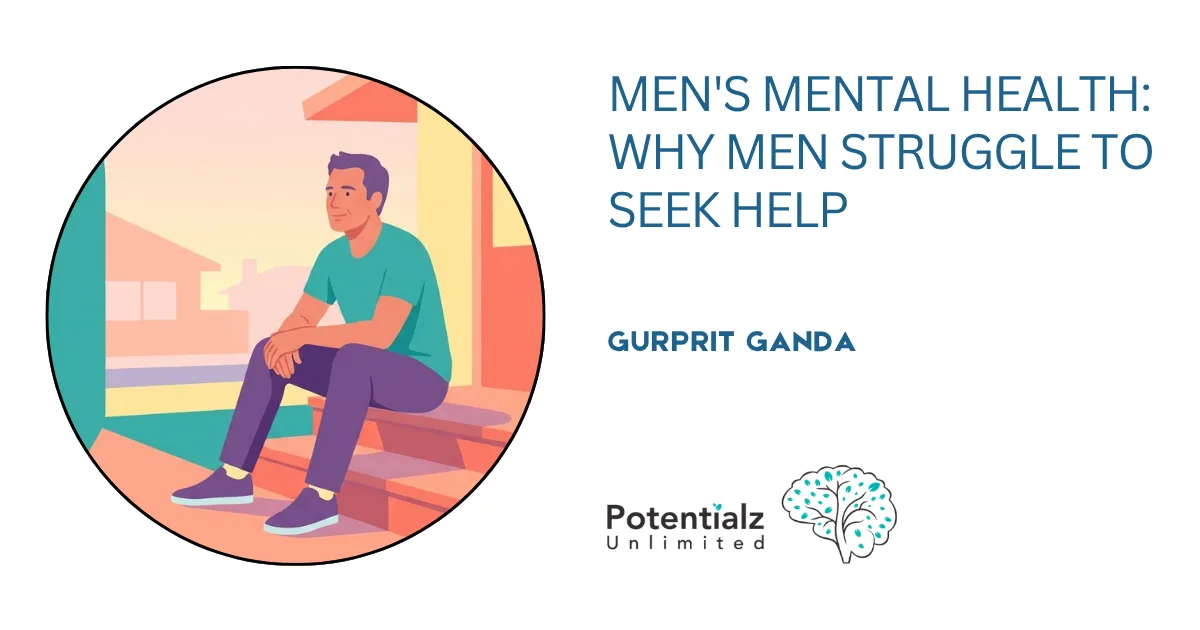
Daniel was always the steady one. The mate who turned up, fixed things, cracked the jokes, and never made a fuss. So when work got brutal and his sleep fell apart, he did what he had always done. He pushed harder, drank a bit more on weekends, and told everyone he was fine.
What his friends saw was a shorter fuse. He snapped at the kids over nothing. He went quiet at the pub, then stopped coming altogether. He told himself it was just stress, that real men sort their own problems out, that talking about feelings was not for him. It was almost a year before a single honest conversation in a car park changed things, and he finally booked an appointment.
Daniel’s story is common, and it is one a psychologist in Bella Vista hears often. Men’s mental health struggles are real, widespread, and very treatable, yet too many men suffer in silence until things reach crisis point. This article looks at why that happens, how distress shows up differently in many men, and what actually helps men get the support they deserve.
The State of Men’s Mental Health in Australia
Men’s mental health is one of the most serious and overlooked health issues in Australia. The numbers are sobering.
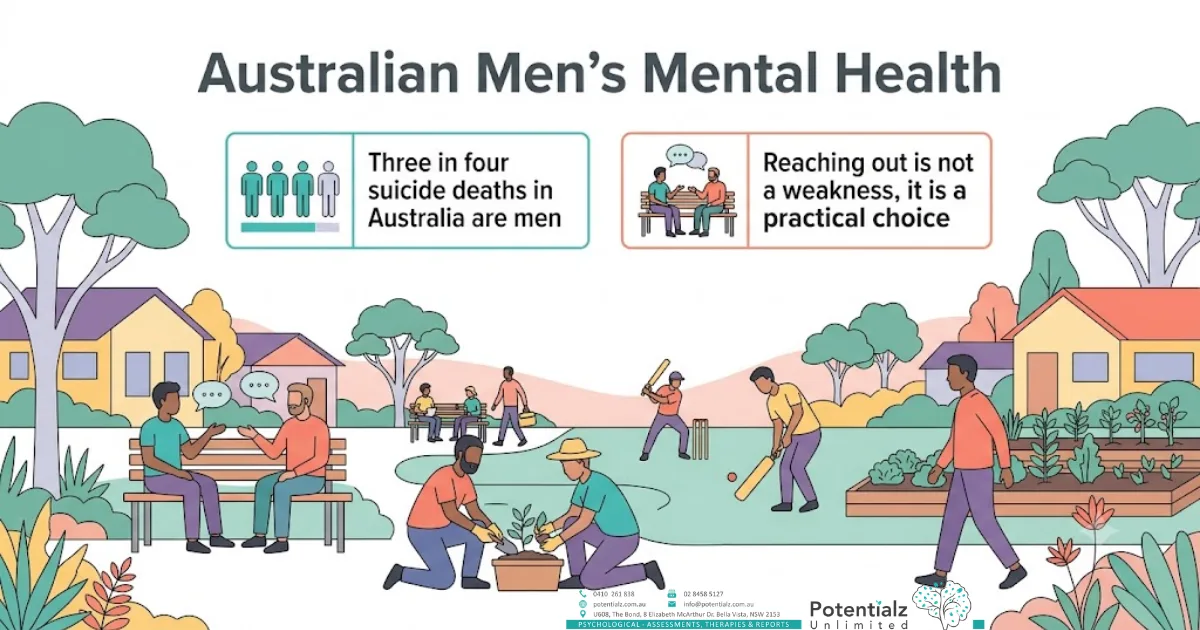
According to the Australian Institute of Health and Welfare, men accounted for around three in four suicide deaths in 2023, with about 2,419 male deaths compared with 795 female deaths. The male suicide rate was roughly 18 deaths per 100,000 people, about three times the female rate of 5.8 (Australian Institute of Health and Welfare, 2024). Beyond Blue notes that, on average, seven of the nine Australians who die by suicide each day are men (Beyond Blue, n.d.).
At the same time, common mental health conditions are far from rare in men. Beyond Blue reports that around 43% of men will experience anxiety or depression at some point in their lives, yet only about 37% of men and boys reach out for support when they need it, and about a quarter admit to delaying seeing their GP (Beyond Blue, n.d.).
Put those facts together and a painful picture emerges. Men are not somehow immune to depression, anxiety, or distress. Many are simply less likely to name it, talk about it, or seek help, and the consequences can be devastating. Understanding why is the first step to changing it.
Why Men Under-Seek Help
There is no single reason men reach out less. It is a mix of how many boys are raised, the messages they absorb, and the stigma that still surrounds mental health.
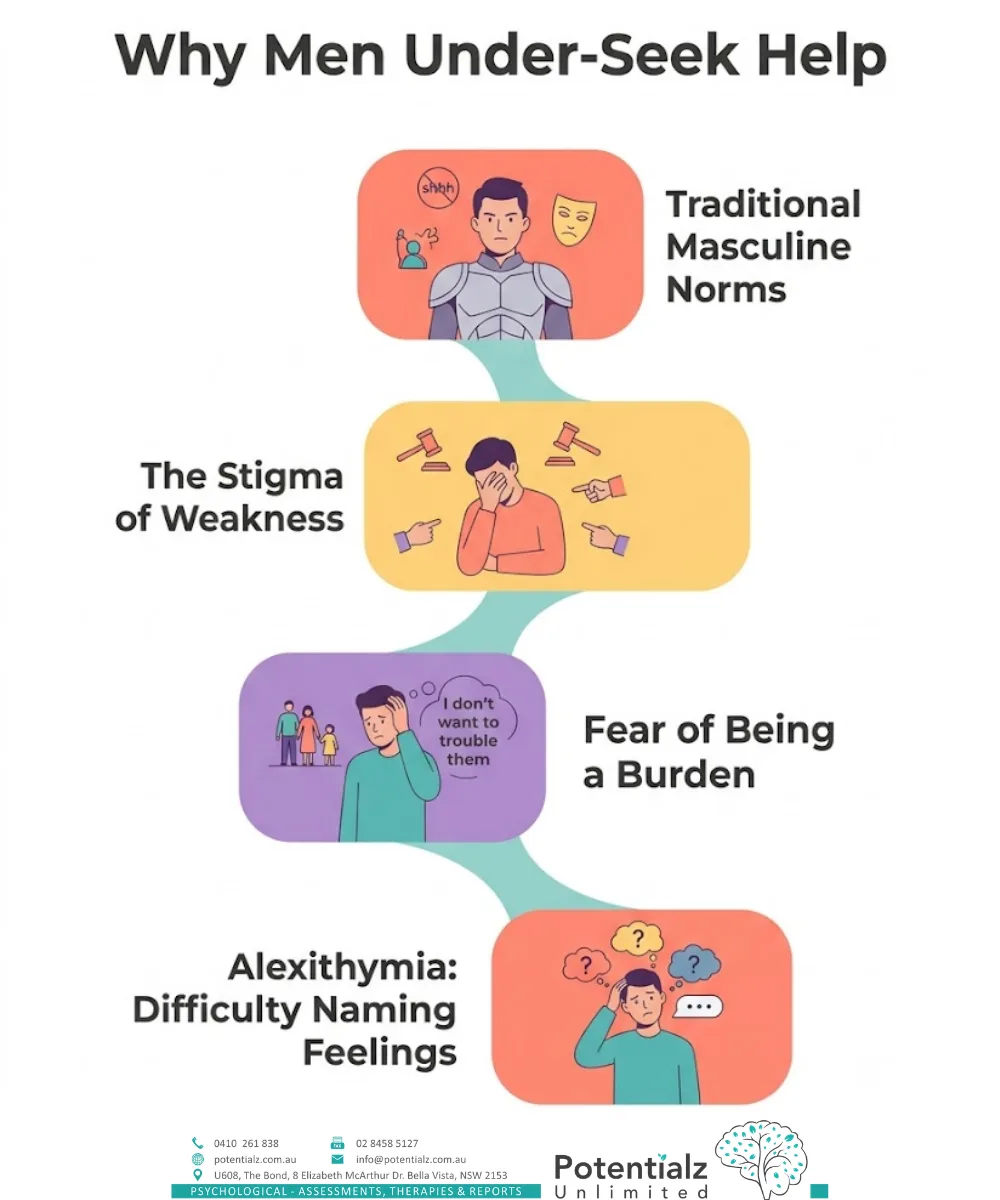
From a young age, many boys hear versions of the same lessons: be tough, don’t cry, sort it yourself, never show weakness. Psychologists call these expectations traditional masculine norms — ideas like self-reliance, emotional control, and toughness. These norms are not “bad,” and many men carry strengths from them. But when they become rigid, they can quietly block a man from admitting he is struggling.
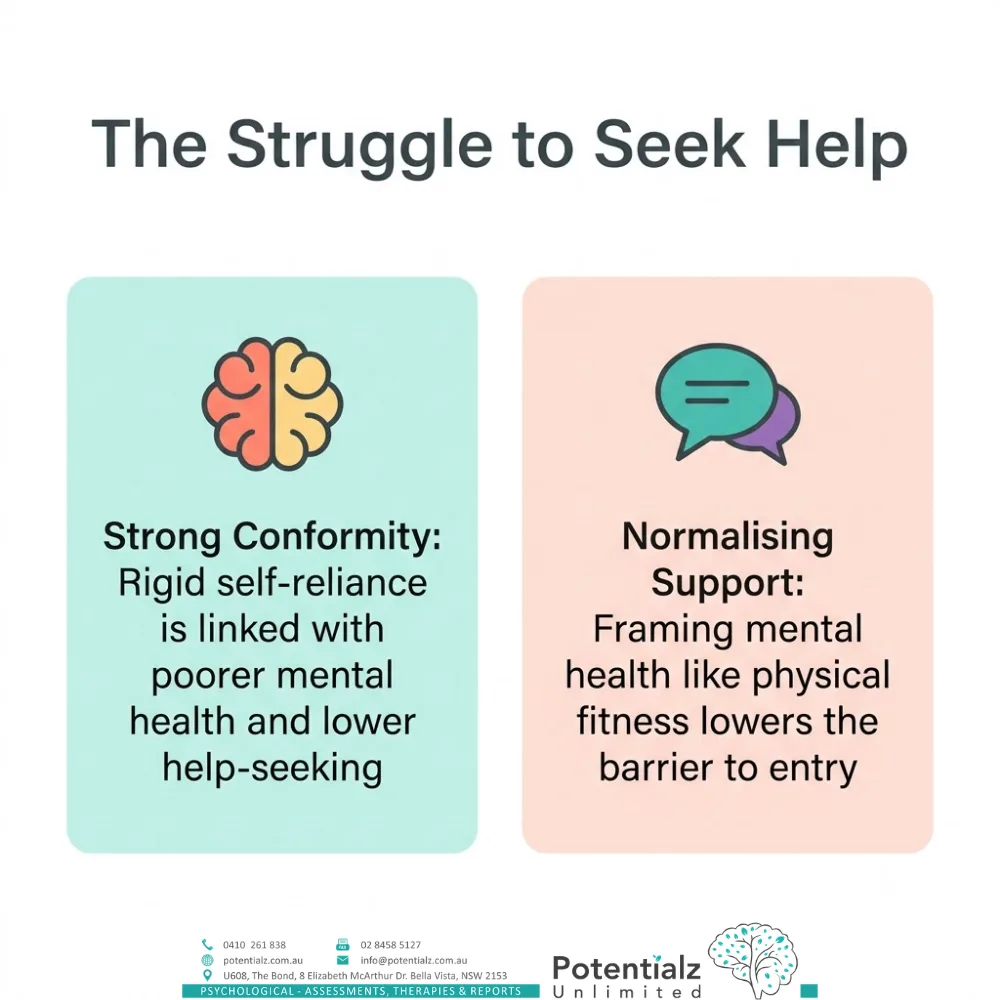
The research here is clear. A large meta-analysis combining 78 studies and more than 19,000 participants found that strong conformity to certain masculine norms — especially self-reliance — was linked with poorer mental health and a lower likelihood of seeking psychological help (Wong et al., 2017). An Australian study of men using the Ten to Men cohort found that higher conformity to masculine norms was associated with a greater likelihood of clinically significant depressive symptoms (Herreen et al., 2021).
On top of this sits stigma. Many men fear that asking for help means they are weak, broken, or a burden. Some worry about what it might mean for their job, their relationships, or their sense of who they are. Others simply do not recognise what they are feeling as a mental health issue at all, because it does not look like the sadness they expect. As researchers have noted, men’s distress is often shaped by social pressures that push it underground rather than into a GP’s office (Affleck et al., 2018).
How Distress Looks Different in Many Men
One of the biggest reasons men’s depression goes unnoticed is that, in many men, it simply does not look like the textbook picture of sadness and tears.
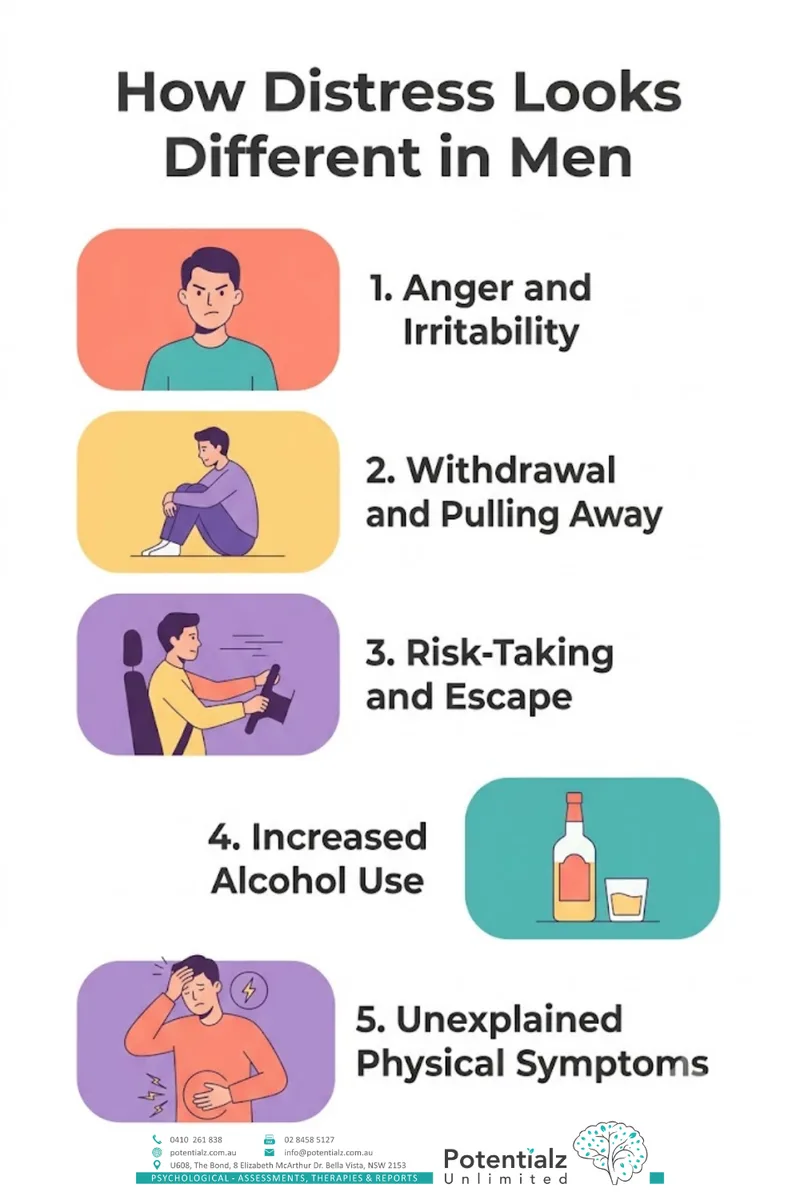
Instead, distress in men more often shows up as:
- Anger and irritability — a short fuse, snapping at family, road rage, frustration over small things.
- Withdrawal — pulling away from friends, partners, hobbies, and conversation.
- Risk-taking and escape — driving fast, gambling, overworking, or throwing himself into anything that numbs the feeling.
- Increased alcohol or drug use — using substances to take the edge off or to sleep.
- Physical symptoms — headaches, gut problems, fatigue, and aches with no clear medical cause.
These are sometimes called externalising symptoms, because the pain comes out as behaviour rather than as visible sadness. Researchers who developed male-specific depression measures, such as the Male Depression Risk Scale, found that these signs — emotion suppression, anger, alcohol and drug use, risk-taking, and physical complaints — are an important part of how depression can present in men (Rice et al., 2013). Our related guide on why anger isn’t the enemy explores this further.
There is also something called alexithymia — difficulty noticing and putting words to your own feelings. It is more common in men, partly because many boys are never taught an emotional vocabulary. A man with alexithymia may genuinely not know that what he is feeling is sadness or anxiety. He just knows he feels “off,” wound up, or flat. When you cannot name a feeling, it is very hard to ask for help with it. This is not a character flaw — it is a skill that was never built, and it can be learned.
The Cost of Silence
When distress stays hidden, it does not disappear. It builds.
Untreated depression and anxiety quietly erode a man’s sleep, focus, energy, and patience. Relationships strain under the irritability and the distance. Work performance can slip. Drinking or other escapes can creep upward and create new problems of their own. And because the man often cannot explain what is happening, the people around him may feel pushed away just when they want to help.
The most serious cost is the one the statistics make impossible to ignore. The combination of high rates of distress and low rates of help-seeking is a key reason men are so over-represented in suicide deaths. Importantly, this is not because men’s problems are unsolvable. It is, in large part, because too many men reach help late, or never reach it at all. Some groups carry an even heavier load — for example, the elevated rates of distress and suicidality seen in neurodivergent populations show how risk can stack when struggles go unrecognised.
The hopeful flip side is just as real: when men do engage with support, the same conditions that feel so heavy are genuinely treatable.
What Actually Helps Men Engage
If the old approach of “just talk about your feelings” worked for every man, the statistics would look very different. Helping men engage usually means meeting them where they are.
A few things tend to make a real difference:
- Normalising it. Framing mental health as something every person manages, like physical fitness, lowers the sense of weakness or shame.
- Making it practical. Many men engage far better when therapy is framed around solving a problem — sleeping better, managing anger, drinking less, fixing a relationship — rather than open-ended “talking.”
- Starting small. One honest conversation, or one appointment, is far less daunting than committing to “getting help” forever.
- Action and doing. Skills, plans, and concrete steps often land better than abstract emotion talk, at least to begin with.
- The right fit. Feeling respected and not judged by the professional matters enormously, especially for a first-timer.
None of this means lowering the bar. It means removing the barriers that stop good men from getting good help.
What Therapy With a Psychologist Actually Looks Like
A common myth is that therapy is just lying on a couch, talking about your childhood for years while someone nods. Modern, evidence-based psychology is nothing like that. It is practical, structured, and goal-focused.
In the first sessions, a psychologist works with you to understand what is going on and what you want to change. Together you set clear, realistic goals — calmer mornings, fewer blow-ups, better sleep, less reliance on a drink, more connection at home.
From there, treatment draws on proven approaches:
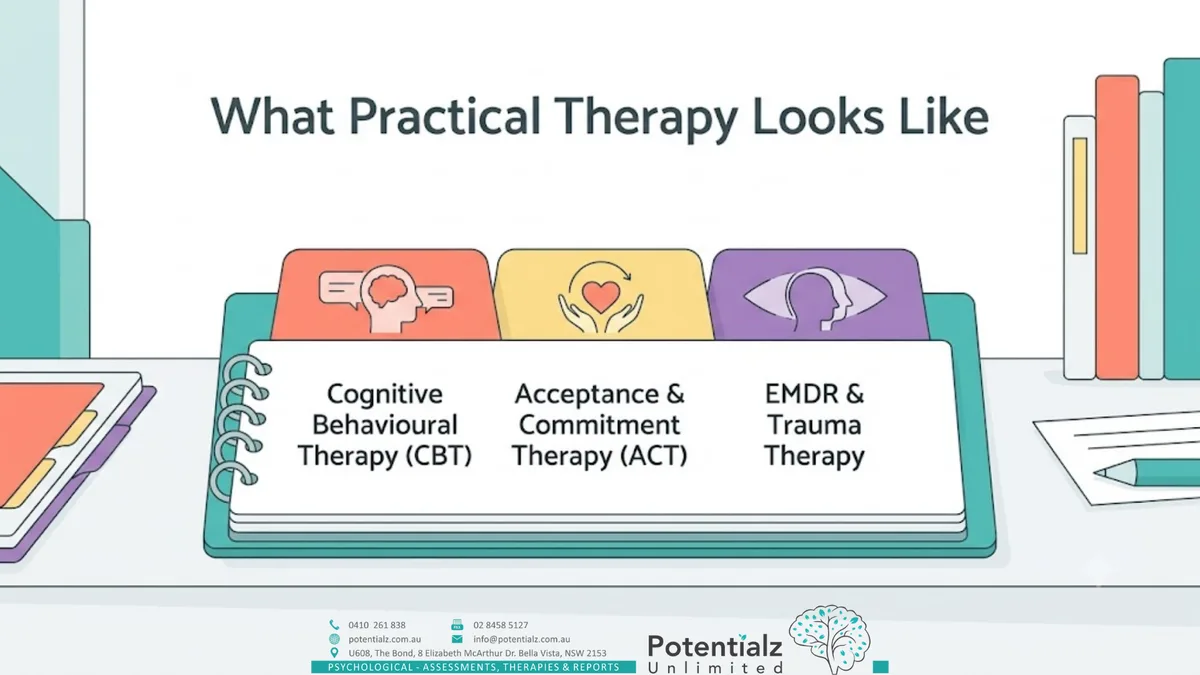
- Cognitive behavioural therapy (CBT) helps you spot the thinking and behaviour patterns that keep stress, anger, or low mood going, and build practical tools to shift them.
- Acceptance and commitment therapy (ACT) helps you make room for difficult feelings without being run by them, and act on what genuinely matters to you.
- EMDR can help when past trauma — accidents, assault, childhood experiences, frontline work — is still driving distress in the present. You can read more about EMDR therapy in Bella Vista.
Crucially, it is collaborative and confidential. You are not being judged or labelled. You are learning skills, much like training for any other part of life. Many men are surprised by how concrete and useful it feels once they start.
Supporting a Man in Your Life
If you are worried about a partner, mate, father, son, or colleague, you do not need to be an expert to make a difference. Often the most powerful thing is simply not looking away.
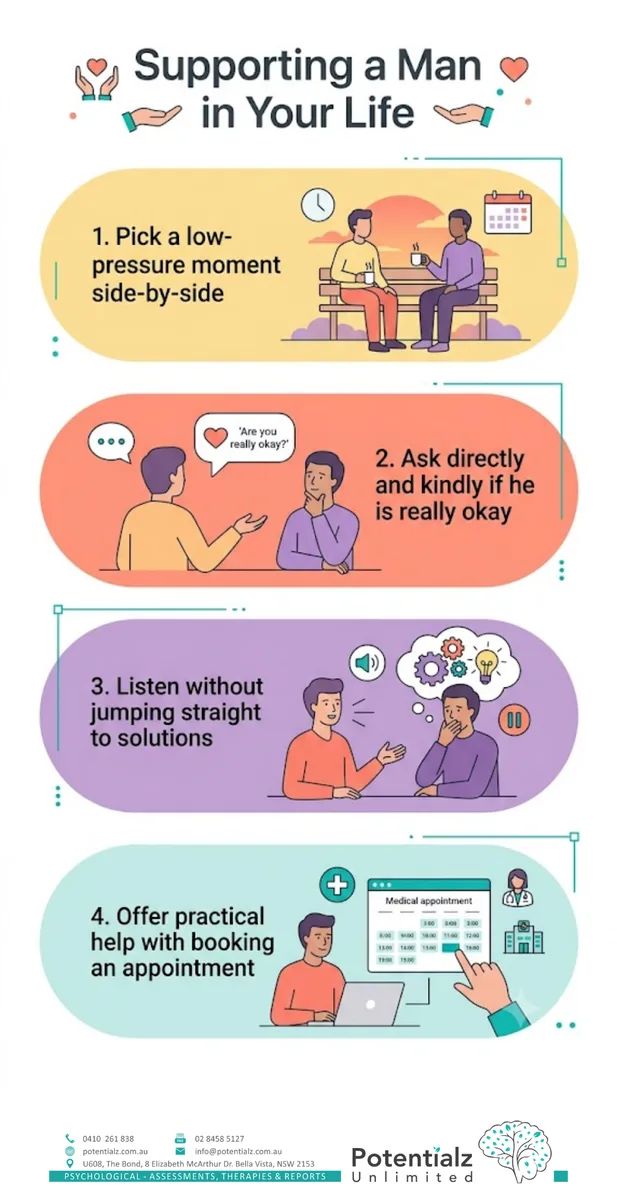
Some things that help:
- Pick a low-pressure moment. A drive, a walk, a job in the shed. Side-by-side often works better than face-to-face.
- Ask directly and kindly. “You haven’t seemed yourself lately — how are you really going?” Then ask a second time, because the first answer is often “fine.”
- Listen, don’t fix. Resist jumping straight to solutions. Feeling heard is the first relief.
- Stay connected. Keep checking in over weeks, not just once. Persistence signals that you actually care.
- Help with the practical step. Offer to help find a psychologist or even sit with him while he books. Lowering the friction can be decisive.
If you ever believe someone is in immediate danger, do not wait. Call 000, or Lifeline on 13 11 14.
Men’s Mental Health Support in Bella Vista and the Hills District
Potentialz Unlimited is based in Bella Vista, NSW, and supports men and families across the Hills District — including Norwest, Castle Hill, Kellyville, Baulkham Hills, Rouse Hill, and Glenhaven.
Dr Gurprit Ganda is a Clinical Psychologist with more than 25 years of experience, trained in CBT, ACT, and EMDR. She offers a warm, practical, judgement-free space where men’s mental health is taken seriously and worked on with proven, down-to-earth methods. Whether it is anger that has started to scare you, low mood you cannot shake, stress that is bleeding into home and work, or heavier drinking you would quietly like to rein in, support is close to home. You can contact the clinic or book directly at live.potentialz.com.au.
Reaching Out
It may be time to speak with a psychologist if you, or a man you care about, notice that:
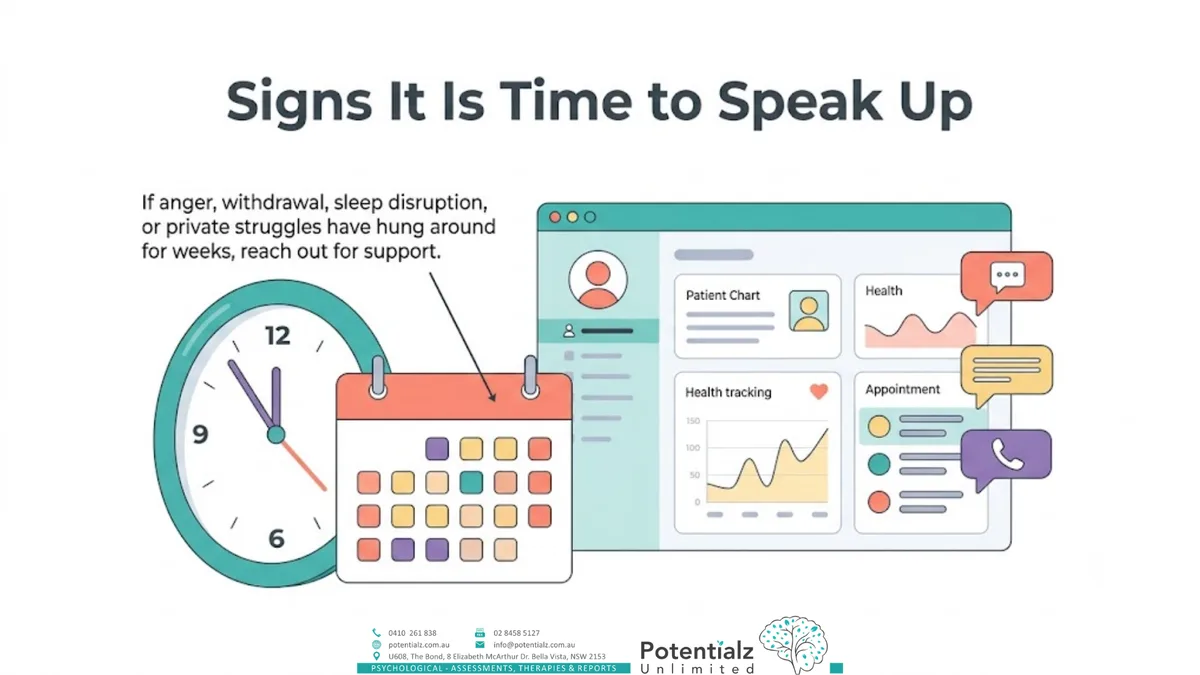
- Low mood, anger, or irritability has hung around for weeks.
- You have pulled away from people, hobbies, or things you used to enjoy.
- You are drinking, using, working, or escaping more to cope.
- Sleep, focus, or patience has clearly dropped off.
- You keep telling everyone you are “fine” while privately struggling.
Reaching out is not weakness. It is one of the strongest, most practical things a person can do.
Support is available now, day or night:
- Lifeline: 13 11 14 — 24/7 crisis support.
- MensLine Australia: 1300 78 99 78 — 24/7 support for men.
- In an emergency, call 000.
If thoughts of not wanting to be here ever show up, please reach out straight away using the lines above. You do not have to carry it alone, and things can get better with the right help.
Men’s mental health struggles are common, understandable, and very treatable. Breaking the silence — for yourself or someone you love — is where it starts.
References
Affleck, W., Carmichael, V., & Whitley, R. (2018). Men’s mental health: Social determinants and implications for services. The Canadian Journal of Psychiatry, 63(9), 581–589. https://doi.org/10.1177/0706743718762388
Australian Institute of Health and Welfare. (2024). Suicide & self-harm monitoring: Suicide deaths. Australian Government. https://www.aihw.gov.au/suicide-self-harm-monitoring/overview/suicide-deaths
Beyond Blue. (n.d.). Men’s mental health. Retrieved June 15, 2026, from https://www.beyondblue.org.au/mental-health/mens-mental-health
Herreen, D., Rice, S., Currier, D., Schlichthorst, M., & Zajac, I. (2021). Associations between conformity to masculine norms and depression: Age effects from a population study of Australian men. BMC Psychology, 9, Article 32. https://doi.org/10.1186/s40359-021-00533-6
Rice, S. M., Fallon, B. J., Aucote, H. M., & Möller-Leimkühler, A. M. (2013). Development and preliminary validation of the Male Depression Risk Scale: Furthering the assessment of depression in men. Journal of Affective Disorders, 151(3), 950–958. https://doi.org/10.1016/j.jad.2013.08.013
Wong, Y. J., Ho, M.-H. R., Wang, S.-Y., & Miller, I. S. K. (2017). Meta-analyses of the relationship between conformity to masculine norms and mental health-related outcomes. Journal of Counseling Psychology, 64(1), 80–93. https://doi.org/10.1037/cou0000176
Related Reading
Knowledge Check Quiz
Test what you have just read. Choose your answer for each question, then submit to reveal the answers and your score.
Need Professional Support?
If you're experiencing mental health concerns, our team is here to help.