Spirituality and psychology can work together — and in many modern therapeutic approaches, they already do. Spirituality is now recognised as a legitimate dimension of human wellbeing, and psychology offers evidence-based tools that complement, not compete with, a person’s sense of meaning, connection, and values. The research base supporting this convergence has grown substantially over the past three decades.
What Do We Actually Mean by “Spirituality”?

Before exploring how spirituality and psychology work together, it helps to get clear on what we mean — because spirituality is often confused with religion, and that confusion puts many people off.
Spirituality is not the same as religion. Religion involves organised belief systems, shared rituals, doctrinal texts, and institutional community. Spirituality is broader and more personal. It refers to:
- A sense of meaning and purpose — why you are here, what matters most
- A feeling of connection — to other people, to nature, to something larger than yourself
- Your values — the principles that guide how you live
- Transcendent experiences — moments of awe, wonder, or deep presence that go beyond the everyday
You can be deeply spiritual without any religious affiliation. You can be religious and find that your spiritual life and your religious practice are deeply entwined. Both are valid. What matters clinically is how these dimensions shape your experience of yourself, others, and difficulty.
For many clients — particularly those from South Asian, Indigenous, or culturally diverse backgrounds — spirituality is not a separate compartment of life but is woven into relationships, identity, and how they make sense of suffering. Acknowledging this in therapy is not just culturally sensitive; it is clinically important.
The Historical Tension — and Why It Is Easing
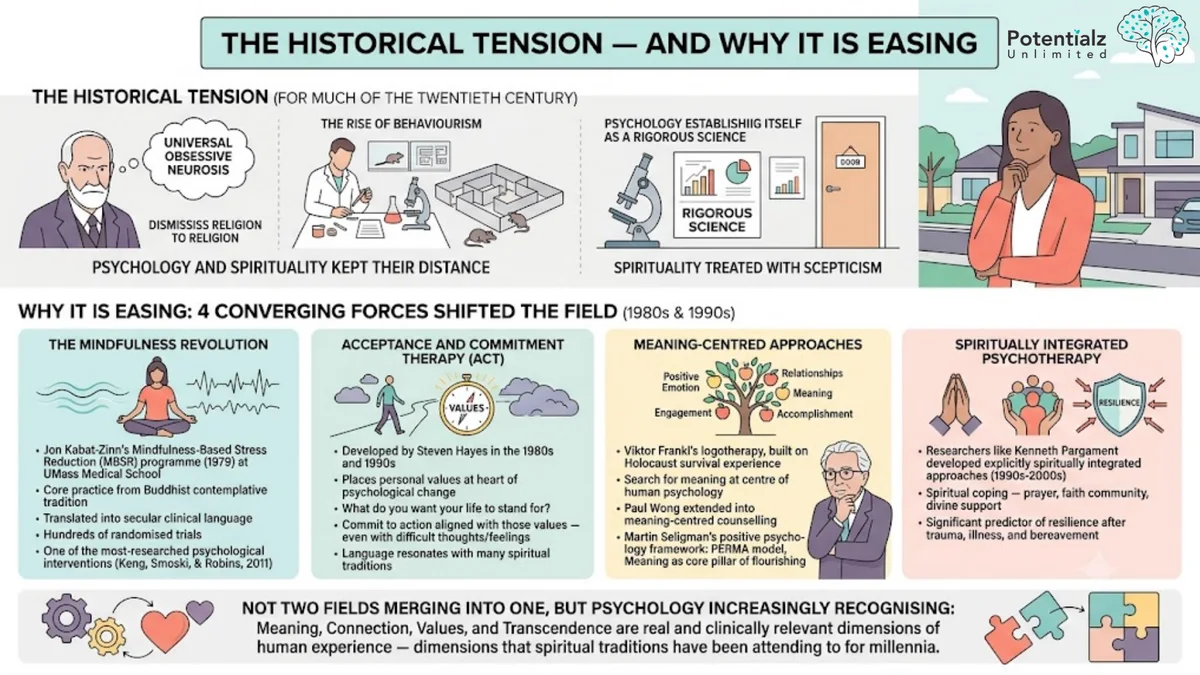
For much of the twentieth century, psychology and spirituality kept their distance. Freud’s dismissal of religion as a “universal obsessive neurosis,” the rise of behaviourism, and psychology’s push to establish itself as a rigorous science all contributed to an atmosphere in which spirituality was treated with scepticism — or simply left outside the consulting room door.
That began to change in the 1980s and 1990s, as several converging forces shifted the field:
-
The mindfulness revolution. Jon Kabat-Zinn’s Mindfulness-Based Stress Reduction (MBSR) programme, launched in 1979 at the University of Massachusetts Medical School, took a core practice from Buddhist contemplative tradition and translated it into secular clinical language. Hundreds of randomised trials later, mindfulness is now one of the most-researched psychological interventions in existence (Keng, Smoski, & Robins, 2011).
-
Acceptance and Commitment Therapy (ACT). Developed by Steven Hayes in the 1980s and 1990s, ACT places personal values at the heart of psychological change. The ACT framework asks: What do you want your life to stand for? and then helps clients commit to action aligned with those values — even in the presence of difficult thoughts and feelings. This is language that resonates with many spiritual traditions.
-
Meaning-centred approaches. Viktor Frankl’s logotherapy, built on his experience of surviving the Holocaust, placed the search for meaning at the centre of human psychology. Paul Wong extended this into meaning-centred counselling. Martin Seligman’s positive psychology framework — the PERMA model — identified Meaning as one of five core pillars of flourishing.
-
Spiritually integrated psychotherapy. Researchers like Kenneth Pargament began developing and testing explicitly spiritually integrated approaches to therapy in the 1990s and 2000s. His research demonstrated that spiritual coping — drawing on prayer, faith community, or a sense of divine support — is a significant predictor of resilience, particularly in the aftermath of trauma, illness, and bereavement.
The picture that emerges from this history is not of two fields merging into one, but of psychology increasingly recognising that meaning, connection, values, and transcendence are real and clinically relevant dimensions of human experience — dimensions that spiritual traditions have been attending to for millennia.
What the Research Broadly Shows
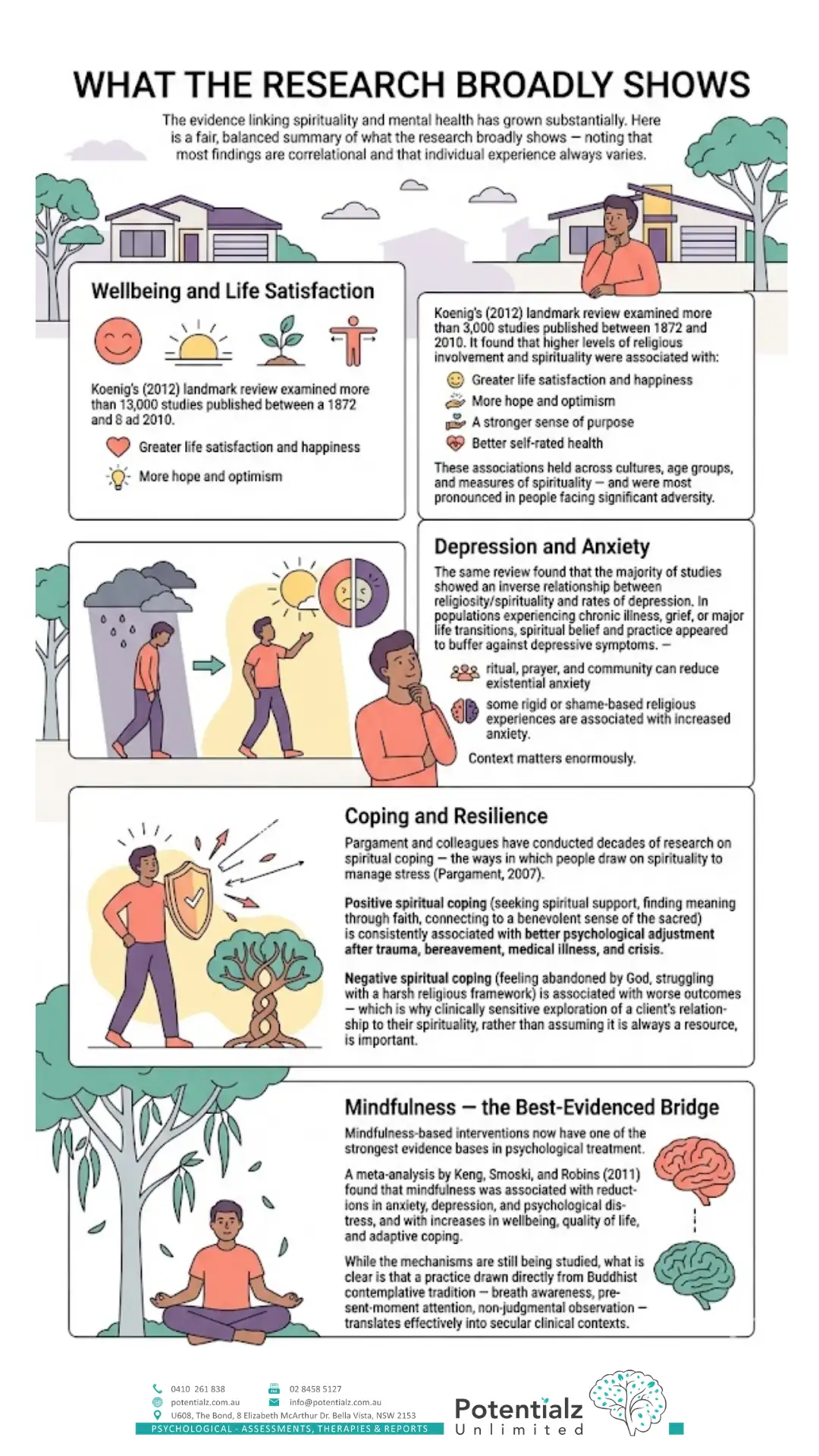
The evidence linking spirituality and mental health has grown substantially. Here is a fair, balanced summary of what the research broadly shows — noting that most findings are correlational and that individual experience always varies.
Wellbeing and Life Satisfaction
Koenig’s (2012) landmark review examined more than 3,000 studies published between 1872 and 2010. It found that higher levels of religious involvement and spirituality were associated with:
- Greater life satisfaction and happiness
- More hope and optimism
- A stronger sense of purpose
- Better self-rated health
These associations held across cultures, age groups, and measures of spirituality — and were most pronounced in people facing significant adversity.
Depression and Anxiety
The same review found that the majority of studies showed an inverse relationship between religiosity/spirituality and rates of depression. In populations experiencing chronic illness, grief, or major life transitions, spiritual belief and practice appeared to buffer against depressive symptoms. For anxiety, the picture is more nuanced — ritual, prayer, and community can reduce existential anxiety, while some rigid or shame-based religious experiences are associated with increased anxiety. Context matters enormously.
Coping and Resilience
Pargament and colleagues have conducted decades of research on spiritual coping — the ways in which people draw on spirituality to manage stress (Pargament, 2007). Positive spiritual coping (seeking spiritual support, finding meaning through faith, connecting to a benevolent sense of the sacred) is consistently associated with better psychological adjustment after trauma, bereavement, medical illness, and crisis. Negative spiritual coping (feeling abandoned by God, struggling with a harsh religious framework) is associated with worse outcomes — which is why clinically sensitive exploration of a client’s relationship to their spirituality, rather than assuming it is always a resource, is important.
Mindfulness — the Best-Evidenced Bridge
Mindfulness-based interventions now have one of the strongest evidence bases in psychological treatment. A meta-analysis by Keng, Smoski, and Robins (2011) found that mindfulness was associated with reductions in anxiety, depression, and psychological distress, and with increases in wellbeing, quality of life, and adaptive coping. While the mechanisms are still being studied, what is clear is that a practice drawn directly from Buddhist contemplative tradition — breath awareness, present-moment attention, non-judgmental observation — translates effectively into secular clinical contexts.
Where Psychology and Spirituality Naturally Converge
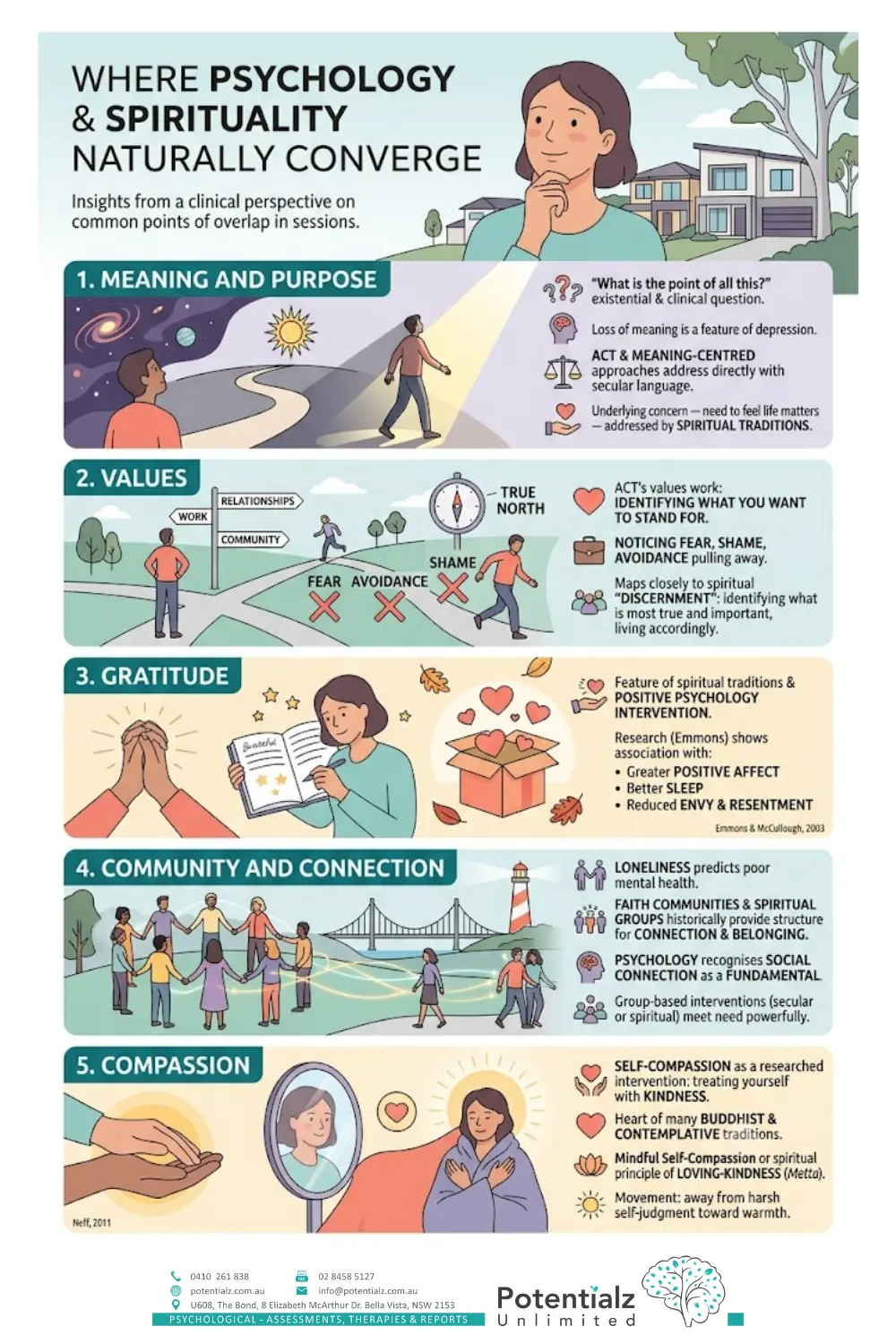
In my clinical practice, the overlap between psychological and spiritual concerns comes up regularly — not because I introduce it, but because it is already there in what people bring to sessions. Some common convergence points:
Meaning and purpose. “What is the point of all this?” is both an existential question and a clinical one. Loss of meaning is a significant feature of depression. ACT and meaning-centred approaches address this directly using secular language, but the underlying concern — the need to feel that life matters — is precisely what spiritual traditions have addressed across human history.
Values. ACT’s values work asks people to identify what they most want to stand for in their relationships, work, and community — then to notice when fear, shame, or avoidance is pulling them away from those values. This maps closely onto what many spiritual traditions call discernment: identifying what is most true and important, and living accordingly.
Gratitude. Gratitude practices are a feature of many spiritual traditions — and they are also among the best-evidenced positive psychology interventions. Robert Emmons’ research shows that regular gratitude practice is associated with greater positive affect, better sleep, and reduced envy and resentment (Emmons & McCullough, 2003).
Community and connection. Loneliness is one of the most significant predictors of poor mental health. Faith communities and spiritual groups have historically provided structure for human connection and belonging. Psychology increasingly recognises social connection as a fundamental need — and group-based interventions, whether secular or spiritually oriented, can meet that need powerfully.
Compassion. Self-compassion — treating yourself with the same kindness you would offer a good friend — is now a well-researched intervention (Neff, 2011). Compassion practices also sit at the heart of many Buddhist and contemplative traditions. Whether approached through mindful self-compassion practice or through the spiritual principle of loving-kindness (metta), the movement is the same: away from harsh self-judgment and toward warmth.
Learn more about self-compassion as a mental health foundation and how meditation offers scientific benefits that echo spiritual practice.
Practical Ways to Integrate Spirituality and Wellbeing
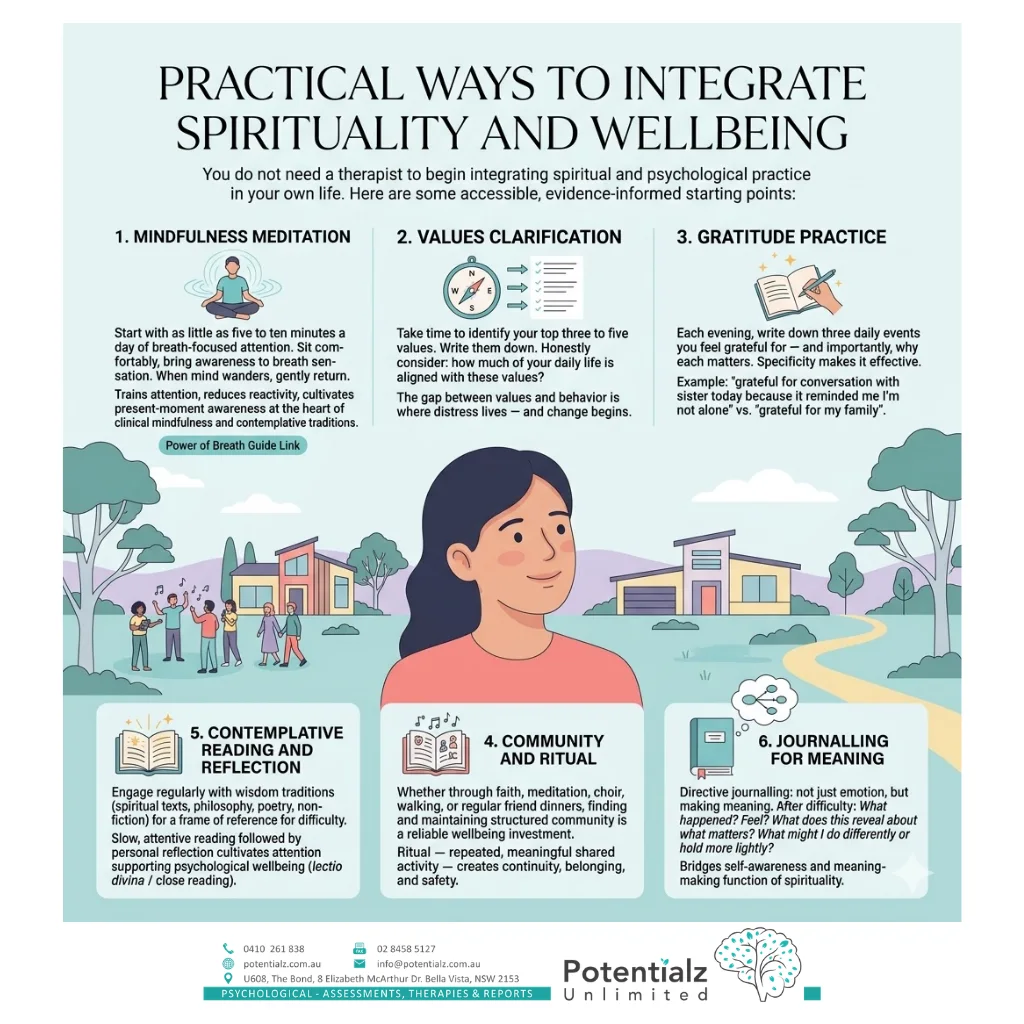
You do not need a therapist to begin integrating spiritual and psychological practice in your own life. Here are some accessible, evidence-informed starting points:
1. Mindfulness Meditation
Start with as little as five to ten minutes a day of breath-focused attention. Sit comfortably, bring your awareness to the physical sensation of breathing, and when your mind wanders — as it will — gently return. This simple practice trains attention, reduces reactivity, and cultivates the quality of present-moment awareness that sits at the heart of both clinical mindfulness and many contemplative traditions.
For more, see our guide to the power of breath for mental wellness.
2. Values Clarification
Take time to identify your top three to five values — not what you think you should value, but what you genuinely care about most. Write them down. Then, honestly, consider: how much of your daily life is actually aligned with these values? The gap between stated values and lived behaviour is often where distress lives — and where meaningful change begins.
3. Gratitude Practice
Each evening, write down three things that happened during the day for which you feel grateful — and, importantly, why each one matters. Specificity is what makes gratitude practice effective. “I’m grateful for the conversation I had with my sister today because it reminded me I’m not alone” is more powerful than “I’m grateful for my family.”
4. Community and Ritual
Whether through a faith community, a meditation group, a choir, a walking group, or regular dinners with friends, finding and maintaining structured community is one of the most reliable wellbeing investments available. Ritual — repeated, meaningful shared activity — creates a sense of continuity, belonging, and safety that is difficult to replicate in isolation.
5. Contemplative Reading and Reflection
Many people find that engaging regularly with wisdom traditions — whether that means reading spiritual texts, philosophy, poetry, or reflective non-fiction — provides a frame of reference for navigating difficulty. The practice of slow, attentive reading followed by personal reflection (sometimes called lectio divina in Christian tradition, or simply “close reading” in secular settings) cultivates a quality of attention that supports psychological wellbeing.
6. Journalling for Meaning
Journalling is most effective when it is directed not just at processing emotion but at making meaning. After a difficult event, try writing: What happened? How do I feel? What does this reveal about what matters to me? What might I do differently or hold more lightly? This kind of reflective practice bridges psychological self-awareness and the meaning-making function of spirituality.
Important Caveats — What Integrated Care Is Not
Integrating spirituality and psychology is not the same as imposing spiritual frameworks on clients. Ethical, competent practice in this area requires:
Respecting client belief. A skilled therapist follows the client’s lead. If a client does not identify with any spiritual tradition, spiritual language and frameworks are not helpful. If a client has a complex or painful relationship with organised religion, that history must be explored carefully — not assumed to be a resource.
Not substituting for clinical care. Spiritual practice can be a powerful complement to psychological treatment, but it does not replace professional care for clinical conditions such as depression, anxiety disorders, trauma, or psychosis. If you are experiencing significant distress, please reach out for professional support.
Avoiding harmful frameworks. Not all spiritual or religious experiences are psychologically healthy. Shame-based religious frameworks, spiritual bypassing (using spiritual practice to avoid processing difficult emotions), and coercive religious environments can cause real harm. A good therapist can help clients distinguish between spiritual beliefs that are supportive and those that are contributing to distress.
Cultural humility. Spiritual and religious belief is deeply personal and often culturally embedded. What spirituality means to a South Asian client with a Hindu background, an Anglo-Australian agnostic, and a client navigating trauma within a Christian community will differ substantially. Effective integrated care requires genuine curiosity and humility, not assumptions.
What This Looks Like at Potentialz Unlimited
At Potentialz Unlimited in Bella Vista, our team brings a holistic, multicultural lens to clinical care. Alongside evidence-based psychological therapy, our team includes practitioners who offer yoga and meditation-informed counselling, and our psychologists are experienced in working with clients from diverse cultural and religious backgrounds.
Dr Gurprit Ganda takes an integrative approach that is guided entirely by what is most helpful for each client. If spirituality — in whatever form it takes for you — is meaningful in your life, it can be a genuine resource within our work together. Sessions are conducted in a way that is warm, non-judgmental, and respectful of your own framework. Nothing is imposed; everything is in service of your goals.
We offer sessions in English, Hindi, Punjabi, and Urdu, and we are experienced in working with clients for whom cultural and spiritual context is central to understanding their experience.
To explore what approach might suit you, you are welcome to meet our team or get in touch directly.
About the Author
Dr Gurprit Ganda is a Clinical Psychologist (AHPRA Clinical Endorsement) and Practice Director at Potentialz Unlimited in Bella Vista, NSW. With over 25 years of clinical experience, she specialises in complex trauma (EMDR), anxiety and depression (CBT, ACT), adult ADHD assessment and treatment, cognitive and forensic assessment, and EFT-informed couples counselling. She offers sessions in English, Hindi, Punjabi, and Urdu and holds a particular commitment to culturally fluent, holistic care.
Potentialz Unlimited | Unit 608/8 Elizabeth Macarthur Drive, Bella Vista NSW 2153 Phone: 0410 261 838 | Book: live.potentialz.com.au | Web: potentialz.com.au Hours: Monday–Friday, 10am–7pm | Telehealth available across NSW Funding: Medicare (GP Mental Health Care Plan), WorkCover, CTP, NDIS
References
Emmons, R. A., & McCullough, M. E. (2003). Counting blessings versus burdens: An experimental investigation of gratitude and subjective well-being in daily life. Journal of Personality and Social Psychology, 84(2), 377–389. https://doi.org/10.1037/0022-3514.84.2.377
Kabat-Zinn, J. (1990). Full catastrophe living: Using the wisdom of your body and mind to face stress, pain, and illness. Delacorte Press.
Keng, S. L., Smoski, M. J., & Robins, C. J. (2011). Effects of mindfulness on psychological health: A review of empirical studies. Clinical Psychology Review, 31(6), 1041–1056. https://doi.org/10.1016/j.cpr.2011.04.006
Koenig, H. G. (2012). Religion, spirituality, and health: The research and clinical implications. ISRN Psychiatry, 2012, 278730. https://doi.org/10.5402/2012/278730
Neff, K. D. (2011). Self-compassion, self-esteem, and well-being. Social and Personality Psychology Compass, 5(1), 1–12. https://doi.org/10.1111/j.1751-9004.2010.00330.x
Pargament, K. I. (2007). Spiritually integrated psychotherapy: Understanding and addressing the sacred. Guilford Press.
Plante, T. G. (2007). Integrating spirituality and psychotherapy: Ethical issues and principles to consider. Journal of Clinical Psychology, 63(9), 891–902. https://doi.org/10.1002/jclp.20383
Seligman, M. E. P. (2011). Flourish: A visionary new understanding of happiness and well-being. Free Press.
Worthington, E. L., Jr., Hook, J. N., Davis, D. E., & McDaniel, M. A. (2011). Religion and spirituality. Journal of Clinical Psychology, 67(2), 204–214. https://doi.org/10.1002/jclp.20760
Related Reading
Knowledge Check Quiz
Test what you have just read. Choose your answer for each question, then submit to reveal the answers and your score.
Need Professional Support?
If you're experiencing mental health concerns, our team is here to help.