Key Takeaways
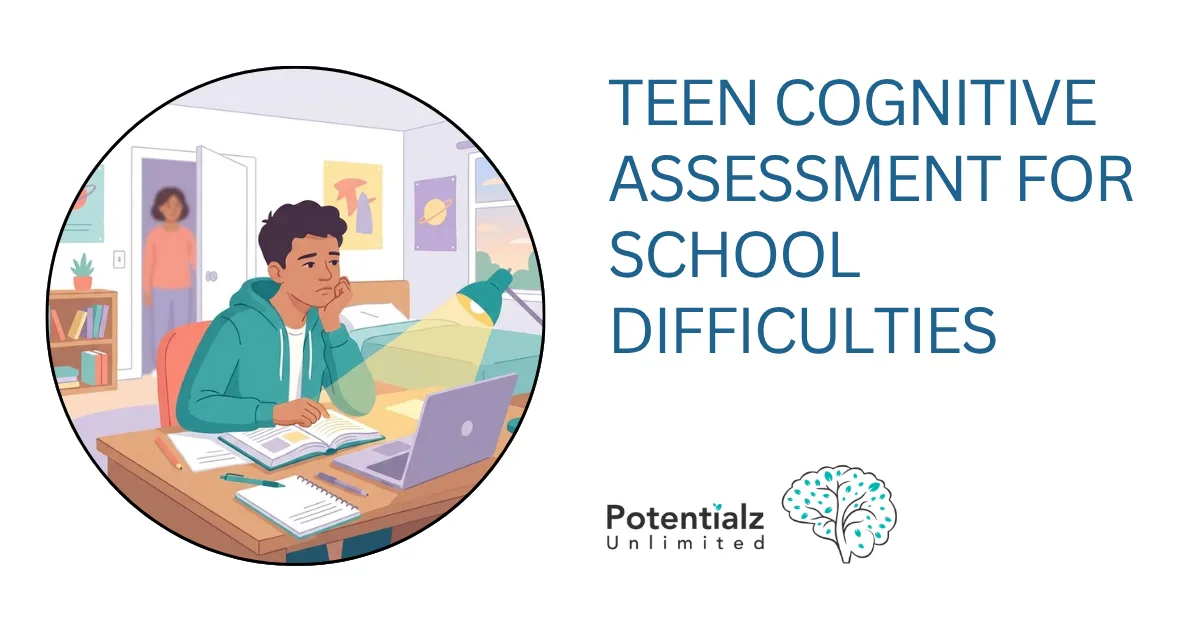
- Adolescence is a period of enormous cognitive, emotional, and social change. Some school struggle in the teenage years is normal — a temporary dip in grades after starting Year 7, a slump in Year 10, an anxious patch around exams — and does not on its own warrant a formal cognitive assessment. The question is when a pattern crosses from normal adolescent turbulence into something that needs a closer look.
- The teenagers we see at Potentialz whose parents are asking about cognitive assessment usually fit one of a handful of patterns: a bright child whose grades have quietly slid; a young person whose written output does not match their obvious verbal ability; a teenager who is exhausted, disorganised, and increasingly avoiding school; or an adolescent whose primary-school learning support is being renewed for the high school context and needs updated evidence.
- The correct cognitive test depends on age. The Wechsler Intelligence Scale for Children, Fifth Edition (WISC-V) is used up to age 16 years, 11 months. From 16 years exactly, the Wechsler Adult Intelligence Scale (WAIS-IV, and increasingly the newer WAIS-5) becomes an option. There is a short overlap window — 16:00 to 16:11 — where the choice of instrument is a clinical judgement about which one better fits the referral question and the young person’s development.
- School reports and psychological assessment are different animals. A school report tells you how your teenager is performing in class relative to a curriculum. A cognitive assessment tells you how their underlying cognitive processes are working relative to a normative population. Both are useful — but they answer different questions.
- Consent and confidentiality get more complicated with teenagers than with primary-aged children. Australian law recognises a mature minor’s capacity to consent to their own healthcare where they demonstrate sufficient understanding. Good practice with adolescent assessment involves talking with the young person directly about what the assessment is, what it means, and what will happen with the results — not just with the parents.
- At Potentialz Unlimited in Bella Vista, formal cognitive assessment is delivered by Dr Gurprit Ganda, our senior Clinical Psychologist. The wider clinical team’s role is to help families work out whether assessment is the right next step, to support the young person and family through the process, and to pick up the therapy that often follows — for anxiety, low mood, school refusal, family conflict around study, or the identity work that accompanies a new diagnostic understanding.
- Cost, wait time, and rebate arrangements vary and shift. Cognitive assessment in Australian private practice typically sits in the low-to-mid four figures; therapy sessions with a Registered Psychologist are eligible for Medicare rebates with a Mental Health Care Plan from your GP. Reception will walk you through current specifics.
- A good assessment does not end the conversation — it starts a more useful one. The report opens doors: to school-based adjustments, to targeted intervention, to informed conversations at home, and, where relevant, to therapy that responds to the actual picture rather than the guessed one.
Why This Post Exists
Most of the parents we speak with about adolescent cognitive assessment did not arrive with the assessment as their first idea. They arrived with a worry about their teenager — grades sliding, homework becoming a nightly war, a bright child now describing themselves as stupid, a young person who was fine in primary school but has come unstuck since Year 8 — and they have been trying to work out whether the problem is developmental, motivational, mental-health-based, learning-based, or something else entirely.
By the time they are asking us about cognitive assessment, they have usually already been through a lot. Parent-teacher conferences that were sympathetic but inconclusive. Tutoring. Removing screens. Adding screens back in. GP visits about sleep, mood, or possible ADHD. Sometimes speech pathology or occupational therapy earlier in the child’s life. And they are trying to work out whether a formal cognitive assessment will finally give them the clarity they have been chasing, or whether it will simply be another expensive step that does not actually change anything.
This post is our honest, plain-English answer to that question. When a school difficulty in a 13-to-17-year-old warrants formal cognitive assessment. What the assessment involves at this age. How the results actually get used. Where the risks and limits of assessment sit. And how to think about the whole thing in a way that keeps the teenager themselves at the centre — because a cognitive assessment of an adolescent that is designed only around the parents’ anxieties rarely produces a report the young person will actually engage with.
At Potentialz Unlimited in Bella Vista, formal cognitive assessment is coordinated through Dr Ganda, our senior Clinical Psychologist, while the pre-assessment conversation, the preparation work with the young person, and the therapy that often follows sit with the wider clinical team — we will come back to that division of labour shortly.
Normal Adolescence Versus a Signal Worth Investigating
The first useful move in this whole conversation is to hold the reasonable possibility that what you are seeing is developmental, not diagnostic.
Adolescence, in cognitive and emotional terms, is a period of large-scale neural reorganisation. The prefrontal cortex — the part of the brain most involved in planning, organisation, impulse control, and complex decision-making — is still maturing well into the mid-twenties. Sleep architecture shifts, with adolescent circadian rhythms genuinely running later than adult ones, which is why teenagers left to their own devices go to bed late and struggle at 7am. Emotional reactivity is heightened. Peer relationships become disproportionately important. Identity work becomes central in a way it was not in primary school. Puberty overlays all of it with hormonal change.
Against that developmental backdrop, some drop in academic performance is common. Year 7 is a big transition — new school, more teachers, more subjects, higher expectations, a longer commute. Year 10 often brings a slump as adolescents grapple with subject selection and the looming shape of senior years. Year 11 and 12 bring exam-related anxiety patterns that can look, in a snapshot, like a cognitive difficulty but are actually driven by anxiety and sleep loss.
So how do you tell the difference?
Here are the patterns that make us lean toward “this is probably developmental, watch and support” rather than “this warrants formal assessment now”:
- Grades have dipped modestly but the young person is engaging, showing up, and reporting the drop as connected to specific stressors they can name.
- The dip is recent (weeks to months) and connected to an identifiable event — a school change, a family stressor, a relationship difficulty, an illness.
- Homework is a struggle but not a chronic emotional battleground, and the young person is broadly participating in family life, friendships, and interests.
- Sleep and screen habits are visibly poor and have not been meaningfully addressed yet.
- The young person has not had a proper conversation with a psychologist or their GP about what is going on for them.
Here are the patterns that make us lean more strongly toward “yes, formal cognitive assessment is likely to help”:
- A pattern of school struggle that has persisted across at least a full year (often much longer), across multiple teachers and subjects, and that is not tracking to the young person’s obvious cognitive ability in conversation, in interests they care about, or in reports from previous years.
- A visible mismatch between what the young person can do orally and what they can produce on paper.
- A specific and long-standing difficulty in a particular academic domain (reading, writing, spelling, maths) that has not resolved despite reasonable intervention.
- Signs of ADHD, autism spectrum characteristics, or specific learning difficulties that were noticed earlier but never formally assessed.
- A young person who is asking their own questions — “am I actually smart?”, “am I broken?”, “why is this so hard for me?” — that a well-conducted assessment could genuinely help answer.
- Formal supports being sought — HSC provisions, tertiary access schemes, NDIS evidence — that require assessment documentation.
- A previous cognitive assessment done in early primary school that is now well out of date and needs updating for the high-school context.
Neither list is exhaustive, and there are grey-zone cases. When a parent describes their teenager to us and we are not sure which side of the line the picture sits on, we usually spend a session together working through the pattern, and if the answer is not yet clear we will often suggest a review after a defined period rather than jumping straight to assessment.
What Cognitive Assessment in the Teenage Years Actually Involves
If we decide that assessment is warranted, the question becomes what the assessment actually is. Here is what it involves for a 13-to-17-year-old.
A detailed history. The assessing clinician will gather developmental history (early milestones, speech and language development, any early concerns), educational history (schools attended, previous assessments, previous learning support, current subjects, current teachers’ observations), medical history (particularly hearing, vision, chronic illness, medication), mental health history (anxiety, mood, sleep, previous therapy), and current functioning (friendships, family life, interests, sleep, screen use, substance use where relevant). For teenagers we would strongly want to hear from the young person themselves as well as the parents — often in a separate part of the intake, so they can speak freely.
A cognitive assessment appropriate to age. For a young person aged 6 to 16 years and 11 months, the WISC-V is the standard test. It gives five index scores — Verbal Comprehension, Visual Spatial, Fluid Reasoning, Working Memory, and Processing Speed — plus a Full Scale IQ. From 16 years exactly onward, the WAIS-IV becomes an option and gives four index scores — Verbal Comprehension, Perceptual Reasoning, Working Memory, and Processing Speed. In the 16:00–16:11 overlap window, the clinician will choose based on the specific question, the young person’s developmental profile, and whether continuity with a previous WISC-V is important. We have written about the WISC-V in more depth in WISC-V Child Cognitive Assessment Explained and about the WAIS in WAIS Adult IQ and Cognitive Assessment in Bella Vista.
An academic achievement assessment where indicated. Where the referral question involves specific learning difficulty — reading, spelling, writing, maths — the cognitive assessment is usually paired with the WIAT-III (Wechsler Individual Achievement Test), which measures actual academic skills against age norms. The gap between cognitive ability and academic achievement in a specific domain is the core evidence for a specific learning disorder diagnosis. We have written more about this in Dyslexia and Learning Difficulty Assessment for Children.
Specific process measures where indicated. Where dyslexia is suspected, phonological processing measures (usually the CTOPP-2) will be added. Where attention or executive dysfunction is central to the picture, behaviour rating scales such as the BRIEF-2 (for parents and teachers to complete about executive functioning at home and at school) or the Conners-4 (for ADHD-relevant symptoms) may be included. Where autism is part of the differential, autism-specific tools may be added, though full autism diagnostic assessment is often a separate pathway.
Collateral information from school. With the family’s consent, the assessing clinician will usually request a summary from the school — recent reports, teacher observations, any current learning support arrangements, results of any school-administered testing. In the teenage years this can be tricky because a young person may not want their assessment discussed with the school at all until after the results are back and they have decided how to use them. That decision belongs to the family and the young person, and should not be assumed either way.
Clinical interpretation and report. The clinician synthesises all of the above — history, cognitive profile, achievement profile, process measures, collateral information, and observations from the assessment itself — into a clinical picture. Diagnosis, where a diagnosis is warranted, is a clinical judgement informed by all the evidence, not a scoring exercise.
A feedback session. The assessing clinician meets with the family and the young person to walk through the findings, answer questions, and provide recommendations. For teenagers, we would strongly favour a feedback structure that includes at least some time speaking directly with the young person about their own results, in language they can engage with, so that the report becomes something they own rather than something that has been done to them.
At Potentialz, this whole process is coordinated by Dr Ganda for formal cognitive assessment. The wider clinical team’s role is often before and after: helping families and young people think through whether assessment is the right next step, preparing them for what it will involve, and picking up the therapy work that often follows.
Each instrument is covered in its own right in the WISC-V child cognitive assessment explained and the WAIS adult IQ and cognitive assessment.
The 16:00 to 16:11 Age Window — Which Test?
Because this comes up regularly with families of older teenagers, it is worth spending a moment on the WISC-V-to-WAIS-IV crossover.
The WISC-V is normed for children aged 6 years 0 months through 16 years 11 months. The WAIS-IV is normed from 16 years 0 months upward. From 16:00 to 16:11 both tests are technically available.
Clinicians choose based on several considerations. Continuity with previous assessment: if the young person had a WISC-V at age 8 and we are now doing a comparison assessment, the WISC-V (or the WAIS-IV, depending on the specific referral question) may be preferred to keep the interpretive frame consistent. Developmental appropriateness: for a very developmentally young 16-year-old, the WISC-V may feel more suitable; for a 16-year-old who is functioning like a young adult, the WAIS-IV may be a better fit. Ceiling effects: for a very high-ability 16-year-old, the WISC-V may not have enough headroom in some subtests, and the WAIS-IV can give a more precise picture at the upper end. Referral question: if the assessment is for HSC provisions or tertiary access, the WAIS-IV is often the more relevant instrument because it is the adult standard the tertiary-access system will most commonly encounter.
For a young person aged 17 or 18 who is still at school, the WAIS-IV is the correct test — the WISC-V norms do not extend to that age.
This is exactly the kind of decision that a good assessing clinician thinks through explicitly with the family in the intake conversation, rather than defaulting to whichever instrument they have most recently administered. If your family is booking an assessment for a 16-year-old and the clinician has not raised the WISC-V-versus-WAIS-IV question with you, it is a fair thing to ask about.
School Reports Versus Psychological Assessment — What Each Actually Tells You
Parents often ask why a psychological assessment is needed when the school already produces reports. It is a fair question. The two answer different things.
A school report tells you how your teenager is performing in a specific class, on a specific curriculum, against classmates and against the school’s expectations for that year level. It is descriptive of performance. It usually includes an effort grade and comments about behaviour and participation. In good schools with attentive teachers, it may include specific observations about strengths and difficulties. It does not, and cannot, tell you what the underlying cognitive processes are that are driving the performance.
A cognitive assessment tells you how your teenager’s cognitive processes — verbal reasoning, visual reasoning, fluid problem-solving, working memory, processing speed — are functioning relative to standardised norms of what is typical for young people of the same age. It is a structured measurement of underlying capacity in the specific ways the test measures it. It is administered under highly controlled conditions with a trained clinician one-on-one.
A cognitive assessment gives you information about a young person that a school report cannot give you. It can distinguish, for instance, between a teenager who is genuinely finding academic content beyond their cognitive reach and a teenager whose cognitive profile is strong but whose working memory or processing speed is disproportionately weak — a distinction that has completely different implications for what to do next. It can distinguish between a young person whose difficulty in a specific subject reflects a specific learning disorder and one whose difficulty reflects something else. It can pick up profiles — twice-exceptional profiles, for instance, where a young person is both cognitively gifted and has ADHD or a specific learning difficulty — that a school report will almost never surface, because the two conditions mask each other in average performance.
Both sources of information matter. A good assessment will explicitly integrate school reports and teacher observations into the interpretation. A cognitive report that ignores the school picture is missing a crucial piece; a school report that ignores what a cognitive assessment might reveal about the underlying picture is also incomplete.
The Consent and Confidentiality Piece — Adolescents Are Not Small Children
One of the ways adolescent assessment differs from primary-aged assessment is that the young person has a much bigger voice — legally, ethically, and practically.
Under Australian law, the concept of a “mature minor” applies. A young person under 18 who has sufficient understanding and intelligence to fully understand a proposed treatment or intervention can consent to it themselves, following the principles established in the Gillick case in the UK and adopted into Australian law. This applies to psychological assessment as it applies to other forms of healthcare. In practice, this means that for a mature 14-, 15-, 16-, or 17-year-old, the young person’s own consent is a genuine, meaningful part of whether the assessment happens.
This is not a technicality. It matters clinically for several reasons.
Engagement. An assessment that a teenager has been dragged into against their will is likely to produce a poor result. Motivation, effort, and engagement on the day directly affect what the assessment can measure. A young person who has actively agreed to the assessment, who understands what it is for, and who is genuinely curious about the outcome will usually perform closer to their true functioning than one who has been coerced.
Ownership of the report. A young person who has consented to the assessment and been genuinely involved in the process is much more likely to see the report as belonging to them — a document that can help them understand themselves — rather than as a document that has been written about them for their parents’ use.
Confidentiality. Good practice with adolescent assessment involves a conversation up front about who will see what. In general, the young person and the family are informed together, the report is written for the family, and specific parts of the assessment session (particularly information the young person shared privately about their own experience) may be reported in ways that protect their privacy. Where a young person has shared something in the assessment that has genuine safety implications, that will be discussed with them and, where necessary, brought into the family conversation with their knowledge.
The right to decline. A mature adolescent has the right to decline assessment. If your teenager is genuinely opposed to being assessed, forcing the issue is unlikely to help. Sometimes the right first step is a therapy relationship where the young person can work through what is going on for them, and the question of assessment can be revisited later if it still fits. Sometimes what looked like a cognitive question turns out to be primarily a mood, anxiety, or relational question, and no formal cognitive assessment is needed at all.
None of this means the parents’ concerns are not important. They are. But adolescent assessment done well brings the young person into the frame as an active participant, not just as a subject.
Where the pattern points to a specific learning difficulty rather than a general cognitive profile, dyslexia and learning difficulty assessment covers the different pathway, and where attention or social differences are the presenting concern, ADHD vs autism: what an assessment actually measures sets out what each one tests for.
Common Patterns We See in Teenagers Referred for Assessment
To make the terrain more concrete, here are several of the composite patterns that come up repeatedly in the conversations we have with families of teenagers. Each is a pattern, not a specific person; each represents the kind of picture that a good cognitive assessment can genuinely help clarify.
Pattern one: the Year 8 boy whose primary-school assessment is out of date. A family comes in about their 13-year-old son. He was assessed in Year 3 with a WISC-IV that identified a specific learning disorder in reading, and the primary school built strong learning support around him. He is now in Year 8 at a different school and the supports have not carried over well. He is struggling with the reading load, particularly in humanities subjects. The new school is asking for updated evidence to formalise adjustments. A cognitive-plus-achievement assessment updated to the current WISC-V and WIAT-III provides current data, refreshes the diagnostic picture in light of the older assessment, and gives the new school what they need. The therapy piece — supporting a young person who is starting to actively hate reading, and helping his parents recalibrate how they talk about school at home — comes to us for a short course of sessions.
Pattern two: the Year 10 girl whose grades have dropped and no one is sure why. A family comes in about their 15-year-old daughter. She was a strong student through primary school and Year 7 to 9. Since the start of Year 10 her grades have dropped noticeably. She has become more withdrawn, harder to reach, and increasingly reluctant to talk about school. The parents are trying to work out whether this is depression, anxiety, a learning difficulty they missed, ADHD that only surfaces under Year 10 workload, or something else. A conversation with us suggests that jumping straight to a cognitive assessment is not the right first move — the picture is dominated by mood and social change, not by anything that looks obviously cognitive. Two months of therapy with us first, addressing sleep, low mood, and some social difficulties that were driving the withdrawal, produces meaningful improvement. At the end of that period, cognitive assessment is no longer necessary — the grade issue has largely resolved as the mood issue has resolved.
Pattern three: the Year 11 boy who has always worked twice as hard for the same result. A family comes in about their 17-year-old son. He is doing his HSC year and finding the workload crushing. He has always been a hard worker — meticulous, conscientious, willing to sit for hours over homework — but has produced average results for the effort involved. His parents suspect ADHD but the picture is complicated by his strong effort profile, which does not fit the stereotypical presentation. A conversation with us leads to a full WAIS-IV cognitive assessment with Dr Ganda plus attention and executive functioning measures. The picture that emerges shows strong verbal reasoning and average perceptual reasoning, alongside significantly weaker processing speed and working memory. Combined with the developmental history and functional information, the profile supports a diagnosis of ADHD, predominantly inattentive presentation. The report provides the basis for HSC special provisions (extra time), a referral to a paediatrician or psychiatrist for medication consideration, and a course of therapy with us focused on ADHD-informed study strategies and reducing the self-critical voice that decades of “having to work twice as hard for the same result” has built.
Pattern four: the twice-exceptional Year 9 girl whose profile has never been characterised. A family comes in about their 14-year-old daughter. She is by any measure exceptionally verbally able — she reads at a university level, has an extraordinary vocabulary, and engages with abstract ideas her peers cannot follow. But her school performance is inconsistent: brilliant work in subjects that engage her, poor work in subjects that do not, patchy homework completion, and increasing conflict with teachers who feel she is capable and not trying. Her parents suspect she is gifted but also suspect something else is going on. A WISC-V confirms a cognitive profile in the very high range across most indices, with a specific weakness in processing speed. Additional attention measures point to inattentive-presentation ADHD, well-masked by her cognitive strength. This is a classic twice-exceptional pattern (gifted plus ADHD), and we have written about the giftedness piece in more depth in Giftedness and High-IQ Assessment for Children. The report changes the family’s understanding of her, the school’s approach to her, and — most importantly — her understanding of herself.
Pattern five: the Year 12 boy with an existing autism diagnosis who needs updated cognitive evidence for tertiary access. A family comes in about their 17-year-old son. He has an autism diagnosis from childhood and is currently completing his HSC. He wants to apply for tertiary access adjustments — extra time, alternative examination arrangements, notetaking support — and the university is asking for a current cognitive assessment. A WAIS-IV is administered, along with review of the existing autism documentation, and the resulting report supports the tertiary access application.
Each of these patterns is real in the sense that families with similar shapes walk through our door regularly. Each of them illustrates that adolescent cognitive assessment can serve very different purposes, and that a thoughtful conversation about what the specific family actually needs is a better starting point than a default assumption that “assessment” is a single thing.
How to Prepare Your Teenager for the Day
Preparation matters more for teenagers than for younger children, precisely because adolescents pick up on framing and can either engage or disengage based on how the assessment has been introduced to them.
Some things that tend to help.
Have an honest, unpressured conversation about why the assessment is happening. Talk with your teenager about what you have been noticing, why you have wondered about assessment, and what you hope the assessment might help clarify. Ask them what they think and what they would want to know from an assessment. Include them in the decision to book, not just in the fact of the booking.
Explain what the day involves in plain terms. “You’ll spend three to four hours with a psychologist, split across a couple of sessions. There’ll be a mixture of talking tasks — defining words, general knowledge, that kind of thing — and doing tasks — building block designs, spotting patterns, timed puzzles. Some will feel easy, some will feel genuinely hard. That’s how the tests work — they’re designed to push everyone until they hit their ceiling.”
Address the “smartness” framing. Many teenagers are anxious that an assessment will reveal they are less intelligent than they hope, or their friends. Address this directly. “This test doesn’t measure how smart you are as a person. It measures a specific set of cognitive processes — verbal reasoning, visual reasoning, working memory, processing speed. Those are useful things to know about, but they are not the same thing as who you are or what you are capable of.” Let them know that the shape of the profile matters much more than the single number, and that most people have peaks and dips.
Do the practical prep. Good sleep the night before. Normal breakfast. Take any regular medication as normal (including ADHD medication if that is what they usually take — the assessment reflects real-world functioning, which means real-world medication). Bring water and a snack for breaks. Wear comfortable clothes. Come without unrealistic time pressure afterwards.
Be honest about what happens with the results. The report will be discussed with the family. The young person will be part of that discussion. The report is not automatically shared with the school; that is a decision the family makes. Nothing gets uploaded to some permanent record without the family’s consent.
Respect that they may be nervous. Assessment anxiety is common and does not have to be argued out of existence. Acknowledging it — “yeah, it makes sense that you’re a bit nervous, this is a new thing” — usually reduces it more than trying to talk them out of it.
Common Myths About Teenage Cognitive Assessment
We hear the same myths from families of adolescents most weeks. Some are worth addressing head-on.
“An assessment will fix the problem.” No. An assessment can identify and characterise a cognitive profile. It cannot on its own change the profile. What it does is open the door to targeted intervention, appropriate accommodations, informed conversations, and — where relevant — therapy that responds to the actual picture. The change comes from what you do with the assessment, not from the assessment itself.
“If they don’t try hard on the day the results will be useless.” Effort does affect assessment results, but good clinicians are trained to notice when engagement is genuinely poor and to interpret the results accordingly. A young person who genuinely does not engage will usually produce a picture that is described as an underestimate of their functioning, not a false low score presented as a true reading. That said, engagement matters — which is another reason the young person’s active consent and buy-in is important.
“The assessment will diagnose ADHD or autism.” Not on its own. Cognitive assessment is one part of an ADHD or autism assessment, not the whole thing. Diagnosis of ADHD requires an assessment against DSM-5-TR criteria that includes developmental history, current functional impact across settings, screening measures, and clinical interview. Diagnosis of autism requires specific tools (ADOS-2, ADI-R) and often a multidisciplinary picture. Cognitive assessment can support and inform these processes but does not replace them. We have written in more detail about the overlap and differences in ADHD vs Autism Assessment: Key Differences.
“Once they’re a teenager it’s too late for assessment to change anything.” No. Assessment in the teenage years opens genuine practical doors — HSC provisions, tertiary access adjustments, updated school-based supports, informed medication decisions, targeted intervention, and therapy that responds to the actual picture. It can also — and this is often the most valuable outcome — give the young person themselves a much clearer sense of how their mind works, which is a foundation for a more compassionate and effective relationship with themselves going forward.
“The score they get is who they are.” No. A cognitive score is a description of a specific set of cognitive processes on a specific day. It is not a verdict on the person. Adolescents in particular are still developing, still finding their strengths, still growing into who they will be. A score is a snapshot, not a prediction.
“If we assess and there’s nothing wrong, we’ve wasted our money.” Sometimes an assessment comes back showing a broadly average or above-average profile with no specific learning disorder or attention issue. That is not a wasted assessment. It is genuinely useful information — it rules out specific cognitive explanations for the school difficulty and directs the family and the young person to look elsewhere (mental health, sleep, motivation, environmental factors, teacher fit) for the drivers. Ruling things out has real clinical value.
“Public school counsellors can do this.” Sometimes. Sometimes not. NSW school counsellors are trained psychologists and some do conduct WISC-V assessments. But wait times are often long, the assessment is usually narrower than a full private assessment, and the resulting report may not meet the requirements of external bodies (HSC provisions, tertiary access, NDIS evidence). If your school counsellor can offer what you need in a reasonable timeframe, it is worth pursuing. If they cannot, private assessment is the alternative.
What Happens After the Report
Once the report is in the family’s hands, the practical question is what to do with it. Common next steps for adolescents include the following.
Share with the school and formalise adjustments. Most NSW schools have processes for reviewing external assessment evidence and building learning adjustments into the young person’s education. Common adjustments at high school include extra time on written tasks, provision of speech-to-text or text-to-speech technology, reduced writing load in some contexts, alternative assessment formats, and specific teacher awareness. The school’s learning support team is usually the first port of call.
Apply for HSC special provisions where relevant. NESA (NSW Education Standards Authority) has a formal process for HSC special provisions. Cognitive assessment reports are one form of evidence that can support these applications. The specific requirements shift over time, and the school’s HSC coordinator will know the current process.
Consider medication where clinically indicated. Where the assessment supports an ADHD diagnosis and medication is being considered, the next step is a referral to a paediatrician (for young people under 18) or a psychiatrist. Prescribing sits with medical clinicians, not psychologists. The assessment report provides the paediatrician with a substantial piece of the clinical picture.
Engage targeted intervention. Where a specific learning disorder is identified, evidence-based intervention (structured literacy for reading, explicit writing instruction, tutoring in the specific weak domain) has a real role. This is often more useful in mid-to-late high school than families expect.
Engage therapy where relevant. Many adolescents by the time they are assessed have accumulated anxiety, low self-esteem, family conflict, and — in some cases — school refusal or depression around their academic difficulty. Therapy is often the piece that translates the assessment into actual change in daily life. This work draws on CBT, ACT, and Solution-Focused Therapy, with strong attention to the family system around the young person.
Talk with the young person about their own report. This is the piece that families sometimes skip and that we think is the most important. The report is about them. Sit down together, read the key parts, and talk about what it means. Ask them what they think of it. What surprised them. What confirms what they already knew. What they want to do differently. A report that lives in a drawer while adults implement adjustments over the young person’s head is a wasted opportunity; a report that becomes a conversation between the young person and their own understanding of themselves is a resource for the rest of their life.
Consider tertiary access early. For young people in Year 11 or 12 who are heading toward university or TAFE, the report can support tertiary access schemes and disability support arrangements. Universities and TAFEs have specific processes; look them up early, because applications often open well before the young person actually enrols.
Plan for review. For a young person assessed in early high school, expect that a review assessment may be useful before the HSC (particularly for HSC provisions applications, which usually require reasonably current evidence). Cognitive profiles are broadly stable but can shift with development, illness, or major life change, and specific provisions applications often want assessments within a few years of the exams.
The Emotional and Family Piece — Where Therapy Often Comes In
An adolescent cognitive assessment does not happen in a vacuum. It happens in a family that has usually been worrying for a long time, in a young person who is often anxious about school and about themselves, and in a system (school, peers, home) that has been under strain.
That means the assessment often reveals — or confirms — a picture that has emotional and relational weight. A young person is diagnosed with a specific learning disorder they have half-suspected for years. A family realises that the difficulty their teenager has been having is not laziness. Parents recalibrate their expectations. Siblings sometimes have to be brought into the conversation. The young person themselves has to integrate a new piece of understanding about who they are.
This is where therapy work often comes in. Some of the most common therapy questions we work on with teenagers and their families after an assessment include:
- Reducing the shame and self-criticism that has built up over years of struggling and blaming themselves.
- Recalibrating the family’s expectations so that homework and study are approached in a way that fits the young person’s actual profile, not the profile everyone had assumed.
- Building study strategies that work with the profile rather than against it — using tools and approaches that fit an ADHD or dyslexia profile, for instance, rather than continuing to try harder at approaches that were never going to work.
- Working on anxiety, low mood, or school refusal where these have developed as a response to sustained academic difficulty.
- Family conflict around study and screens — a common flashpoint that shifts substantially once everyone understands the young person’s cognitive picture properly.
- Identity work — helping the young person integrate the assessment findings into a broader, healthier sense of who they are, that includes but is not limited to their cognitive profile.
This work draws on Cognitive Behavioural Therapy (CBT), Acceptance and Commitment Therapy (ACT), and Solution-Focused Therapy. Where the family system needs work, we bring parents in explicitly. Where the young person needs to be seen individually, we protect that. Where a broader specialist input is needed (medication, occupational therapy, speech pathology, tutoring), we coordinate with those other clinicians.
The Assessment Team at Potentialz — Who Does What
A quick clarifying note on how the team at Potentialz works.
Dr Gurprit Ganda is our senior Clinical Psychologist. Formal cognitive and academic achievement assessment — WISC-V, WAIS-IV, WIAT-III, phonological processing measures, and integration into a full learning-difficulty or diagnostic assessment for adolescents and adults — is her territory. She also delivers medico-legal, Section 14, and forensic assessment work.
Sushama Sathe is a Registered Psychologist with two decades of experience, including EMDR, perinatal and grief work, and multicultural family work.
Samita Rathor is our holistic counsellor and yoga therapist.
Bhavini Ambaram is our Practitioner in Therapeutic Play, with PTUK / PTSA accreditation and additional training in Synergetic Play, LEGO-Based Therapy, and Parent-Child Attachment Play. For children under 8 who need play-based rather than talking-based therapy, Bhavini is often the primary clinician on the therapy side.
If you are unsure who to see, reception can help triage. A brief phone conversation is usually more useful than trying to work it out from a website.
Cost, Wait Time, and Rebates — Honestly
We do not want to quote specific numbers that will become out of date within months. What we can do is give you the shape of the picture, and encourage you to check current specifics with reception when you enquire.
Cost. A full cognitive-plus-achievement assessment for a teenager (WISC-V or WAIS-IV plus WIAT-III where indicated plus any additional process measures plus report and feedback) is a substantial piece of clinical work — usually eight to twelve hours of clinician time when all the direct testing, scoring, interpretation, report writing, and feedback are counted. A ballpark for the total investment in Australian private practice is in the low-to-mid four figures, though this varies with the specific assessment plan.
Wait time. Wait times vary depending on clinician availability. Reception at Potentialz will give you an honest current figure when you enquire.
Medicare. Medicare rebates for cognitive and academic achievement assessment specifically are limited. The standard Mental Health Care Plan (MHCP) from a GP does not fund a full assessment of this kind. Some specific item numbers may apply in specific circumstances — reception can walk you through what applies. For therapy sessions with a registered psychologist at Potentialz (for anxiety, self-esteem, family work, school refusal, or the identity work that often follows assessment), Medicare rebates are available with an MHCP from your GP.
NDIS. For eligible NDIS participants, assessment may be funded under capacity-building supports, particularly where the assessment is directly relevant to disability evidence or plan development. Self-managed and plan-managed participants generally have more flexibility here than NDIA-managed participants.
Private health insurance. Some private health insurance psychology extras cover a portion of psychological assessment; check with your insurer.
Employer, school, or scholarship funding. Occasionally a NSW school will contribute to or fund an assessment where they have specifically requested it, or where a scholarship or learning support pathway has assessment as a prerequisite. It is worth asking your school before you book.
We know none of this gives you a specific number. That is the honest answer. Reception will.
A Note on the Young Person’s Voice
We want to end by returning to something we said earlier because it is easily lost in the practical logistics.
An adolescent cognitive assessment is much more useful when the young person is a genuine participant in it — from the decision to book, through the day itself, into the feedback conversation and beyond. That does not mean the young person has to be excited about it. It does mean they should know what is happening, why it is happening, what will be done with the results, and what part they have in shaping how those results are used.
Assessments that are done to a young person, rather than with them, tend to produce reports that get filed away without changing anything. Assessments that are done with a young person, where they have understood the purpose and consented to the process, tend to produce reports the young person actually engages with — and those are the reports that translate into practical change.
If your teenager is dead-set against being assessed and no amount of conversation is shifting that, our honest suggestion is to pause the assessment plan and consider therapy first. A trust-building relationship with a psychologist who is on their side, in which the young person can work through what they are actually experiencing at school and at home, is often a better starting point than a formal assessment they have resisted. The assessment question can be revisited once the young person has had space to think about it, and sometimes it turns out to be no longer needed, and sometimes it is exactly what they want once it has stopped being framed as something being done to them.
How Potentialz Can Help
If you have read this far and you have a genuine worry about how your teenager is doing at school, or a longstanding question about a pattern that has never quite added up, you are welcome to reach out.
Because the formal WISC-V and WAIS-IV assessment at Potentialz is Dr Ganda’s territory, the practical first step for a formal assessment enquiry is usually a phone conversation with reception, who will scope out the referral question, walk you through current cost, wait time, and rebate arrangements, and book you in with Dr Ganda where that is the right fit.
If your question is more general — “we’re not sure whether an assessment is the right next step, or whether therapy would help, or whether we should talk to the school first” — that is a conversation you can have with our team first, and we can work out together what makes sense. Where a formal assessment is the right step, we will connect you with Dr Ganda in-house. Where therapy for the anxiety, low mood, family conflict, or school-related distress is the better first step, we can do that piece together.
Potentialz Unlimited is a psychology practice in Bella Vista working with children (aged 8 and up), adolescents, young adults, and older adults, using Cognitive Behavioural Therapy (CBT), Acceptance and Commitment Therapy (ACT), and Solution-Focused Therapy, always grounded in a strong, non-judgemental therapeutic relationship.
Medicare rebates are available with a Mental Health Care Plan (MHCP) from your GP for therapy sessions. NDIS (self-managed and plan-managed) referrals are accepted. Formal cognitive and achievement assessment cost and rebate arrangements are separate and best confirmed at the point of enquiry.
- Address: Unit 608, 8 Elizabeth Macarthur Drive, Bella Vista NSW 2153
- Phone: 0410 261 838
- Book: live.potentialz.com.au
- Hours: Monday–Friday 10am–7pm | Saturday & after-hours available | Telehealth via phone or Zoom (for therapy; formal assessment is delivered in person)
You may also find these related posts useful: WAIS Adult IQ and Cognitive Assessment in Bella Vista, Dyslexia and Learning Difficulty Assessment for Children, Giftedness and High-IQ Assessment for Children, ADHD vs Autism Assessment: Key Differences, and When and Why Adults Consider Cognitive Assessment.
References
American Psychiatric Association. (2022). Diagnostic and statistical manual of mental disorders (5th ed., text rev.). https://doi.org/10.1176/appi.books.9780890425787
Barkley, R. A. (2015). Attention-deficit hyperactivity disorder: A handbook for diagnosis and treatment (4th ed.). Guilford Press.
Blakemore, S.-J. (2018). Inventing ourselves: The secret life of the teenage brain. Public Affairs.
Casey, B. J., Jones, R. M., & Hare, T. A. (2008). The adolescent brain. Annals of the New York Academy of Sciences, 1124(1), 111–126. https://doi.org/10.1196/annals.1440.010
Fletcher, J. M., Lyon, G. R., Fuchs, L. S., & Barnes, M. A. (2019). Learning disabilities: From identification to intervention (2nd ed.). Guilford Press.
Groth-Marnat, G., & Wright, A. J. (2016). Handbook of psychological assessment (6th ed.). Wiley.
Kaufman, A. S., Raiford, S. E., & Coalson, D. L. (2016). Intelligent testing with the WISC-V. John Wiley & Sons.
Lichtenberger, E. O., & Kaufman, A. S. (2013). Essentials of WAIS-IV assessment (2nd ed.). John Wiley & Sons.
Sattler, J. M. (2018). Assessment of children: Cognitive foundations and applications (6th ed.). Jerome M. Sattler, Publisher.
Steinberg, L. (2014). Age of opportunity: Lessons from the new science of adolescence. Houghton Mifflin Harcourt.
Wechsler, D. (2008). Wechsler Adult Intelligence Scale — Fourth Edition (WAIS-IV): Technical and interpretive manual. Pearson.
Wechsler, D. (2014). Wechsler Intelligence Scale for Children — Fifth Edition (WISC-V): Technical and interpretive manual. Pearson.
Weiss, L. G., Saklofske, D. H., Holdnack, J. A., & Prifitera, A. (Eds.). (2019). WISC-V: Clinical use and interpretation (2nd ed.). Academic Press.
Weiss, L. G., Saklofske, D. H., Coalson, D. L., & Raiford, S. E. (Eds.). (2010). WAIS-IV clinical use and interpretation: Scientist-practitioner perspectives. Academic Press.
AHPRA Disclaimer
This guide was prepared by the Potentialz Unlimited Editorial Team and reviewed by our AHPRA-registered practitioners. The information in this post is general in nature and does not constitute clinical advice for your particular situation. Please consult a qualified health professional for your individual circumstances. If you are experiencing a mental health crisis, contact your GP, call Lifeline on 13 11 14, or go to your nearest emergency department.
Crisis Resources
- Lifeline: 13 11 14 (24/7)
- Beyond Blue: 1300 22 4636
- Kids Helpline: 1800 55 1800
- MensLine Australia: 1300 78 99 78
- 13YARN (Aboriginal & Torres Strait Islander crisis line): 13 92 76
- Emergency: 000
Knowledge Check Quiz
Test what you have just read. Choose your answer for each question, then submit to reveal the answers and your score.
Need Professional Support?
If you're experiencing mental health concerns, our team is here to help.