The Sunday Night That Felt Like Monday Already
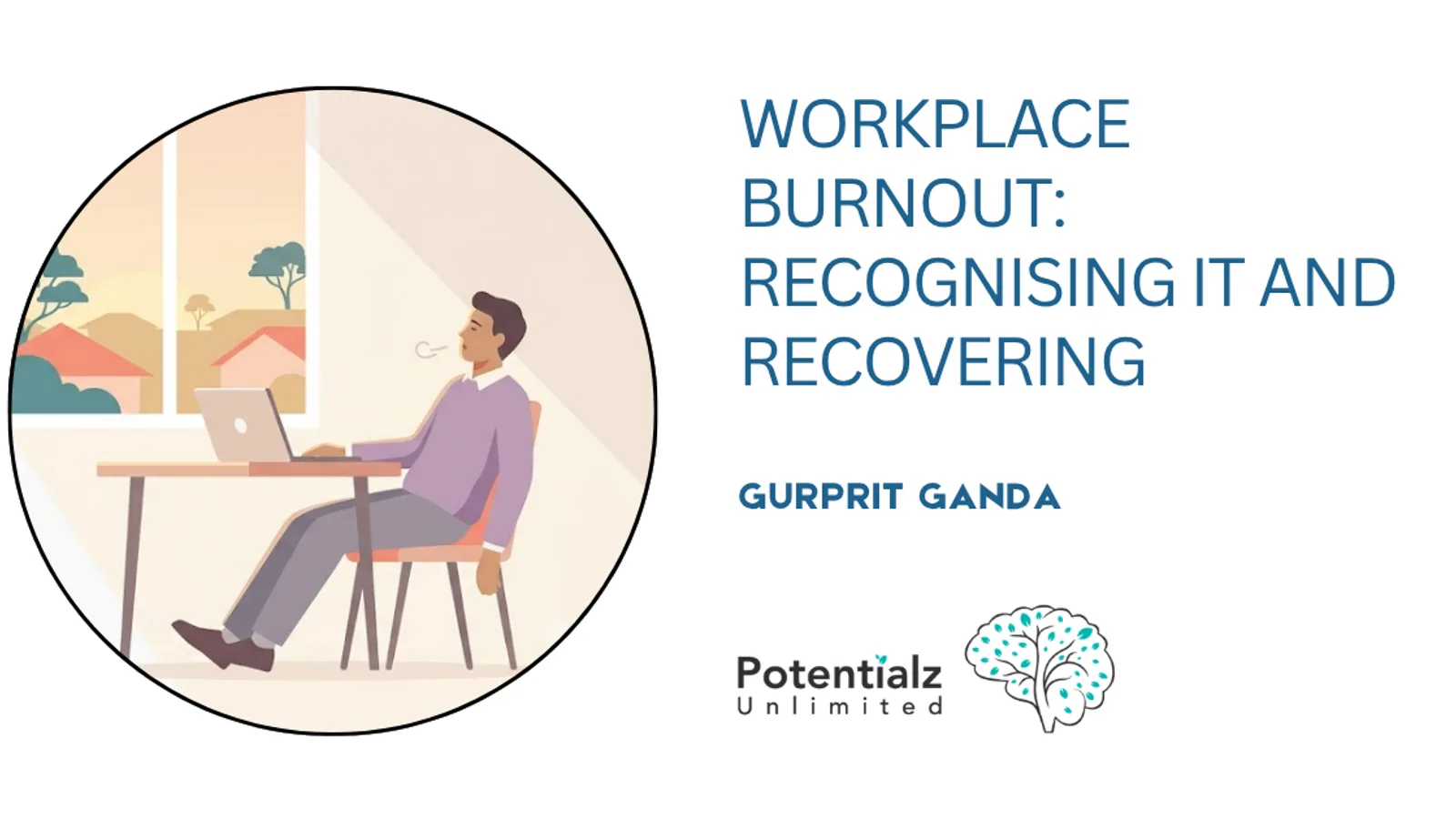
By Sunday afternoon, Marcus could feel it building. A tightness in his chest. A heaviness behind his eyes. He had not even opened his laptop, yet his mind was already racing through tomorrow’s meetings, the emails he had not answered, and the project that kept slipping. He used to love his job. Now he dreaded it.
For months, Marcus had told himself he was just tired. A good weekend would fix it. But the weekends were not fixing it anymore. He felt drained before the day began, snappy with people he cared about, and quietly convinced he was no longer any good at work he had once done with ease.
If this sounds familiar, you are not weak, and you are not failing. This pattern has a name. It is called workplace burnout, and it is something a workplace burnout psychologist in Bella Vista sees often. This article explains what burnout really is, how to recognise it, why it happens, and the evidence-based ways to recover.
What Burnout Actually Is (and Is Not)
It helps to start with what the experts mean by the word. In 2019, the World Health Organization (WHO) included burnout in the eleventh edition of the International Classification of Diseases, known as the ICD-11. The WHO describes burnout as “a syndrome conceptualized as resulting from chronic workplace stress that has not been successfully managed” (World Health Organization, 2019).
Two points matter here. First, burnout is an occupational phenomenon — it is tied to work. The WHO is clear that burnout “should not be applied to describe experiences in other areas of life.” Second, burnout is not classified as a medical condition or a mental illness. It sits in a part of the ICD-11 that covers factors influencing health, not the section for diseases.
So why take it seriously if it is not a diagnosis? Because burnout still has a real impact on your health, your mood, your relationships, and your work. And because the things that cause it can be understood and changed.
Everyday stress is normal. A busy week, a tight deadline, a hard project — these come and go, and most of us bounce back after rest. Burnout is different. It is what can happen when the stress does not let up, the demands keep outpacing your resources, and there is no real chance to recover. Over time, the well runs dry.
The Three Dimensions of Burnout
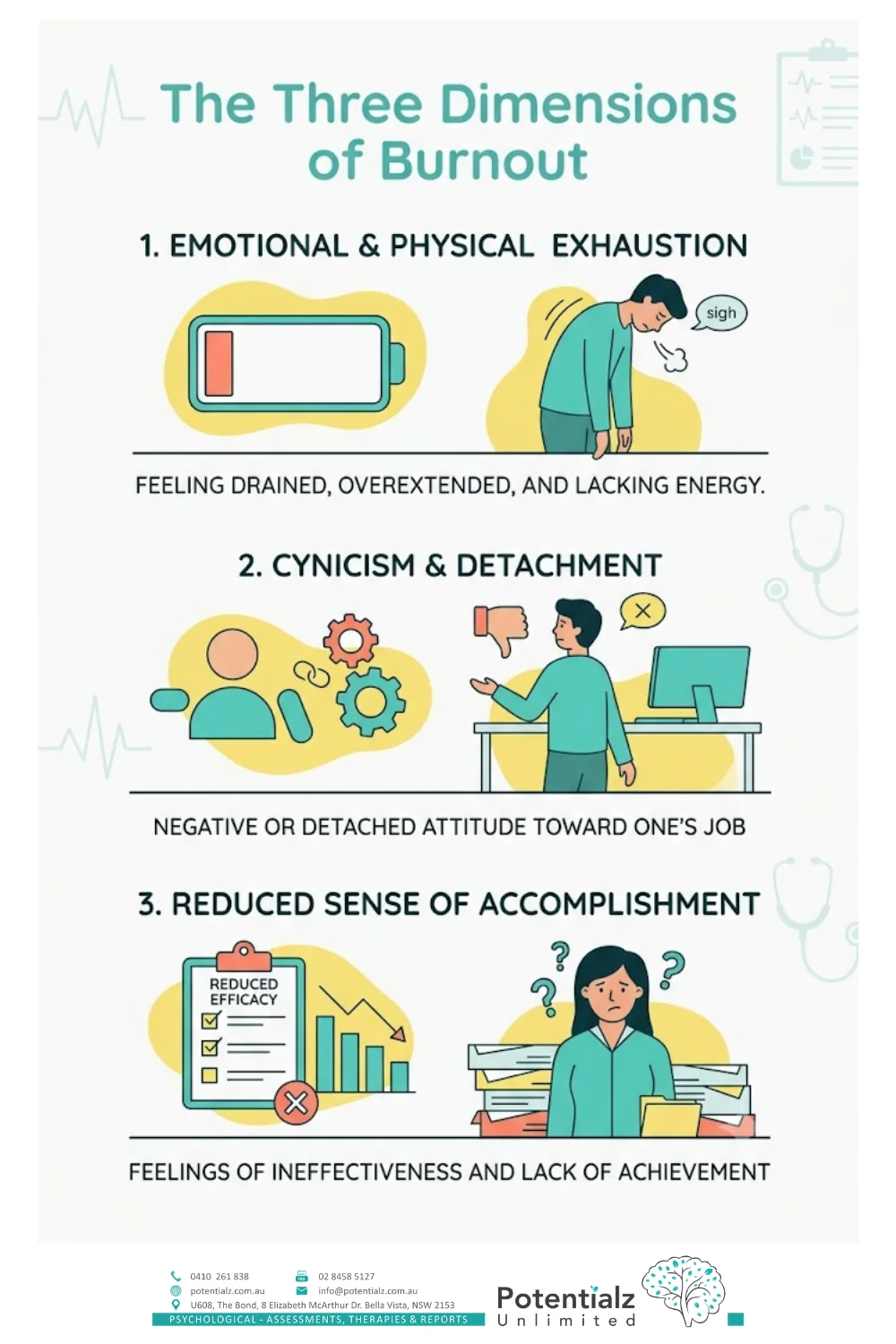
The WHO definition names three dimensions of burnout (World Health Organization, 2019). These match the model developed over decades by researchers Christina Maslach and Michael Leiter, whose Maslach Burnout Inventory is the most widely used burnout measure in the world (Maslach & Leiter, 2016).
- Exhaustion. Feelings of energy depletion or exhaustion. This is the most obvious sign. You feel drained, physically and emotionally, and rest does not seem to refill the tank. You may dread the workday before it starts.
- Cynicism or mental distance. Increased mental distance from your job, or feelings of negativism or cynicism related to it. Work that once felt meaningful starts to feel pointless. You pull back, go through the motions, or become irritable and detached from colleagues and clients.
- Reduced professional efficacy. A sense that you are no longer doing your job well, or that your efforts do not matter. Tasks that were once easy feel hard. Confidence drops, even when your actual performance has not changed much.
Burnout is not just one of these. It is the combination, building up over time. Recognising all three in yourself can be the first step toward taking it seriously rather than pushing through.
Why Burnout Happens: Psychosocial Hazards at Work
Here is one of the most important things to understand: burnout is not simply a personal failing. It is not caused by being weak, lazy, or unable to cope. The research points strongly to the conditions of work itself.
In Australia, work health and safety law now recognises this directly. Safe Work Australia’s model Code of Practice, Managing psychosocial hazards at work, was published in 2022 (Safe Work Australia, 2022). It defines psychosocial hazards as anything in the design or management of work, the working environment, or workplace behaviour that may cause psychological harm.
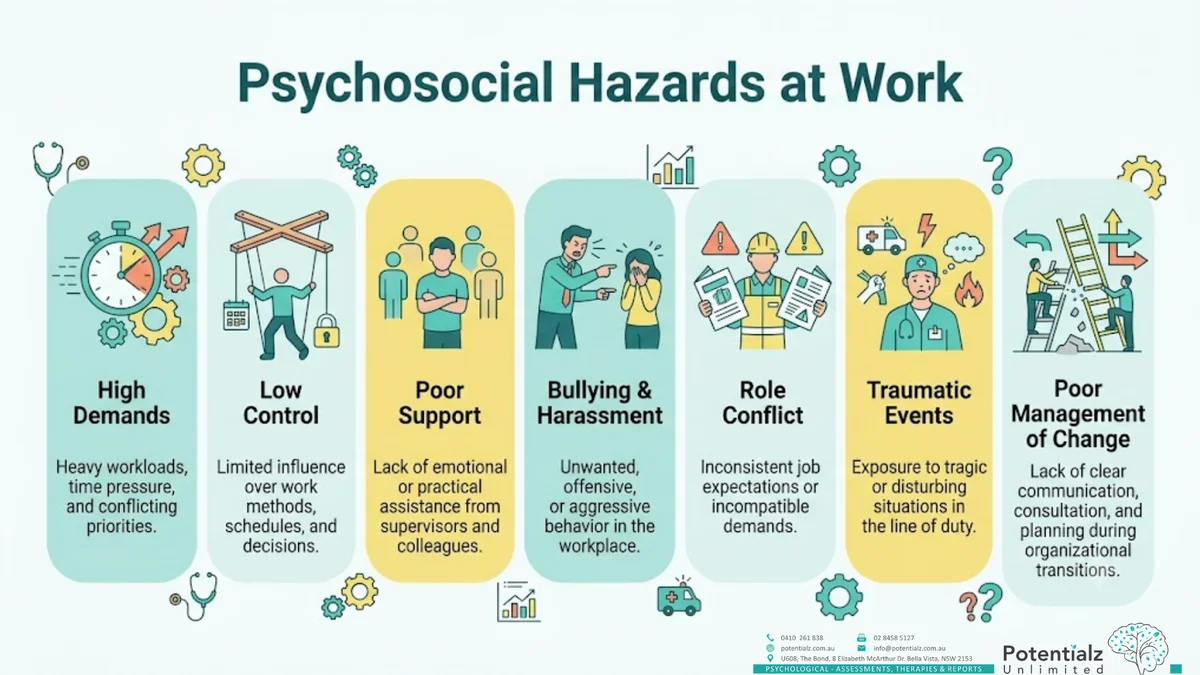
SafeWork NSW lists psychosocial hazards that can drive stress and burnout, including (SafeWork NSW, n.d.):
- High job demands — heavy workloads, unrealistic deadlines, long hours, or doing several roles at once.
- Low job control — little say over how, when, or what work gets done.
- Poor support — not enough help, information, or backing from managers or colleagues.
- Lack of role clarity — unclear or conflicting expectations about your job.
- Poor recognition and reward — effort that goes unnoticed or unappreciated.
- Poor workplace relationships — conflict, incivility, bullying, or harassment.
- Poor organisational change management — change that is poorly planned or communicated.
Maslach and Leiter describe burnout as a mismatch between the person and the job across six areas: workload, control, reward, community, fairness, and values (Maslach & Leiter, 2016). When the demands of work keep outweighing what a person is given to meet them, burnout becomes far more likely. This is why fixing burnout is rarely just about the individual — the work conditions matter too.
Who Is Most at Risk
Burnout can affect anyone, in any job. But some patterns make it more likely. People in caring and “human service” roles — health workers, teachers, social workers, emergency services — face high emotional demands and are well represented in the research (Maslach & Leiter, 2016).
Beyond the type of job, certain conditions raise the risk: chronically high workloads, long hours, low control, and weak support. Personal traits can play a part too. People who are highly conscientious, who find it hard to say no, who tie their self-worth tightly to performance, or who struggle with perfectionism often push past warning signs until the tank is empty. None of this is a character flaw. It simply means the early signs are worth taking seriously.
Burnout vs Depression: An Important Distinction
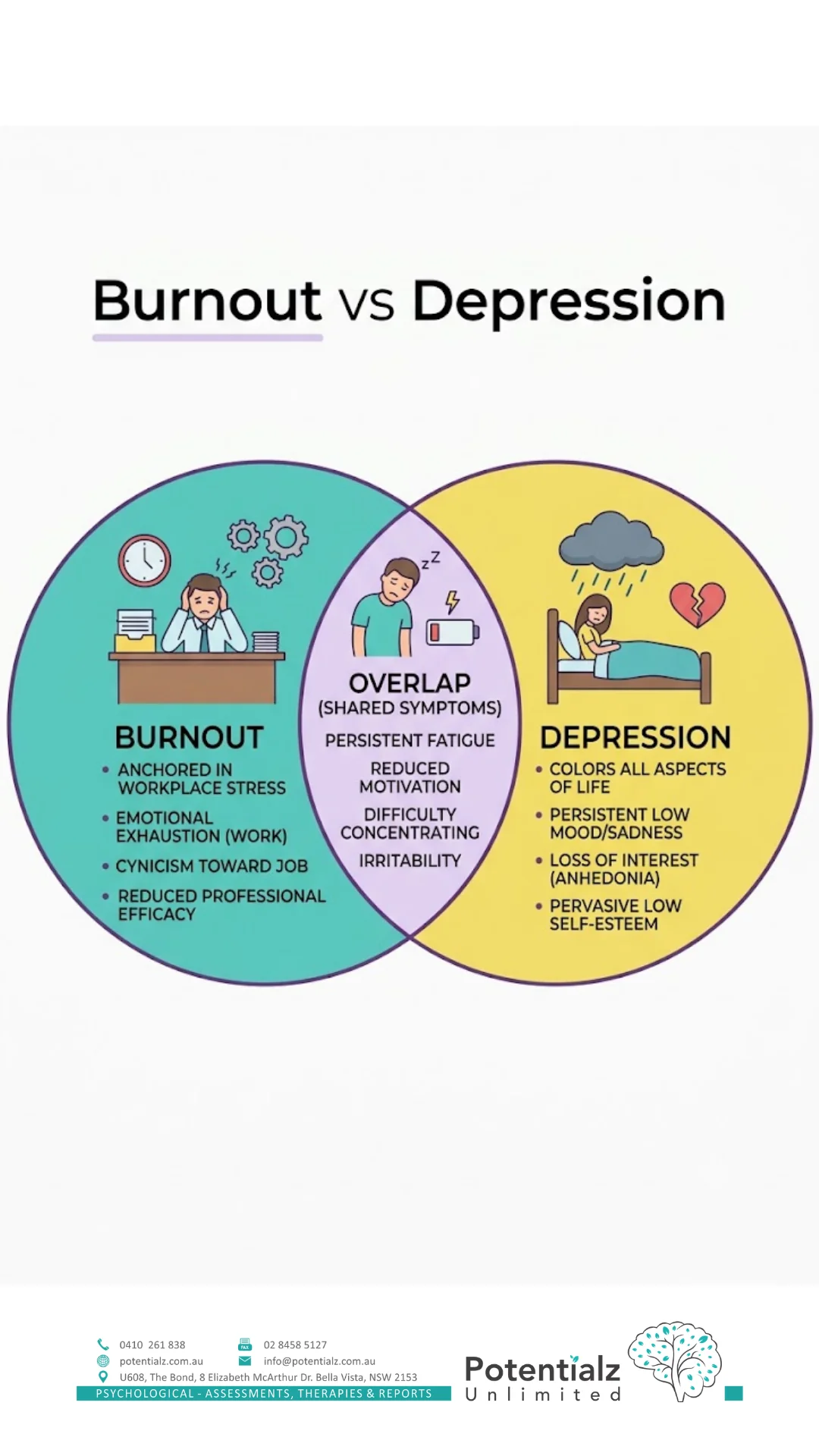
Because burnout and depression share symptoms — exhaustion, low motivation, poor concentration, irritability — they can be hard to tell apart. Research confirms they overlap a great deal. Studies by Bianchi, Schonfeld and colleagues found burnout and depressive symptoms are strongly linked, and a large meta-analysis concluded that exhaustion, the core of burnout, is closely tied to depression (Bianchi et al., 2015; Bianchi et al., 2021).
The practical difference is usually this: burnout is anchored in work. When you are away from the source of stress for long enough, the cloud often begins to lift. Depression tends to colour everything — work, home, hobbies, relationships — and may not ease simply by stepping back from the job.
This distinction matters because it shapes the right support. Sometimes what looks like burnout is, or has become, depression that needs treatment in its own right. This is why a careful assessment with a psychologist is so valuable. If you ever notice low mood that does not lift, loss of interest in things you used to enjoy, or thoughts that life is not worth living, please treat that as a reason to seek help promptly.
The Toll Burnout Takes on Body and Mind
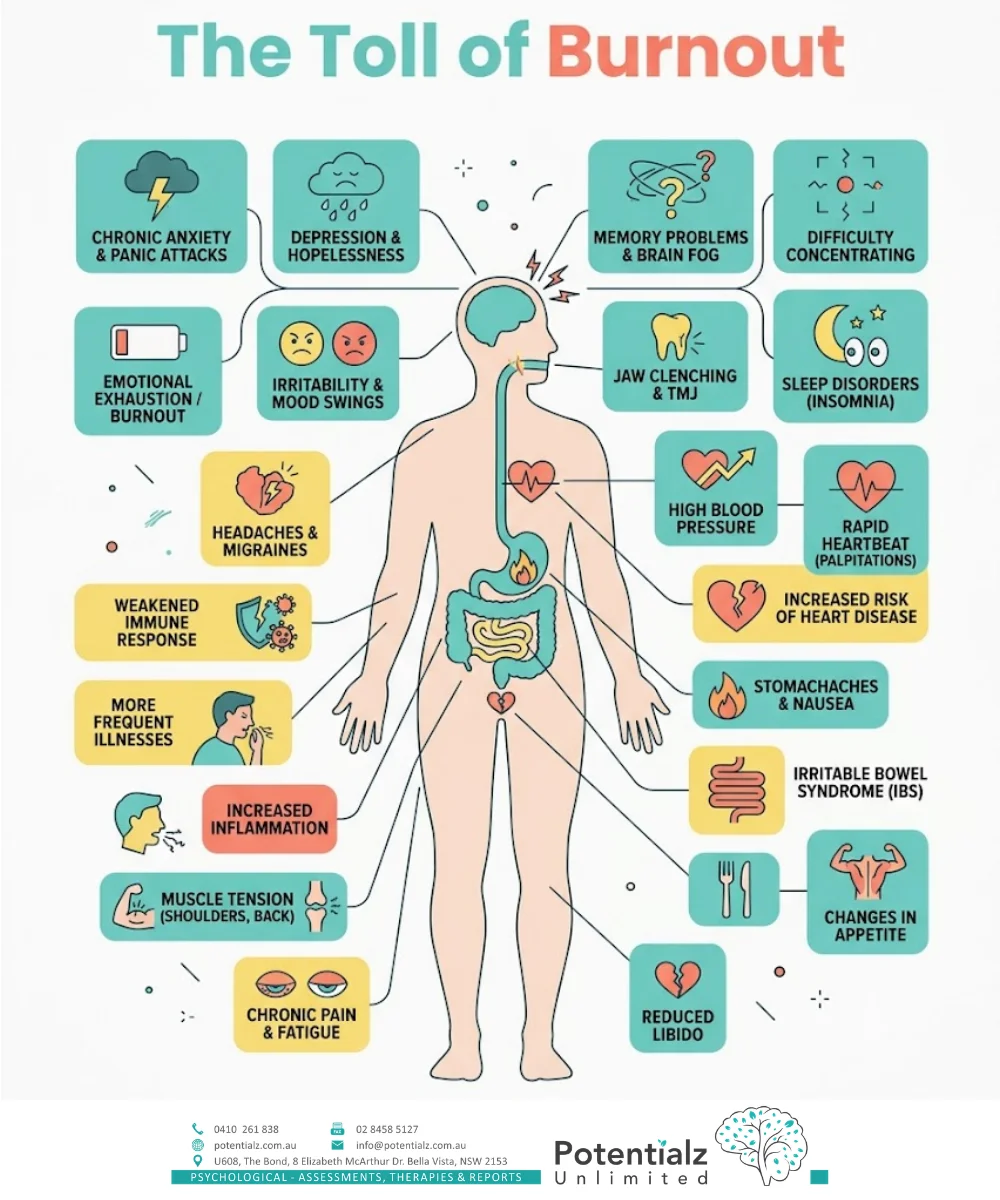
Burnout does not stay neatly at the office. Left unaddressed, chronic work stress affects the whole person.
On the mind, it shows up as low mood, anxiety, poor concentration, and a growing sense of dread or detachment. Sleep often suffers — lying awake replaying the day, or waking exhausted. Relationships strain as patience wears thin and there is little energy left for the people who matter.
The body keeps the score too. Chronic stress has been linked to real physical risks. A large meta-analysis of more than 600,000 people found that working long hours (55 or more per week) was associated with a higher risk of stroke and a modestly raised risk of coronary heart disease, compared with standard hours (Kivimäki et al., 2015). This does not mean a hard week will harm you. It means sustained, unrelenting work stress is worth taking seriously as a health matter, not just a mood one.
Evidence-Based Recovery: What Actually Helps
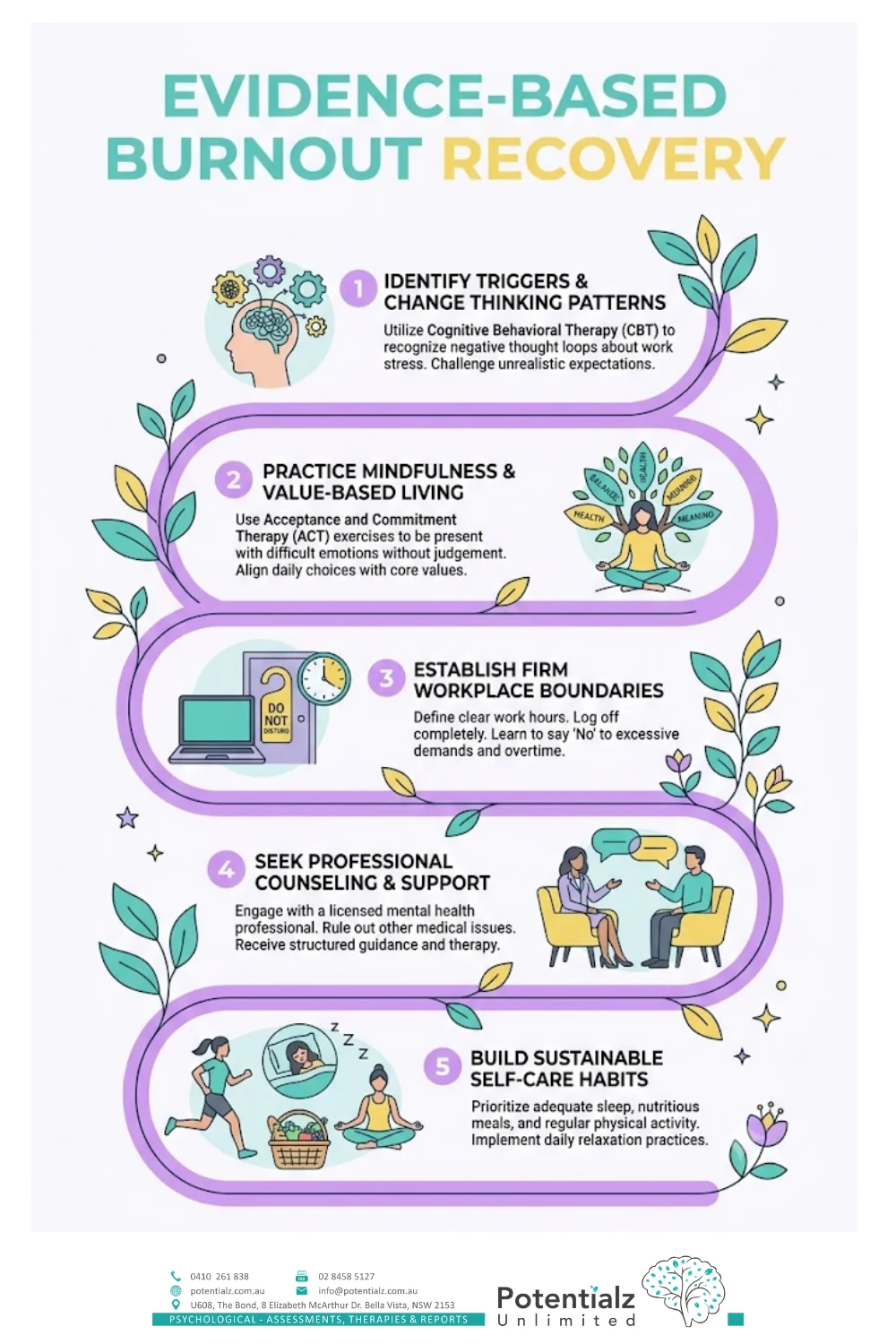
The encouraging news is that burnout can be turned around. Recovery usually works best when it addresses both sides: the personal and the practical. Here is what an evidence-based approach looks like.
1. Restore boundaries and recovery. Burnout is, at heart, an imbalance between demand and recovery. Rebuilding genuine downtime is essential — protected time off, sleep, movement, and switching off from work after hours. Learning to say no, delegate, and set limits is not selfish; it is how the tank refills.
2. Cognitive strategies (CBT). Cognitive behavioural therapy helps you notice and challenge the unhelpful thinking that fuels burnout: “If I don’t do it, no one will,” “Resting means I’m slacking,” “I have to be perfect.” Softening these rigid rules reduces the internal pressure that keeps you pushing past empty.
3. Values and acceptance (ACT). Acceptance and commitment therapy helps you step back from self-critical thoughts and reconnect with what genuinely matters to you. When work has swallowed everything, ACT helps you make room for the rest of life again and take small, values-based steps back toward it.
4. Address the work conditions. Because burnout is driven by psychosocial hazards, lasting recovery often needs change at work too — a more realistic workload, clearer roles, better support, or a conversation with a manager. Australian WHS law now places a duty on employers to manage these hazards (Safe Work Australia, 2022). Sometimes a role or job change is the healthiest path; often, targeted changes are enough.
5. Know when workplace change is needed. If a workplace is unable or unwilling to reduce the hazards driving your burnout, recovery may depend on moving on. This is a significant decision, and it helps to make it thoughtfully, with support, rather than in a moment of crisis.
The Psychologist’s Role in Burnout Recovery
A psychologist does not just hand you a list of tips. The work is collaborative and tailored to you. Together, you map out where your burnout is coming from across those three dimensions and six mismatch areas, sort burnout from depression or anxiety where they overlap, and build a plan that fits your real life and real job.
Dr Gurprit Ganda draws on CBT, ACT, and EMDR, blending personal strategies with practical problem-solving about the work itself. The aim is not to make you “tougher” so you can absorb more stress. It is to help you recover, protect your wellbeing, and build a sustainable relationship with work. You can read more about our related work on workplace stress and resilience and how to manage work-related stress.
Burnout Support in Bella Vista and the Hills District
Potentialz Unlimited is based in Bella Vista, NSW, and supports working people and families across the Hills District — including Norwest, Castle Hill, Baulkham Hills, Kellyville, Rouse Hill, and Glenhaven.
We understand the pressures of working life in this part of Sydney: long commutes, demanding corporate and small-business roles, shift work, and the juggle of career and family. Dr Gurprit Ganda is a Clinical Psychologist with more than 25 years of experience and AHPRA Clinical Endorsement. She offers a warm, practical, judgement-free space where burnout is taken seriously and addressed with proven methods. Burnout also overlaps with family life, and if the exhaustion you feel is closer to home, our guide on parental burnout and mental health may help. You can contact the clinic or book directly at live.potentialz.com.au.
When to Seek Help
It may be time to speak with a psychologist if you notice that:
- You feel exhausted most days, and rest does not seem to recharge you.
- You have grown cynical, detached, or negative about a job you once cared about.
- You doubt your ability to do work you used to do well.
- The stress is affecting your sleep, mood, health, or relationships.
- You have been pushing through for months, telling yourself it will pass.
You do not have to wait until you hit a wall. Earlier support usually means a smoother, shorter recovery.
If low mood or stress ever brings thoughts of not wanting to be here, please reach out for urgent support now: call Lifeline on 13 11 14, or in an emergency call 000.
Burnout is common, understandable, and recoverable. With the right support — and the right changes — you can refill the tank, reconnect with what matters, and build a working life that does not cost you your wellbeing.
References
Bianchi, R., Schonfeld, I. S., & Laurent, E. (2015). Burnout–depression overlap: A review. Clinical Psychology Review, 36, 28–41. https://doi.org/10.1016/j.cpr.2015.01.004
Bianchi, R., Verkuilen, J., Schonfeld, I. S., Hakanen, J. J., Jansson-Fröjmark, M., Manzano-García, G., Laurent, E., & Meier, L. L. (2021). Is burnout a depressive condition? A 14-sample meta-analytic and bifactor analytic study. Clinical Psychological Science, 9(4), 579–597. https://doi.org/10.1177/2167702620979597
Kivimäki, M., Jokela, M., Nyberg, S. T., Singh-Manoux, A., Fransson, E. I., Alfredsson, L., Bjorner, J. B., Borritz, M., Burr, H., Casini, A., Clays, E., De Bacquer, D., Dragano, N., Erbel, R., Geuskens, G. A., Hamer, M., Hooftman, W. E., Houtman, I. L., Jöckel, K.-H., … Virtanen, M. (2015). Long working hours and risk of coronary heart disease and stroke: A systematic review and meta-analysis of published and unpublished data for 603,838 individuals. The Lancet, 386(10005), 1739–1746. https://doi.org/10.1016/S0140-6736(15)60295-1
Maslach, C., & Leiter, M. P. (2016). Understanding the burnout experience: Recent research and its implications for psychiatry. World Psychiatry, 15(2), 103–111. https://doi.org/10.1002/wps.20311
Safe Work Australia. (2022). Model code of practice: Managing psychosocial hazards at work. https://www.safeworkaustralia.gov.au/doc/model-code-practice-managing-psychosocial-hazards-work
SafeWork NSW. (n.d.). Code of practice: Managing psychosocial hazards at work. https://www.safework.nsw.gov.au/resource-library/list-of-all-codes-of-practice/codes-of-practice/managing-psychosocial-hazards-at-work
World Health Organization. (2019, May 28). Burn-out an “occupational phenomenon”: International Classification of Diseases. https://www.who.int/news/item/28-05-2019-burn-out-an-occupational-phenomenon-international-classification-of-diseases
Related Reading
If this is affecting you or someone close to you, you can speak with a burnout psychologist in Bella Vista.
Knowledge Check Quiz
Test what you have just read. Choose your answer for each question, then submit to reveal the answers and your score.
Need Professional Support?
If you're experiencing mental health concerns, our team is here to help.