The Email She Read Eleven Times Before Sending
Priya stared at the screen. Her manager had just added another project to her week, and her week was already full. She had typed a reply, deleted it, and started again. Eleven times. Each version felt either too soft (“No worries, happy to help!” — even though she was not happy) or too sharp (“This isn’t fair”).
In the end she sent the soft one. Then she went home, lay awake, and felt the familiar mix of resentment and self-blame. Why could she never just say what she meant?
If you recognise that feeling, you are not weak and you are not alone. Speaking up clearly, kindly, and without guilt is a skill called assertiveness. The good news is that it can be learned. This article explains what assertiveness really is, why so many of us struggle with it, and how therapy and structured assertiveness training build it, with support from an assertiveness and communication psychologist in Bella Vista.
What Assertiveness Is (and What It Is Not)

Assertiveness is the ability to express your thoughts, feelings, and needs in a way that is honest and direct, while still respecting the rights and feelings of other people (Alberti & Emmons, 2017). It is the steady middle ground between two less helpful styles: staying silent and giving in, or pushing your needs onto others.
Being assertive does not mean getting your own way every time. It does not mean being loud, blunt, or difficult. And it is not about winning. It is about being clear. An assertive person can say “yes,” “no,” and “I’d like to talk about this” with the same calm confidence.
People often confuse assertiveness with selfishness. In truth, it is one of the most respectful ways to communicate, because it treats both you and the other person as equals who deserve to be heard.
The Four Communication Styles
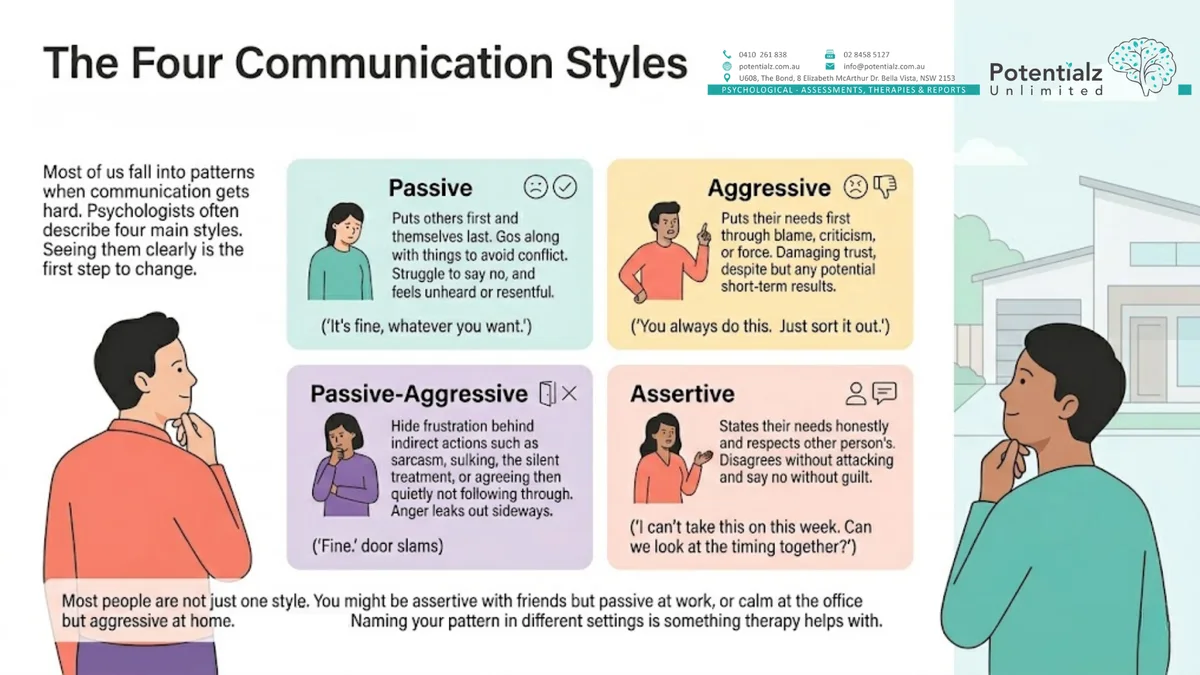
Most of us fall into patterns when communication gets hard. Psychologists often describe four main styles. Seeing them clearly is the first step to change.
- Passive. You put others first and yourself last. You go along with things to avoid conflict, struggle to say no, and often feel unheard or resentful. (“It’s fine, whatever you want.”)
- Aggressive. You put your needs first, sometimes through blame, criticism, or force. You may get short-term results but damage trust. (“You always do this. Just sort it out.”)
- Passive-aggressive. You hide frustration behind indirect actions: sarcasm, sulking, the silent treatment, or agreeing then quietly not following through. The anger leaks out sideways. (“Fine.” door slams)
- Assertive. You state your needs honestly and respect the other person’s. You can disagree without attacking and say no without guilt. (“I can’t take this on this week. Can we look at the timing together?”)
Most people are not just one style. You might be assertive with friends but passive at work, or calm at the office but aggressive at home. Naming your pattern in different settings is something therapy helps with.
Why So Many People Struggle to Speak Up
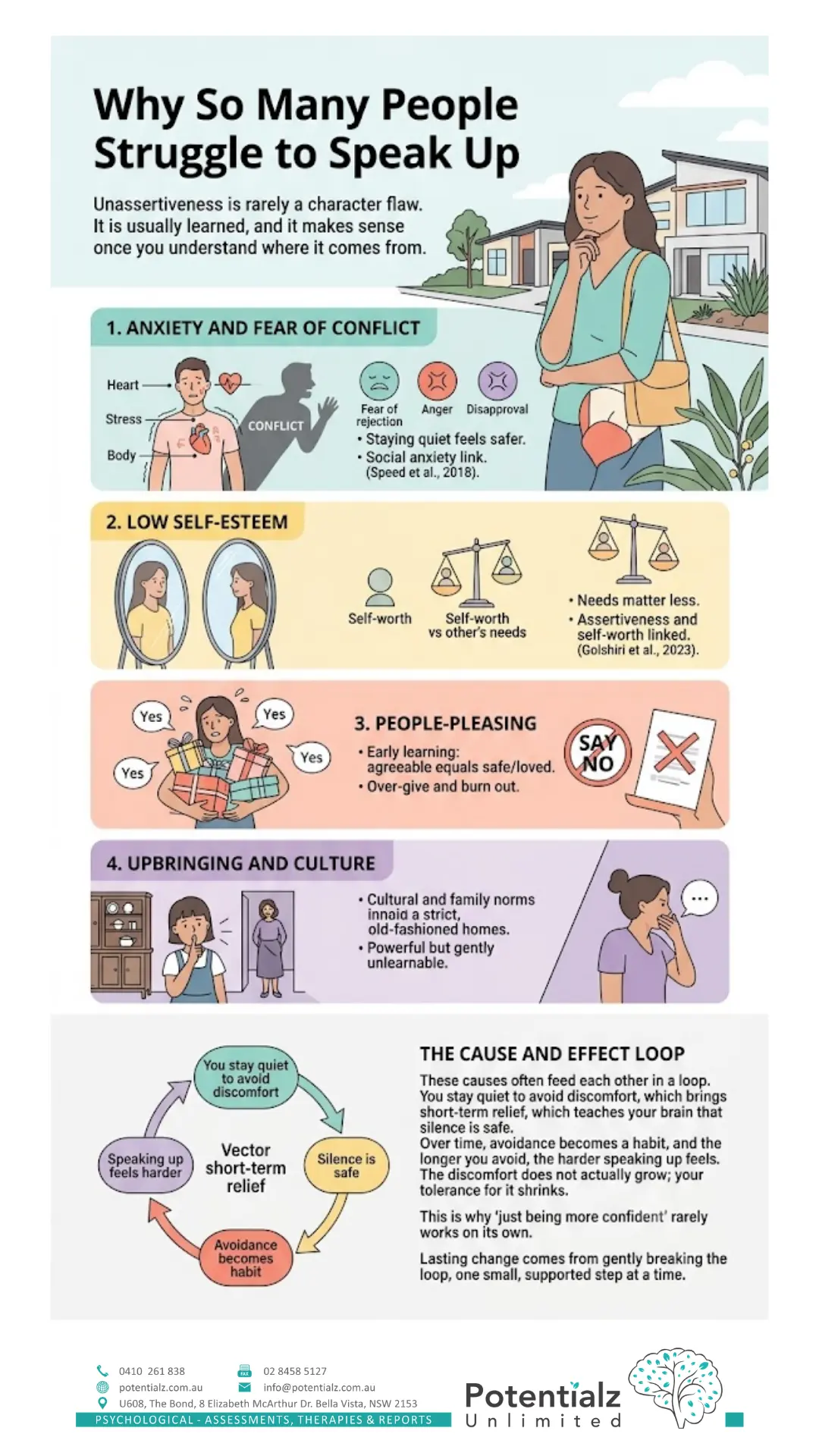
Unassertiveness is rarely a character flaw. It is usually learned, and it makes sense once you understand where it comes from.
Anxiety and fear of conflict. For many people, the body reacts to a hard conversation as if it were a threat. The fear of rejection, anger, or disapproval feels so strong that staying quiet seems safer. This link is especially clear in social anxiety, where speaking up can feel risky (Speed et al., 2018).
Low self-esteem. If you quietly believe your needs matter less than other people’s, you will struggle to voice them. Assertiveness and self-worth are closely tied, and they tend to rise together (Golshiri et al., 2023).
People-pleasing. Some of us learned early that being agreeable kept us safe or loved. Saying no can then feel selfish or even dangerous, so we over-give and burn out.
Upbringing and culture. Many people grew up in homes where children were told to be seen and not heard, or where speaking up was punished. Cultural and family norms shape how comfortable we feel asserting ourselves as adults. These are powerful, but they can be gently unlearned.
These causes often feed each other in a loop. You stay quiet to avoid discomfort, which brings short-term relief, which teaches your brain that silence is safe. Over time, avoidance becomes a habit, and the longer you avoid, the harder speaking up feels. The discomfort does not actually grow; your tolerance for it shrinks. This is why “just being more confident” rarely works on its own. Lasting change comes from gently breaking the loop, one small, supported step at a time.
How Therapy Builds Assertiveness
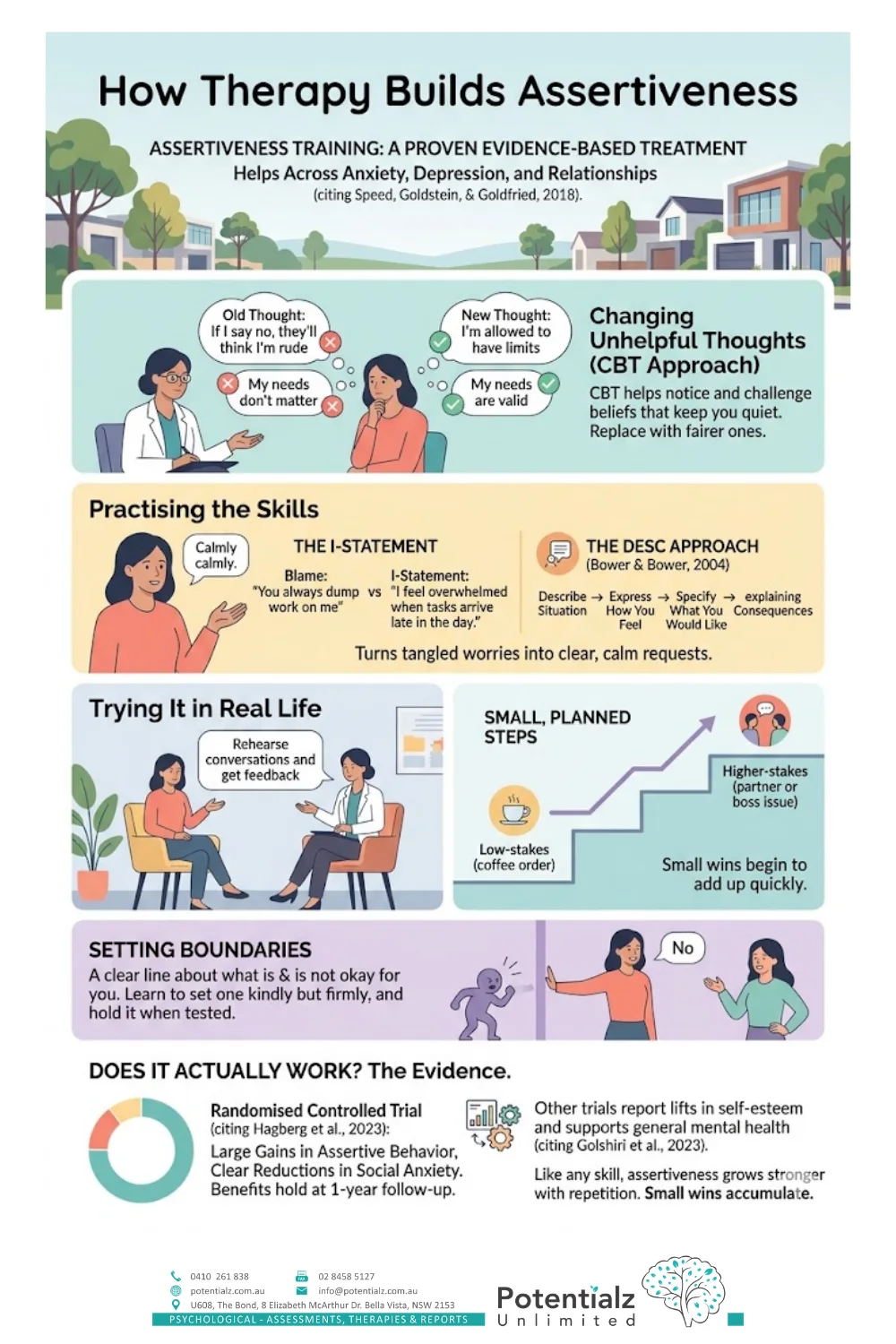
Assertiveness training has a long and solid evidence base. In a widely cited review, Speed, Goldstein, and Goldfried (2018) called it a “forgotten evidence-based treatment,” noting decades of research showing it helps across anxiety, depression, and relationship difficulties. Modern therapy weaves it into approaches like Cognitive Behavioural Therapy (CBT). Effective assertiveness training usually has three parts (Hagberg et al., 2023).
1. Changing unhelpful thoughts. CBT helps you notice and challenge the beliefs that keep you quiet, such as “If I say no, they’ll think I’m rude” or “My needs don’t matter.” Your psychologist helps you test these thoughts and replace them with fairer ones, like “I’m allowed to have limits.”
2. Practising the skills. A core tool is the I-statement: naming your feeling and the situation without blame. “I feel overwhelmed when tasks arrive late in the day” lands very differently from “You always dump work on me.” Therapists also teach the DESC approach (Bower & Bower, 2004): Describe the situation, Express how you feel, Specify what you would like, and explain the Consequences. It turns a tangled worry into a clear, calm request.
3. Trying it in real life. Role-play in sessions lets you rehearse hard conversations in a safe space and get feedback. Then you take small, planned steps in daily life, building from low-stakes moments (sending back a wrong coffee order) to bigger ones (raising an issue with a partner or boss). This is similar to how a CBT psychologist in Bella Vista approaches anxiety: gradual, practised, and supported.
Setting boundaries is a key part of this work. A boundary is simply a clear line about what is and is not okay for you. Learning to set one kindly but firmly, and to hold it when it is tested, is often where the biggest change happens.
Does it actually work? The evidence is encouraging. A randomised controlled trial of a structured assertiveness programme found large gains in assertive behaviour and clear reductions in social anxiety, with benefits holding at a one-year follow-up (Hagberg et al., 2023). Other trials report that assertiveness training also lifts self-esteem and supports general mental health (Golshiri et al., 2023). In plain terms: these are practised skills, and like any skill, they grow stronger with repetition. Many people are surprised by how quickly small wins begin to add up once they start.
Assertiveness Is Not Aggression
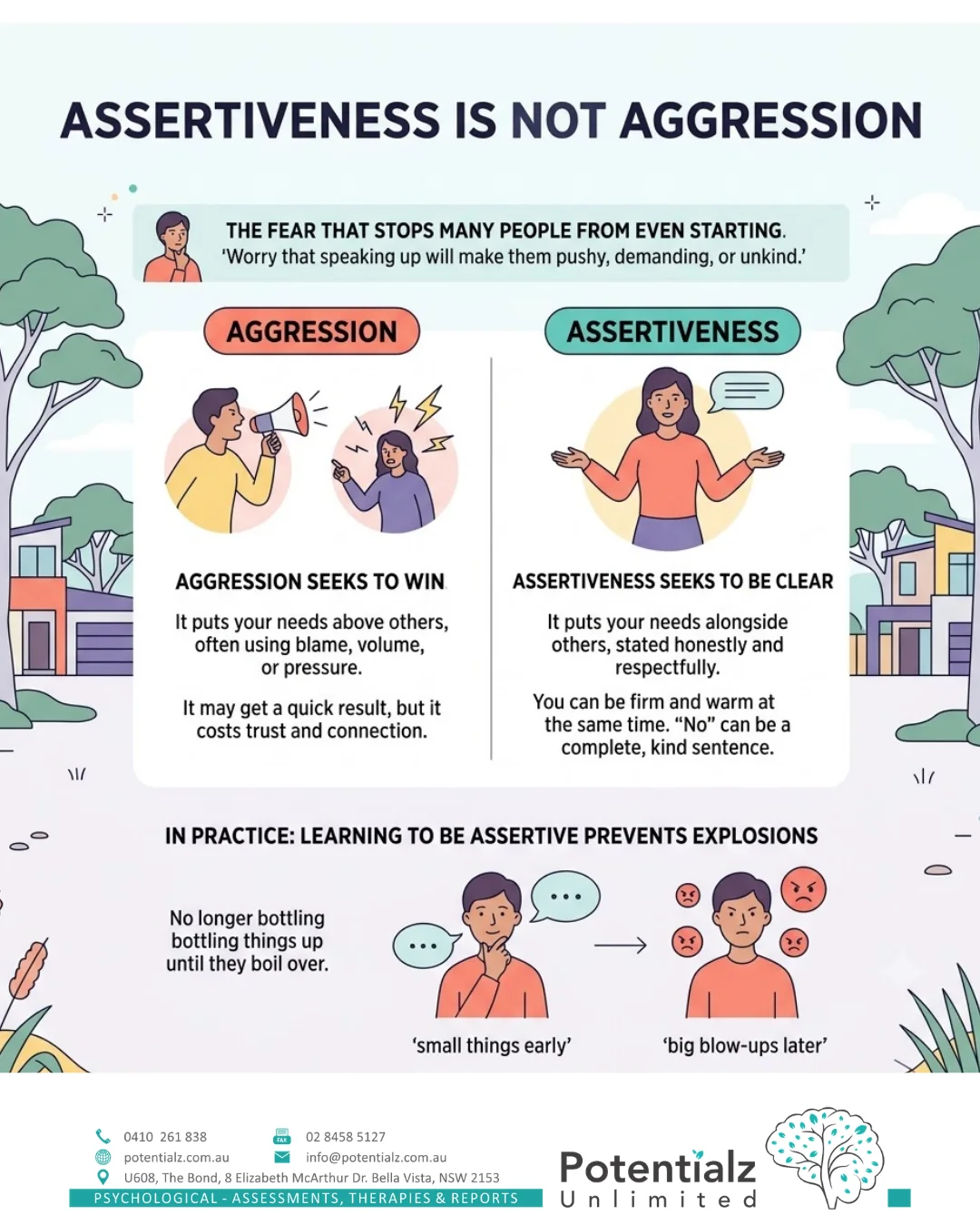
This is the fear that stops many people from even starting. They worry that speaking up will make them pushy, demanding, or unkind. So it is worth saying plainly: assertiveness and aggression are not the same.
Aggression seeks to win. It puts your needs above others, often using blame, volume, or pressure. It may get a quick result, but it costs trust and connection.
Assertiveness seeks to be clear. It puts your needs alongside others, stated honestly and respectfully. You can be firm and warm at the same time. “No” can be a complete, kind sentence.
In practice, learning to be assertive often makes people less likely to explode, because they no longer bottle things up until they boil over. Saying the small thing early prevents the big blow-up later.
At Work and in Relationships
Assertiveness shows up everywhere, but two areas matter most for everyday wellbeing.
At work. Assertive communication helps you negotiate workload, ask for what you need, give and receive feedback, and protect your time. Strong communication is consistently ranked among the skills employers value most (National Association of Colleges and Employers, 2024). Without it, people quietly overcommit, miss credit for their work, and slide toward burnout. Picture Priya from the start of this article. The assertive reply she could not find might have been simple: “I’d like to take this on, but my week is full. Can we look at what to move, or push the timing?” It is honest, respectful, and solves the real problem, all without guilt or blame. That single sentence protects her workload and her relationship with her manager at the same time.
In relationships. This is where I-statements and boundaries change daily life. Partners who can each say what they feel and need, and truly listen in return, have fewer cold wars and more genuine closeness. Assertiveness pairs naturally with active listening, and together they form the backbone of healthy, lasting relationships. Saying what you mean, and hearing what they mean, builds trust on both sides.
Assertiveness Support in Bella Vista and the Hills District
You do not have to untangle this alone. Potentialz Unlimited is based in Bella Vista and supports people right across the Hills District, including Baulkham Hills, Castle Hill, Kellyville, Rouse Hill, Norwest, and the wider Sydney Hills area.
Dr Gurprit Ganda is a clinical psychologist with more than 25 years of experience. She draws on CBT, ACT, and EMDR to help people who feel stuck in passive, people-pleasing, or conflict-avoidant patterns. Together you can map your communication style, gently shift the beliefs holding you back, and practise real assertiveness skills you can use at work and at home. You can meet the team or get in touch to ask any questions first.
When to Seek Support
Plenty of people benefit from professional support to build assertiveness. It may be worth reaching out if you:
- Often agree to things you do not want to do, then feel resentful.
- Lie awake replaying conversations, wishing you had spoken up.
- Avoid conflict so much that problems pile up unspoken.
- Feel anxious, shaky, or sick at the thought of saying no.
- Swing between staying silent and then exploding.
- Notice your communication style is straining your work or relationships.
None of these mean anything is wrong with you. They are common, learned patterns, and they respond well to support. If they are affecting your mood, sleep, or relationships, a psychologist can help. You can book online at live.potentialz.com.au.
This article is general information and is not a substitute for personalised advice from a qualified health professional. If you are in crisis or need urgent help, contact Lifeline on 13 11 14 or call 000 in an emergency.
References
Alberti, R. E., & Emmons, M. L. (2017). Your perfect right: Assertiveness and equality in your life and relationships (10th ed.). Impact Publishers.
Bower, S. A., & Bower, G. H. (2004). Asserting yourself: A practical guide for positive change (Updated ed.). Da Capo Press.
Golshiri, P., Mostofi, A., & Rouzbahani, S. (2023). The effect of problem-solving and assertiveness training on self-esteem and mental health of female adolescents: A randomized clinical trial. BMC Psychology, 11, Article 106. https://doi.org/10.1186/s40359-023-01154-x
Hagberg, T., Manhem, P., Oscarsson, M., Michel, F., Andersson, G., & Carlbring, P. (2023). Efficacy of transdiagnostic cognitive-behavioral therapy for assertiveness: A randomized controlled trial. Internet Interventions, 32, Article 100629. https://doi.org/10.1016/j.invent.2023.100629
National Association of Colleges and Employers. (2024). Job outlook 2024. https://www.naceweb.org/
Speed, B. C., Goldstein, B. L., & Goldfried, M. R. (2018). Assertiveness training: A forgotten evidence-based treatment. Clinical Psychology: Science and Practice, 25(1), Article e12216. https://doi.org/10.1111/cpsp.12216
Related Reading
Knowledge Check Quiz
Test what you have just read. Choose your answer for each question, then submit to reveal the answers and your score.
Need Professional Support?
If you're experiencing mental health concerns, our team is here to help.