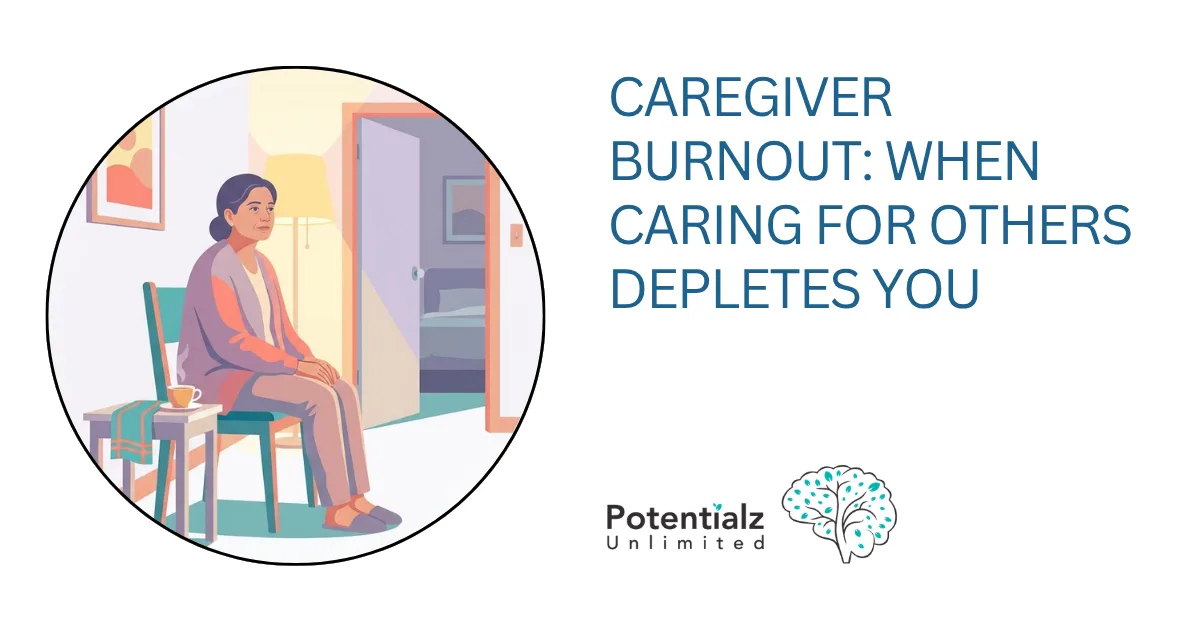
Caregiver Burnout: When Caring for Others Depletes You
Key Takeaways
- Caregiver burnout is emotional, physical, and cognitive exhaustion from the sustained demands of caring for another person. It is distinct from ordinary tiredness.
- In one US national survey during the pandemic, 66.6% of unpaid carers of adults reported mental or behavioural health symptoms, and 30.7% had seriously considered suicide in the previous 30 days against 3.6% of non-carers. In a two-year Dutch study of spousal carers of people with dementia, 60% developed a diagnosable depressive or anxiety disorder.
- The biggest barrier to caregivers seeking help is often guilt: the belief that having needs of their own is a form of neglect of the person they are caring for.
- Cultural expectations — particularly in Indian and South Asian families — add an additional layer of obligation and shame around acknowledging caregiver struggle.
- CBT, ACT, and Mindfulness-based approaches each offer specific and clinically meaningful tools for caregiver mental health.
- Psychology sessions for the caregiver themselves — not just the person with the condition — are a legitimate and important use of mental health services. Medicare and NDIS both provide pathways.
- Seeking support is not abandoning the person you care for. It is the sustainable basis for continuing to care for them.
Introduction: The People Nobody Asks About
There is a person in almost every family who carries more than their share. They are the one who attends every medical appointment, manages the medications, navigates the NDIS paperwork, advocates at the school, or sits with an ageing parent who no longer knows their name. They do these things not because they were formally appointed or because they were specifically trained — but because they love someone who needs them, and they were there.
At Potentialz Unlimited, our psychologists work with many people who come to us not because they have been identified as needing support — but because they have finally reached a point where they can no longer keep going. The person caring for a husband with a severe spinal injury, navigating WorkCover and managing a family on a single income. The mother of a child with autism who has been fighting every battle herself for ten years. The daughter whose elderly parents moved in when they could no longer manage alone, who is now managing three households and her own professional career, and who stopped sleeping properly eighteen months ago.
These are caregivers. And in our clinical experience, they are among the most genuinely depleted people we see.
This post is about caregiver burnout: what it is, why it happens, what the research shows about its impact, and what evidence-based psychological support looks like for the person who is doing the caring.
Who Caregivers Are
The word “caregiver” — or “carer” in Australian usage — covers an enormous range of people and circumstances. What they share is an ongoing responsibility for the wellbeing of another person that significantly shapes their own daily life.
Across the clinical experience of our psychologists, caregivers include:
Family members caring for ageing parents: adult children who are managing the gradual or sudden decline of a parent — coordinating medical care, often managing daily assistance with personal care, navigating the healthcare and aged care systems, and managing their own grief about what is being lost.
Partners and spouses of people with chronic illness or disability: living with the realities of a partner’s depression, anxiety disorder, physical disability, brain injury, or chronic pain — bearing the weight of managing a household where one person cannot contribute as they once did, maintaining the emotional support, and often becoming the de facto case manager for their partner’s care.
Parents of children with disability or complex needs: in particular, parents of children on the NDIS — managing therapy schedules, school meetings, specialist appointments, NDIS reviews and plan management, as well as the daily caregiving reality of a child whose needs are significantly greater than a typically developing child. This is a population our psychologists work with extensively.
Spouses of people with work injuries: through experience with WorkCover presentations, our psychologists work with families where a partner’s workplace injury has changed the entire structure of the household — roles, finances, intimacy, and the emotional climate of the family. The uninjured partner often carries this burden entirely alone.
Informal community caregivers: people who are not receiving formal recognition as carers but who are providing significant unpaid support to friends, neighbours, or community members — often migrants and refugees who are supporting fellow community members navigating an unfamiliar system.
What unites all of these people is that their caregiving role is largely invisible. Society recognises and celebrates caregiving as an expression of love and commitment. It is less willing to acknowledge that caregiving is also work — demanding, often thankless, frequently without clear limits, and progressively depleting when done without adequate support.
The Hidden Toll: What the Research Shows
The research on caregiver mental health is unambiguous — and it is sobering.
In a large US national survey taken during the COVID-19 pandemic, 66.6% of unpaid carers of adults reported at least one adverse mental or behavioural health symptom, against roughly a third of people who were not caring for anyone. In the same survey, 30.7% of unpaid carers had seriously considered suicide in the previous 30 days, compared with 3.6% of non-carers — about 8.5 times the rate (Czeisler et al., 2020). That was one cross-sectional survey of 5,470 people in an extraordinary period, so it is a snapshot rather than a settled rate. It is still the clearest published signal of how far carer distress can run. If any of this is where you are right now, the crisis and support numbers at the end of this article are there for exactly this, and Lifeline is 13 11 14, 24 hours a day.
More strikingly: a two-year study followed 181 spousal carers of people with dementia, none of whom had a depressive or anxiety disorder at the outset. 60% developed one: 37% a depressive disorder, 55% an anxiety disorder, and 32% both (Joling et al., 2015). Findings like this are rarely mentioned in public conversations about caregiving — which tend to focus on the dedication and love involved, rather than the clinical reality of what sustained caregiving does to a person’s mental health.
Additional findings from the research:
- Caregivers have significantly elevated rates of depression and anxiety compared to non-caregivers
- Caregiver stress is associated with measurable immune system suppression — caregivers get sick more often and take longer to recover
- Caregiver burden is associated with shortened telomere length — a biological marker of cellular ageing. Sustained caregiving stress appears to accelerate biological ageing
- Female caregivers — who carry a disproportionate share of caregiving responsibility — have significantly worse health outcomes than male caregivers, and worse outcomes than women who are not in caregiving roles
These are not minor findings. Caregiver burnout is a serious public health issue that receives a fraction of the clinical attention it deserves.
What Caregiver Burnout Is
Caregiver burnout is not the same as ordinary tiredness. Ordinary tiredness resolves with rest. Burnout does not.
Burnout — first described by Herbert Freudenberger in the 1970s and subsequently developed by Christina Maslach — involves three core dimensions:
-
Emotional exhaustion: a deep, pervasive depletion of emotional resources. The feeling of having nothing left to give. Not just tiredness at the end of a hard day, but a fundamental emptiness that rest does not adequately restore.
-
Depersonalisation and detachment: becoming emotionally distant from the person being cared for — the flat, mechanical performance of caregiving tasks without the warmth and engagement that once characterised it. For many caregivers, this is the most distressing symptom: feeling numb or detached toward someone they love deeply, and interpreting this as evidence that something is wrong with them rather than as a symptom of burnout.
-
Reduced sense of personal accomplishment: the progressive erosion of the sense that the caregiving is making a difference. Feeling trapped. Feeling that everything is pointless. Struggling to see a future.
Caregiver burnout builds gradually. There is usually not a single identifiable moment when it began. What caregivers most often describe is a progressive narrowing — of social life, personal interests, professional engagement, physical health, and ultimately of a sense of self outside the caregiving role.
The pattern is close kin to the one described in parental burnout and mental health, where the same belief — that your own needs come last — does the same damage, and it shares its shape with burnout in professionals.
Why Caregivers Don’t Seek Help
In our clinical experience, caregivers seek help late — if at all. The barriers are specific and powerful.
“They need me”: The most common statement our psychologists hear from caregivers is some version of this. The conviction that the person they are caring for cannot manage without them. That if they take time for themselves — or admit they are struggling — the person they care for will be worse off. This belief is often factually accurate to a degree, which makes it particularly resistant to challenge. But it operates without reference to the cost being paid by the caregiver, and without recognition that a burned-out carer is not actually an effective carer.
“Who would look after them?”: The practical reality of caregiving often means that taking time away from the caregiving role feels genuinely impossible. There is no obvious substitute. There is no easy handover. This is a real practical barrier — but it is also a cognitive barrier that often prevents caregivers from even investigating what support is available.
Guilt about having needs: Many caregivers have internalised the belief — often implicitly, sometimes explicitly — that having their own needs, desires, or limits is a form of selfishness. That the right response to caregiving is to give endlessly and without complaint. And that feeling resentful, exhausted, or depleted is evidence of moral failure rather than of human limitation.
The identity investment in being a carer: For some caregivers — particularly those who have been in the role for many years — the caregiving role has become central to their identity. Acknowledging burnout feels like threatening that identity.
For CALD Caregivers: Cultural Expectations and the Invisible Burden
In our clinical work with clients from Indian and South Asian backgrounds — as well as from other CALD communities across the Hills District — caregiver burnout presents with specific cultural dimensions that deserve direct acknowledgment.
In many South Asian families, the care of elderly parents within the family home is not a choice — it is a cultural expectation. Family care is a duty, and this duty is often distributed unevenly: it falls primarily on daughters-in-law or daughters, and it is expected to be performed without complaint. In this cultural context, seeking professional help for caregiver stress can feel like admitting that you are not managing your duty — which carries enormous shame implications.
Our psychologists have worked with many women from Indian, Sri Lankan, and Pakistani backgrounds who have been caring for elderly parents or parents-in-law — often with minimal support from other family members — while also managing their own families, professional roles, and the challenges of life in Australia. The cultural expectations they carry — to be selfless, to put family first, to not complain — are not simply self-imposed. They are held in place by real family and community dynamics.
The additional specific burden in CALD caregiving contexts includes:
- Caring for elderly family members in Australia who do not speak English, which adds the task of language brokering to the caregiving role
- Navigating a healthcare and aged care system that can feel opaque and hostile — particularly for caregivers from non-English-speaking backgrounds
- The isolation of being a carer in a new country, separated from the extended family networks that might otherwise share the caregiving load
- The grief of watching a parent who was competent and capable in their home country become confused and dependent in an unfamiliar one
Providing services in Hindi, Marathi, and Punjabi is not incidental to our work with CALD caregivers. It is often the difference between a caregiver being able to speak about what they are experiencing and not.
Warning Signs of Caregiver Burnout
Caregiver burnout is often not recognised for what it is — by the caregiver themselves, by their families, or by health professionals who see them as the person who brings someone else to appointments. The following signs warrant clinical attention:
- Resentment: feelings of resentment toward the person being cared for — often immediately followed by intense guilt. The resentment is not a character flaw. It is a symptom of depletion.
- Withdrawal: pulling back from social connections, hobbies, and personal interests — gradually stopping the activities that once provided relief and pleasure
- Persistent exhaustion that rest does not resolve: sleeping and waking up exhausted; no amount of sleep feeling restorative
- Feelings of hopelessness: the progressive erosion of any sense that things could be different; difficulty imagining a future that is better than the present
- Neglecting own health: skipping medical appointments, ignoring symptoms, not exercising or eating well — because there is no time or energy, or because it feels irrelevant
- Depression and anxiety: persistent low mood, inability to experience pleasure, excessive worry, physical symptoms of anxiety
- Physical symptoms: frequent illness, chronic pain, headaches, gastrointestinal symptoms — the body’s response to sustained stress
- Thoughts of escape — or worse: in severe cases, thoughts of leaving, or thoughts that it would be easier if neither the caregiver nor the person they care for were there. These thoughts are a clinical emergency.
Evidence-Based Approaches to Caregiver Mental Health
1. Respite: The Research on Why It Matters
The most fundamental intervention for caregiver burnout is respite — time away from the caregiving role. The research is consistent: caregivers who have regular, meaningful respite have significantly better mental health outcomes, lower rates of depression, and a longer capacity to sustain their caregiving role (Maayan et al., 2014).
Our psychologists are consistently direct with caregiver clients about this: respite is not a luxury. It is a clinical requirement for sustainable caregiving. The belief that taking time away from the caregiving role is selfish is not only incorrect — it is clinically harmful.
The practical barriers to respite are real. And part of psychological treatment with caregivers involves identifying and addressing those barriers — whether they are logistical, cognitive (the beliefs about guilt and duty), or relational (family dynamics that make it difficult to accept help).
2. CBT for Caregivers
CBT addresses the thought patterns that sustain caregiver burnout and prevent help-seeking. The most clinically significant thought patterns our psychologists address with caregiver clients include:
- “I must do everything myself”: examining the evidence for this belief, and the cost of maintaining it
- “Asking for help means I’m not coping”: challenging the equation between self-sufficiency and competence
- “If I don’t do it, it won’t be done properly”: the perfectionism that prevents delegation and respite
- “Taking time for myself is selfish”: examining the implicit logic, and building an alternative perspective grounded in sustainability
Behavioural activation — gradually re-engaging with activities that provide meaning, pleasure, and a sense of identity outside the caregiving role — is also a core component. For many caregivers, the caregiving role has progressively displaced everything else. Restoring even small amounts of personal activity is clinically significant. (For a fuller explanation of how CBT works and what sessions involve, see our guide to how CBT therapy works.)
3. ACT for Caregivers: Values and Self-Compassion
ACT offers two specific contributions to caregiver mental health.
Values clarification: What does this person want their caregiving to be? What kind of carer do they want to be — not what do they think they should be, but what genuinely matters to them? For many caregivers, values work reveals that what they want is to be present, warm, and loving — and that the burnout is actually preventing them from being the carer they want to be. This reframes self-care not as selfishness, but as the foundation for values-aligned caregiving.
Self-compassion: Many caregivers have a deeply critical internal voice — one that catalogues every moment they fell short, every impatient response, every instance of resentment. ACT teaches self-compassion as a clinical skill: treating oneself with the same warmth and understanding that one would extend to a close friend in the same situation. The research on self-compassion in caregiving contexts shows that it is one of the strongest predictors of caregiver wellbeing (Neff & Germer, 2013).
4. Mindfulness for Caregiver Stress
Mindfulness — in the clinical sense of intentional, present-moment, non-judgmental attention — is particularly valuable for caregivers because it addresses one of the most common features of caregiver experience: being physically present in one task while mentally carrying the weight of everything else.
Mindfulness-based approaches help caregivers develop the capacity to be genuinely present in the current moment — which reduces rumination about past difficulties and anticipatory anxiety about future ones. This does not make the caregiving easier objectively. It changes the subjective experience of it significantly.
The values-and-self-compassion work described above is drawn from Acceptance and Commitment Therapy, and where the person you care for is an NDIS participant, our NDIS psychology support page explains how psychological support fits alongside a plan.
Practical Support Pathways for Caregivers
NDIS
For caregivers of a family member with a disability, the NDIS provides funded supports that can directly relieve the caregiving burden: support workers, therapy services, day programs, and short-term accommodation (respite). Navigating the NDIS is itself a significant task — and our psychologists have extensive experience working with NDIS participants and their families across the Hills District. Potentialz Unlimited is not a registered NDIS provider, so support is available to self-managed and plan-managed participants; our psychologists can help families understand how psychology fits into their NDIS plan, and support caregivers in their own right. You can read more about this on our NDIS psychology page.
Carer Gateway
The Australian Government’s Carer Gateway (1800 422 737) provides free services for caregivers including counselling, coaching, peer support, and emergency respite. This is a significantly underused resource.
Medicare
Psychology services for the caregiver themselves — addressing their own depression, anxiety, or burnout — are accessible via a GP Mental Health Care Plan. The caregiver does not need to be the patient in the formal medical sense. They are their own patient, with their own clinical needs, and those needs are legitimate.
WorkCover
For caregivers of people with workplace injuries — a population our psychologists have clinical experience with through rehabilitation counselling contexts — the psychological impact on the uninjured partner is significant and real, even though WorkCover claims are typically focused on the injured worker. Psychology sessions for caregivers in this context can be accessed through Medicare or self-funded referrals.
How Potentialz Unlimited Can Help
At Potentialz Unlimited in Bella Vista, our psychologists work with caregivers across a wide range of caring contexts: parents of children with disability or complex needs (including NDIS families), adult children caring for ageing parents, partners of people with chronic illness or injury, and carers from CALD backgrounds navigating the specific burdens described above.
This work draws on CBT, ACT, and Mindfulness-based approaches, tailored to the specific demands of the caregiving context. Sessions are for the caregiver — their wellbeing, their sustainability, their sense of identity beyond the caregiving role. You can explore the full range of therapies offered at Potentialz Unlimited, and if the caregiving strain is tipping into persistent worry, our anxiety psychology page may also help.
Referrals are accepted via:
- Medicare Mental Health Care Plan (GP referral required — sessions for the caregiver themselves, addressing their own mental health needs)
- NDIS (self-managed or plan-managed — for caregivers who are also NDIS participants, or as part of a family-focused approach when working with NDIS families)
- EAP / Employee Assistance Program (for employed caregivers whose employer provides this benefit)
- WorkCover (for families affected by workplace injury)
- Private (self-funded appointments available)
Services are available in English, Hindi, Marathi, and Punjabi, which is essential for many caregivers from CALD backgrounds for whom discussing family dynamics, cultural expectations, and personal distress in their first language makes a genuine clinical difference.
If your caregiving role includes a teenager who is struggling, our guide to teen mental health, anxiety and stress may be useful, and parents recovering from the early-parenthood years may find our article on postnatal depression in new mothers relevant too.
Sushama Sathe is an AHPRA Registered Psychologist (PSY0001370871) with 20 years of clinical experience. Potentialz Unlimited, Unit 608, 8 Elizabeth Macarthur Drive, Bella Vista NSW 2153. Book at live.potentialz.com.au or call 0410 261 838. Monday–Friday 10am–7pm | Saturday and after-hours available | Telehealth available.
References
Joling, K. J., van Marwijk, H. W. J., Veldhuijzen, A. E., van der Horst, H. E., Scheltens, P., Smit, F., & van Hout, H. P. J. (2015). The two-year incidence of depression and anxiety disorders in spousal caregivers of persons with dementia: Who is at the greatest risk? American Journal of Geriatric Psychiatry, 23(3), 293–303. https://doi.org/10.1016/j.jagp.2014.05.005
Maayan, N., Soares-Weiser, K., & Lee, H. (2014). Respite care for people with dementia and their carers. Cochrane Database of Systematic Reviews, (1), CD004396. https://doi.org/10.1002/14651858.CD004396.pub3
Czeisler, M. É., Lane, R. I., Petrosky, E., Wiley, J. F., Christensen, A., Njai, R., Weaver, M. D., Robbins, R., Facer-Childs, E. R., Barger, L. K., Czeisler, C. A., Howard, M. E., & Rajaratnam, S. M. W. (2020). Mental health, substance use, and suicidal ideation during the COVID-19 pandemic — United States, June 24–30, 2020. MMWR. Morbidity and Mortality Weekly Report, 69(32), 1049–1057. https://doi.org/10.15585/mmwr.mm6932a1
Neff, K. D., & Germer, C. K. (2013). A pilot study and randomized controlled trial of the mindful self-compassion program. Journal of Clinical Psychology, 69(1), 28–44. https://doi.org/10.1002/jclp.21923
Pinquart, M., & Sörensen, S. (2003). Differences between caregivers and noncaregivers in psychological health and physical health: A meta-analysis. Psychology and Aging, 18(2), 250–267. https://doi.org/10.1037/0882-7974.18.2.250
Disclaimer
Sushama Sathe is an AHPRA Registered Psychologist (PSY0001370871) at Potentialz Unlimited. The information in this post is for general educational purposes only and does not constitute clinical advice or diagnosis. Please consult a qualified health professional for assessment and treatment tailored to your circumstances.
Crisis and Support Resources
If you or someone you know needs support:
- Lifeline: 13 11 14 (24/7 crisis support)
- Beyond Blue: 1300 22 4636 (mental health support)
- Kids Helpline: 1800 55 1800
- Carer Gateway: 1800 422 737 (free services for caregivers)
- NDIS: 1800 800 110
- Emergency: 000
Knowledge Check Quiz
Test what you have just read. Choose your answer for each question, then submit to reveal the answers and your score.
Need Professional Support?
If you're experiencing mental health concerns, our team is here to help.