Key Takeaways
- Emotion coaching — helping children notice, name, and manage their feelings — is one of the most powerful things parents can do for their child’s mental health and development.
- Research by John Gottman and colleagues shows that children of emotion-coaching parents have lower rates of anxiety and depression, better peer relationships, and higher academic achievement.
- Emotion coaching is not permissive parenting. You can validate a child’s feelings while still holding firm boundaries around behaviour.
- The four steps of emotion coaching are: notice the emotion, name it precisely, validate it, and problem-solve together if needed.
- Emotional labelling — simply putting a name to a feeling — has a direct calming effect on the brain’s threat-response system.
- Cultural context matters. Parents from Indian and South Asian backgrounds may carry different norms around emotional expression that can shape how emotion coaching is practised.
- Parents benefit from learning to emotion-coach themselves first. You cannot teach what you have not practised.
Introduction: Why Emotions Are the Foundation of Development
A child who cannot manage their emotions struggles with nearly everything else — friendships, learning, family relationships, and eventually their own mental health in adulthood. This is not an opinion. It is one of the most consistent findings in developmental psychology.
In my clinical practice as a Registered Psychologist in Bella Vista, I work with many families where parenting the emotional life of a child has become the central challenge. I work with parents who love their children deeply and want to help, but who were not taught how to handle big emotions — their own or their child’s. Many of them grew up in households where emotions were minimised, or where only calm and composed behaviour was acceptable. They are now raising children in a different world, with different pressures, and they want to do it differently. They just need a map.
John Gottman, one of the foremost researchers in family and developmental psychology, developed the concept of emotion coaching in the 1990s based on longitudinal research with families (Gottman et al., 1996). His findings were striking: the parenting style that most powerfully shaped children’s long-term wellbeing was not about discipline techniques or academic enrichment. It was about how parents responded to children’s emotional experiences. Parents who approached their child’s emotions with curiosity and acceptance — rather than dismissal or punishment — raised children who were measurably more resilient, socially skilled, and academically capable. Those children also showed lower rates of anxiety, depression, and behavioural difficulties.
I have been running the “Parenting Skills: Parents as Emotion Coach” workshop in the Hills District and broader Sydney community for many years. This post sets out what emotion coaching is, why it works, and how you can begin practising it with your child starting today.
What Emotion Coaching Actually Is
Emotion coaching is not about making children feel happy all the time, or rescuing them from every difficulty. It is about being a reliable, attuned guide through the emotional landscape of childhood.
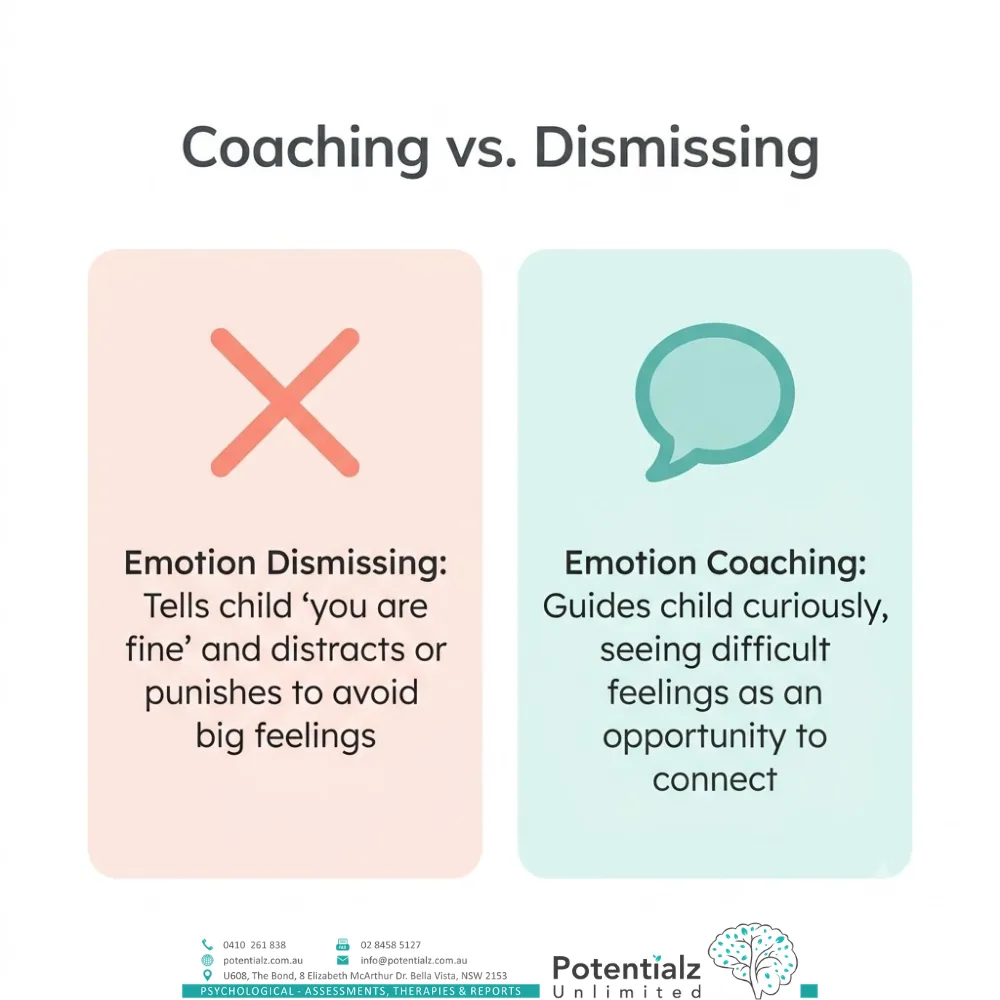
An emotion-coaching parent:
- Notices when their child is experiencing an emotion, including low-level emotions that the child might not be able to articulate
- Names the emotion — and does so precisely, not just “upset” but “frustrated,” “disappointed,” “embarrassed,” “scared”
- Validates the feeling: communicates to the child that their emotion makes sense, even if the behaviour that came with it was not acceptable
- Problem-solves with the child where appropriate — not every emotional moment requires a solution, but where one is needed, working through it together builds the child’s capacity to do it independently later
Emotion coaching is distinguished from what Gottman calls emotion dismissing — which is the most common alternative. Emotion dismissing includes:
- “You’re fine. Stop crying.”
- “That’s not a big deal.”
- “Boys don’t cry.”
- “Don’t be so sensitive.”
- Distracting the child away from the feeling before it is acknowledged
- Punishing the emotional expression (“Go to your room until you can calm down”)
These responses are not motivated by cruelty. In most cases, they come from a genuine desire to relieve the child’s distress, combined with discomfort about big emotions. But the research is consistent: children who are regularly dismissed develop a weaker capacity to identify, regulate, and communicate emotions. Over time, they learn that emotions are problems to be suppressed rather than experiences to be understood.
The Neuroscience: Why Naming Feelings Calms the Brain
One of the most well-supported findings in neuroscience has direct implications for emotion coaching. The research of Matthew Lieberman and colleagues at UCLA demonstrated that labelling an emotion — simply putting a word to it — significantly reduces the activation of the amygdala, the brain’s threat-response centre (Lieberman et al., 2007).
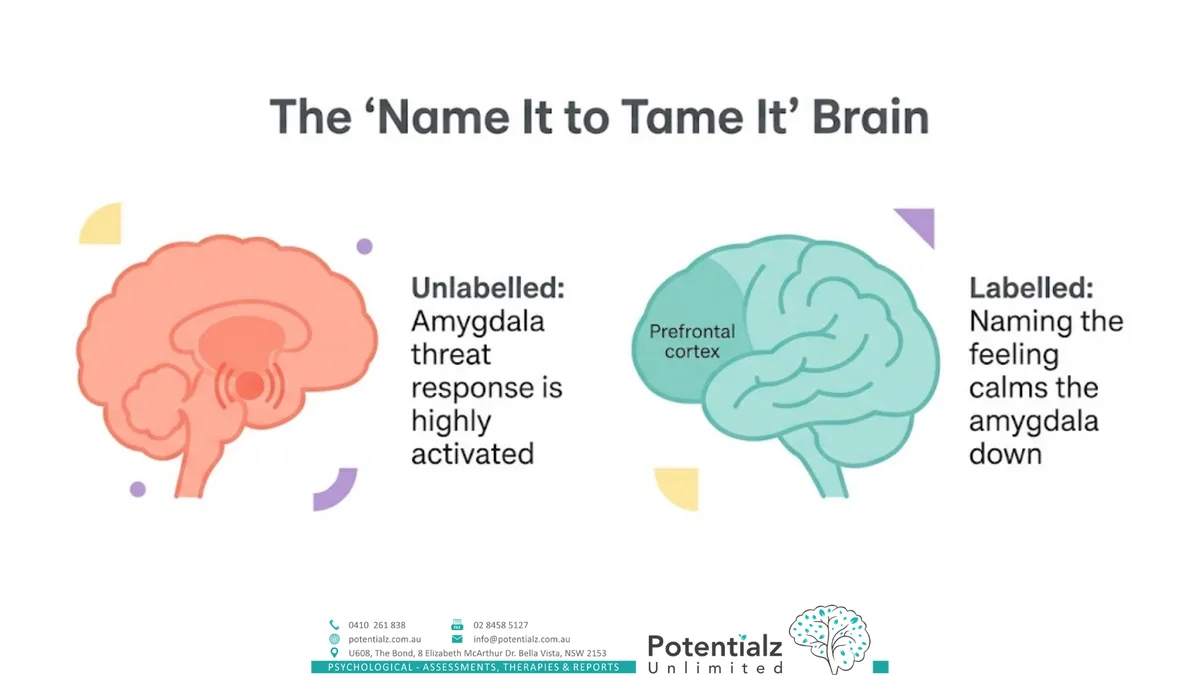
This is the mechanism behind what therapists sometimes call “name it to tame it.” When a child is in the grip of an overwhelming emotion, the prefrontal cortex — the rational, thinking brain — is effectively offline. The child cannot reason, cannot respond to logic, and cannot be talked out of their distress. Attempting to reason with a highly activated child (“Just think about this rationally…”) almost always makes things worse.
But when a trusted adult accurately names what the child is experiencing — “You’re really frustrated that he took your toy” — something shifts. The brain recognises itself. The amygdala activation begins to reduce. The child starts to come back online. This is not magic. It is neuroscience.
In my clinical practice, I teach parents to use precise emotional language — not just “upset” but the specific word that fits. Frustrated. Scared. Embarrassed. Disappointed. Jealous. Lonely. The larger a child’s emotional vocabulary, the more accurately they can identify what they are experiencing, and the more effectively they can manage it. This is one of the clearest examples in psychology of a skill that can be directly taught.
The Four Steps of Emotion Coaching
Step 1: Notice the Emotion — and See It as an Opportunity
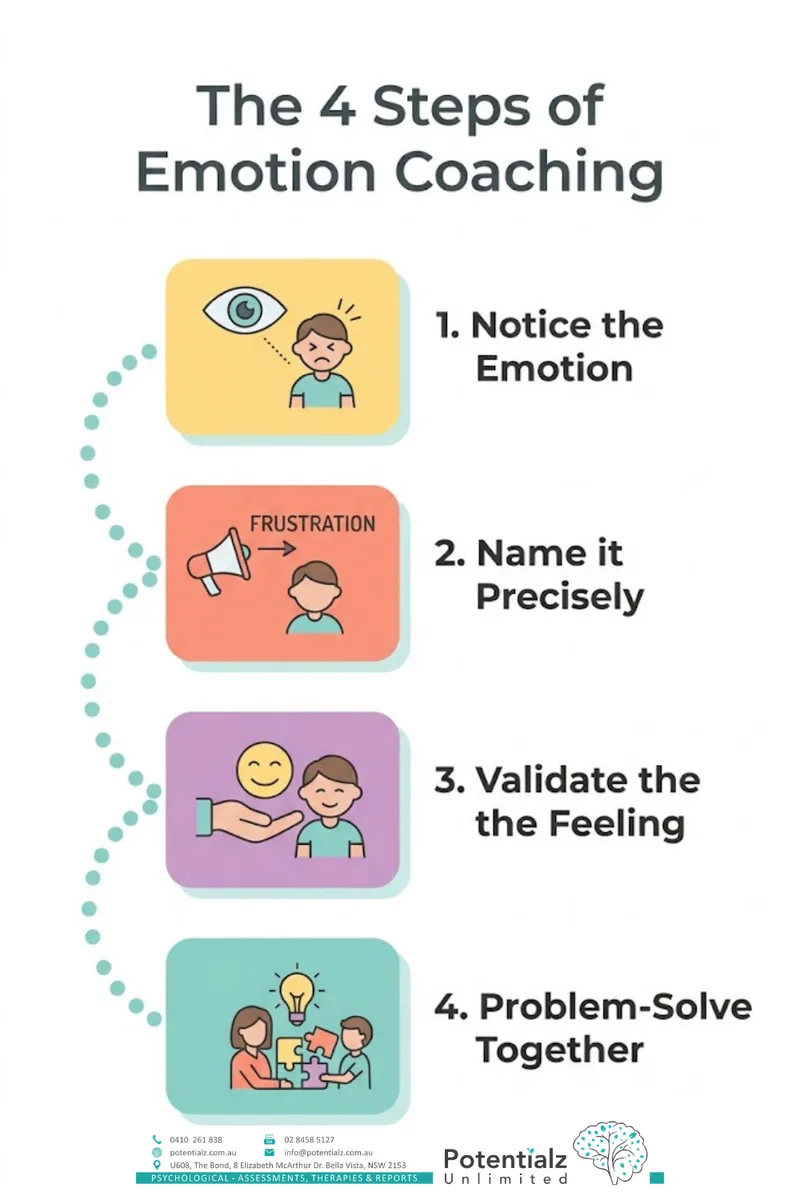
The first step is simply being present enough to notice that something is happening emotionally for your child. This sounds simple. In practice, it requires parents to slow down enough to observe — and to see the emotion not as a problem to manage, but as an opportunity to connect.
Gottman uses the phrase “lean into the emotion.” Rather than steering away from the distress, you move toward it. “You look a bit flat today. How was school?” This communicates to the child that their inner life matters to you, and that you are safe to turn to when things are hard.
Step 2: Name the Emotion Precisely
This is where the neuroscience I described above comes in. When you put an accurate word to what your child is experiencing, you are doing something clinically significant — you are helping their brain regulate.
A few principles for emotion labelling:
- Aim for precision: “Disappointed” is more useful than “sad”; “anxious” is more useful than “worried”
- Offer a label as a gentle hypothesis, not a declaration: “It seems like you’re feeling left out — is that right?”
- Build emotional vocabulary gradually: younger children can work with basic categories (mad, sad, scared, happy), older children can learn more nuanced distinctions
- Model labelling your own emotions: “I’m feeling a bit stressed right now — I’m going to take five minutes before I respond to that”
Step 3: Validate the Feeling
Validation does not mean agreeing with your child’s interpretation of events, and it does not mean tolerating any behaviour that came with the emotion. It means communicating that the feeling itself makes sense.
“I understand why you’re angry. It felt unfair. That makes sense.”
Validation is not: “You’re right, your teacher was terrible.” It is not agreeing. It is acknowledging that the emotion is real and comprehensible given the child’s perspective.
One of the most common mistakes I see in my clinical work with parents is skipping validation and jumping straight to problem-solving. Parents want to fix things. But a child who does not feel heard cannot engage in problem-solving. The validation is not optional — it is the foundation everything else is built on.
Step 4: Problem-Solve Together (Where Appropriate)
After the emotion has been named and validated — after the child has felt genuinely heard — there may be a problem that needs addressing. Sometimes there is not. Sometimes the child just needed to feel understood.
When problem-solving is needed, do it with the child, not for them:
- “What do you think you could do next time?”
- “What are some options here?”
- “What do you think would help?”
This develops the child’s own problem-solving capacity. It also maintains the collaborative relationship that makes emotion coaching powerful in the first place.
Emotion Coaching Is Not Permissive Parenting
I want to address this directly because it is one of the most common concerns I hear from parents in my workshops.
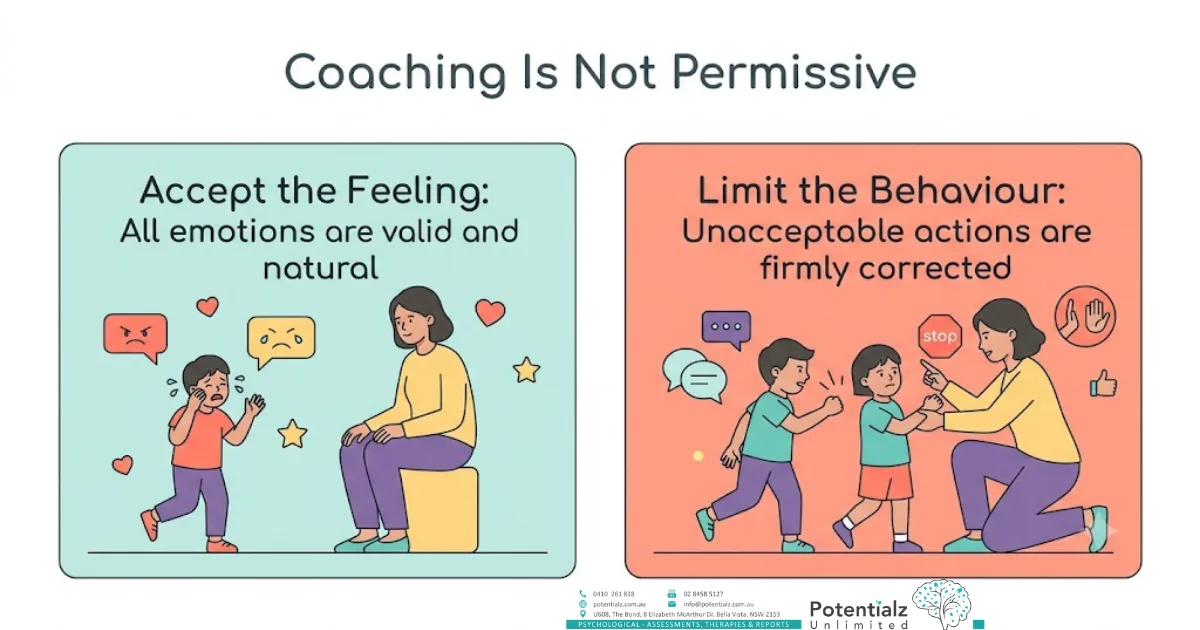
Emotion coaching does not mean accepting all behaviour. It means accepting all feelings.
The distinction is important. A child’s anger is always valid — the feeling of anger is a natural human response to perceived injustice or frustration. But hitting a sibling is not acceptable behaviour, even if the anger that prompted it is completely understandable.
Emotion coaching keeps these two things separate: “I can see you’re really angry right now. Your anger makes sense. And we do not hit in this family. Let’s talk about what’s going on.”
First the feeling is acknowledged. Then the limit is held. This is more difficult than simply punishing the behaviour — but the research is unequivocal about which approach builds children’s long-term emotional regulation and reduces behavioural problems (Gottman et al., 1996).
For CALD Parents: Navigating Cultural Norms Around Emotional Expression
In my clinical practice and community workshops, I work extensively with parents from Indian, South Asian, and other culturally and linguistically diverse backgrounds. Emotion coaching sits in complex territory for many of these families.
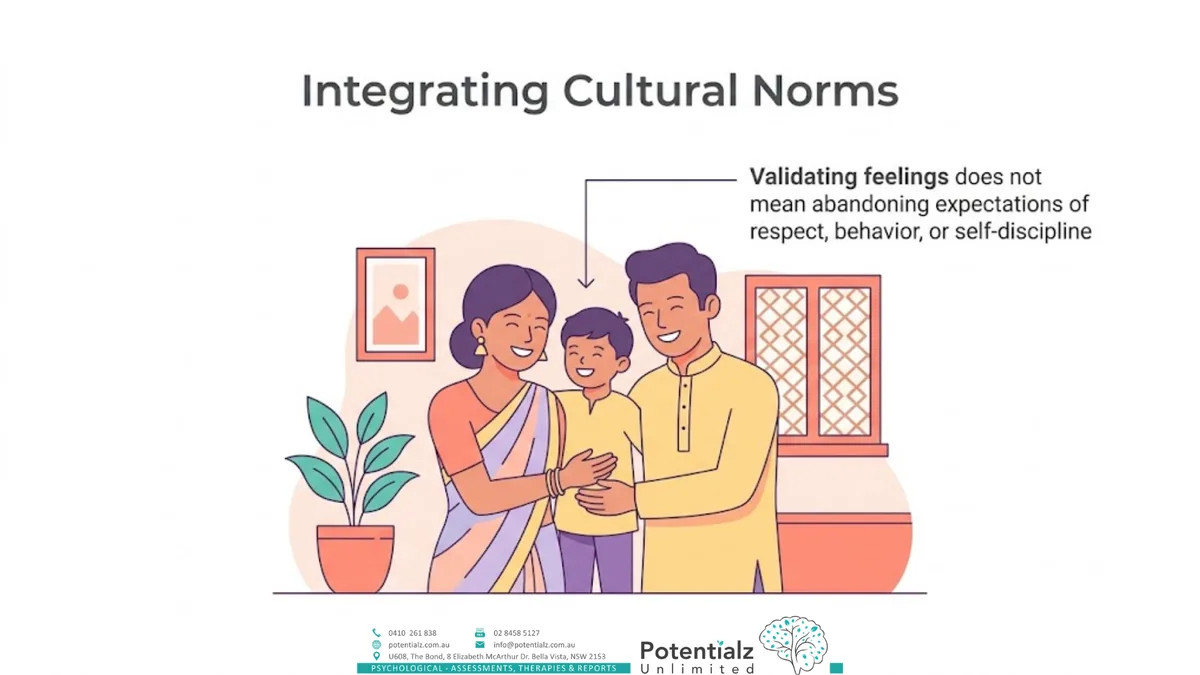
In many Indian and South Asian families, the cultural norms around emotional expression differ significantly from mainstream Australian psychological approaches. In many households, children are expected to be emotionally composed, to manage distress without making it visible, and to respect authority without question. Emotional displays — especially in children — may be seen as weakness, or as disrespectful behaviour that should be corrected rather than accommodated.
These cultural values are not wrong. They have served families across generations and contain real wisdom about resilience and self-discipline. But they can create difficulty when the psychological research on emotional development points in a different direction — and when parents are raising children in an Australian context where different emotional norms apply.
What I offer parents in this situation is not a rejection of their cultural background. It is an invitation to consider how emotion coaching can be adapted to their family’s values. Validating a child’s feelings does not mean abandoning expectations about behaviour, respect, or self-discipline. It means adding something that the research tells us is essential for long-term wellbeing.
I also address the generational dimension: parents who were not emotion-coached themselves will find this more difficult. If your own emotions were routinely dismissed as a child, you will have less practice noticing and naming your own emotional states — which makes it harder to do the same for your child. This is not a character flaw. It is a learned skill gap, and it can be addressed.
Age-Specific Emotion Coaching
Emotion coaching looks different at different developmental stages.
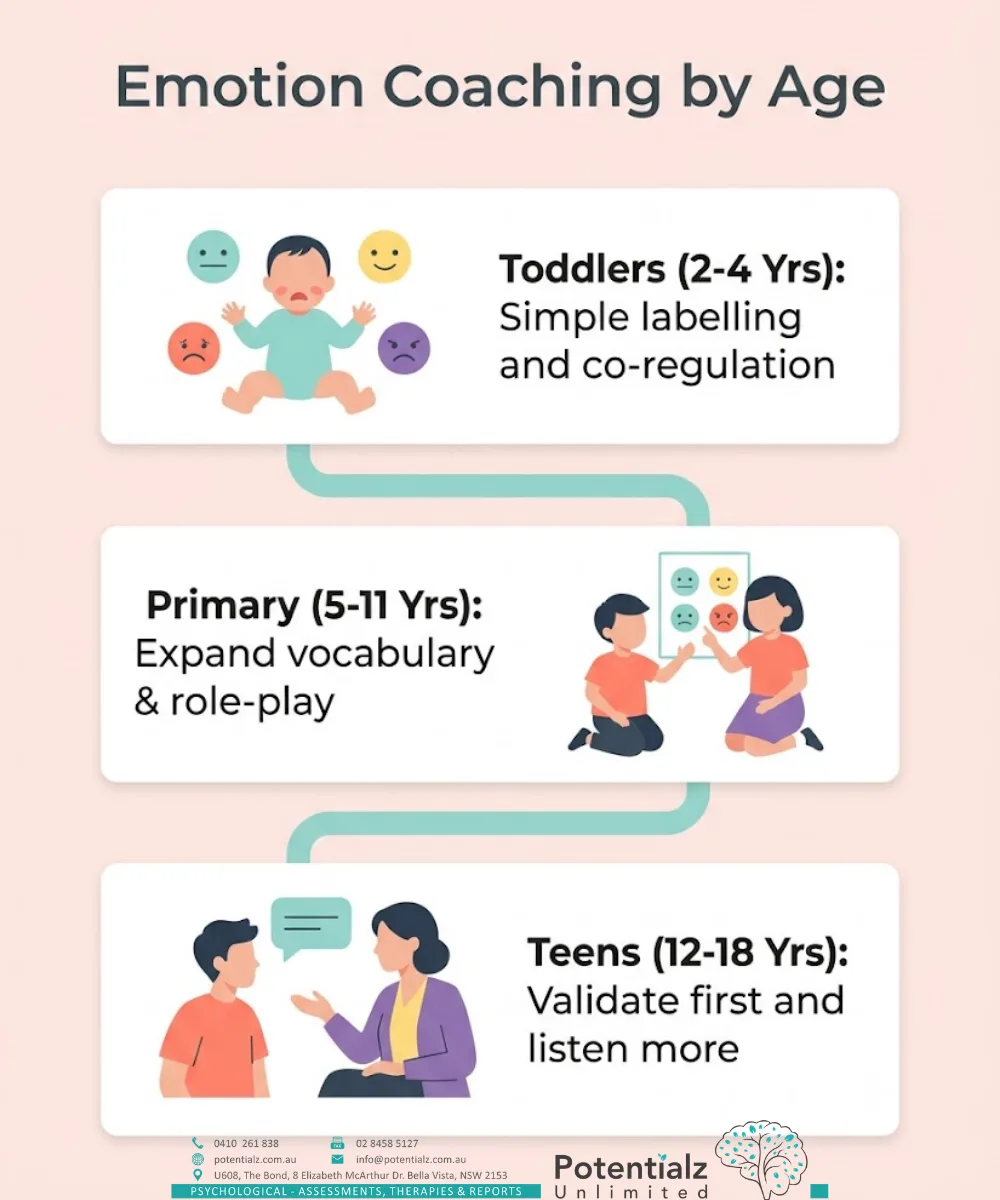
Toddlers (2–4 years)
Toddlers are in the early stage of emotional development. Their vocabulary is limited, their self-regulation capacity is minimal, and their meltdowns can be overwhelming for everyone. With toddlers:
- Keep emotional labelling very simple: “You’re angry. I can see you’re really angry.”
- Physical co-regulation — your calm presence, a gentle hand, a steady voice — is what matters most at this age
- Do not attempt to reason during a meltdown; wait for regulation first
- Routines and predictability are essential for toddler emotional regulation
Primary School (5–11 years)
This is the prime window for building emotional vocabulary and problem-solving skills:
- Use books, films, and everyday situations to practise emotion labelling (“How do you think she’s feeling right now?”)
- Begin teaching the link between thoughts, feelings, and actions
- Role-play alternative responses to difficult situations
- Emotion coaching conversations can be brief and practical — this age group responds well to structured approaches
Teenagers (12–18 years)
Adolescence is a period of intensified emotional experience combined with a brain that is still developing its regulation capacity. Teenagers often receive less emotion coaching than younger children — parents pull back, assuming the child no longer needs it. The research suggests the opposite.
With teenagers:
- Listen more than you direct
- Validate before advising
- Resist the urge to immediately problem-solve or lecture
- Show genuine curiosity about their inner world rather than focusing only on behaviour
- Choose your moments — a teenager in the middle of an emotional activation cannot hear you; wait for a calmer moment
When to Seek Professional Support
Emotion coaching is a prevention and enrichment strategy. But there are times when a child’s emotional difficulties have moved beyond what parenting strategies alone can address.
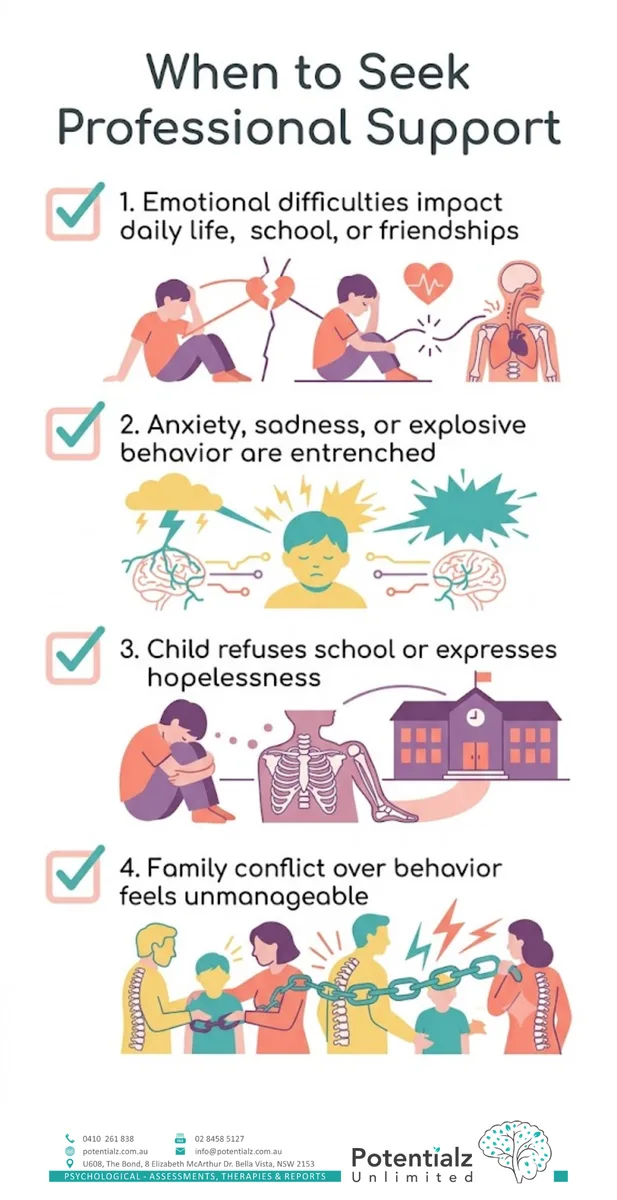
Consider seeking professional support if:
- Your child’s emotional difficulties are significantly affecting daily life, school, or family relationships
- Anxiety, withdrawal, persistent sadness, or explosive behaviour are becoming entrenched patterns
- Your child is self-harming, expressing hopelessness, or refusing to attend school
- Family conflict around your child’s behaviour has reached a level that feels unmanageable
A Registered Psychologist can work directly with children and adolescents, and also work with parents to help them build emotion coaching skills tailored to their specific child. For some families, a few sessions with a psychologist makes the difference between a strategy that works in theory and one that works in practice.
How I Can Help
At Potentialz Unlimited in Bella Vista, I work with parents, children, and families across the Hills District and Western Sydney. I have been facilitating my “Parenting Skills: Parents as Emotion Coach” workshop in the community for many years — a program designed to give parents the practical skills and confidence to support their child’s emotional development.
In my clinical practice, I work with:
- Parents seeking support for their own emotional wellbeing
- Parents wanting individual clinical support to build emotion coaching skills
- Children and adolescents who are experiencing anxiety, depression, school avoidance, or behavioural difficulties
- Families navigating the challenges of multicultural parenting, where different generational and cultural expectations are creating conflict
I accept referrals via:
- Medicare Mental Health Care Plan (GP referral required — up to 10 sessions per calendar year, with a rebate for parents and for children)
- NDIS (for children with an autism diagnosis or other disability where psychology is part of their plan)
- EAP / Employee Assistance Program (for working parents whose employer offers this benefit)
- Private (self-funded appointments available)
I provide services in English, Hindi, Marathi, and Punjabi — which makes a significant difference for parents who feel more comfortable discussing family and parenting issues in their first language.
Sushama Sathe is an AHPRA Registered Psychologist (PSY0001370871) with 20 years of clinical experience. Potentialz Unlimited, Unit 608, 8 Elizabeth Macarthur Drive, Bella Vista NSW 2153. Book online at live.potentialz.com.au or call 0410 261 838. Monday–Friday 10am–7pm | Saturday and after-hours available | Telehealth available.
References
Gottman, J. M., Katz, L. F., & Hooven, C. (1996). Parental meta-emotion philosophy and the emotional life of families: Theoretical models and preliminary data. Journal of Family Psychology, 10(3), 243–268. https://doi.org/10.1037/0893-3200.10.3.243
Havighurst, S. S., Wilson, K. R., Harley, A. E., Prior, M. R., & Kehoe, C. (2010). Tuning in to Kids: Improving emotion socialization practices in parents of preschool children — findings from a community trial. Journal of Child Psychology and Psychiatry, 51(12), 1342–1350. https://doi.org/10.1111/j.1469-7610.2010.02303.x
Lieberman, M. D., Eisenberger, N. I., Crockett, M. J., Tom, S. M., Pfeifer, J. H., & Way, B. M. (2007). Putting feelings into words: Affect labeling disrupts amygdala activity in response to affective stimuli. Psychological Science, 18(5), 421–428. https://doi.org/10.1111/j.1467-9280.2007.01916.x
Morris, A. S., Silk, J. S., Steinberg, L., Myers, S. S., & Robinson, L. R. (2007). The role of the family context in the development of emotion regulation. Social Development, 16(2), 361–388. https://doi.org/10.1111/j.1467-9507.2007.00389.x
Saarni, C. (1999). The development of emotional competence. Guilford Press.
Disclaimer
Sushama Sathe is an AHPRA Registered Psychologist (PSY0001370871) at Potentialz Unlimited. The information in this post is for general educational purposes only and does not constitute clinical advice or diagnosis. Please consult a qualified health professional for assessment and treatment tailored to your circumstances.
Crisis and Support Resources
If you or your child needs immediate support:
- Lifeline: 13 11 14 (24/7 crisis support)
- Beyond Blue: 1300 22 4636 (mental health support)
- Kids Helpline: 1800 55 1800 (24/7 support for children and young people)
- Emergency: 000
Related Reading
Knowledge Check Quiz
Test what you have just read. Choose your answer for each question, then submit to reveal the answers and your score.
Need Professional Support?
If you're experiencing mental health concerns, our team is here to help.