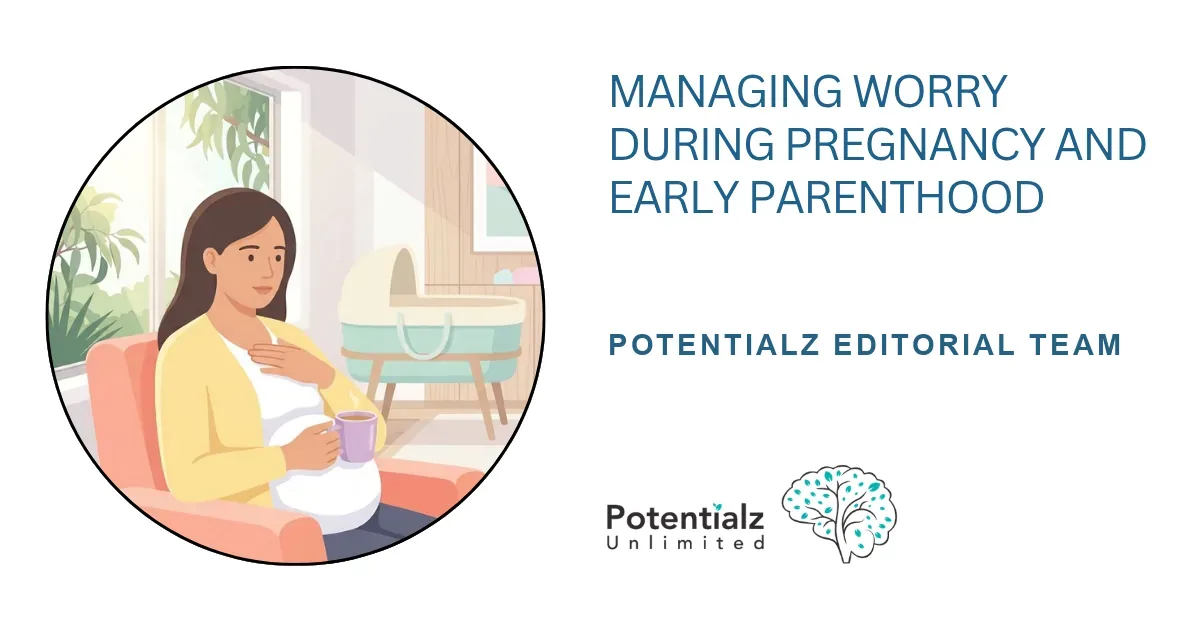
Becoming a parent is a huge change. It brings deep joy. It also brings a lot of new worry. At Potentialz Unlimited, our team works with many women. For some, the worry that comes with pregnancy or early parenthood grows and grows. It becomes constant. It becomes hard to control. It can affect sleep. It can affect the people around you. It can stop you from feeling present. This is called perinatal anxiety. It is far more common than most people realise.
Maybe you lie awake at night with thoughts that will not settle. Maybe you feel a constant sense of dread, and you cannot say why. If so, you are not alone. This is a real condition. It is not a personal failing. It is treatable. This post explains what perinatal anxiety is. It explains how it is not the same as postnatal depression. And it explains what well tested support looks like.
Our team has special training in perinatal mental health. This includes work at the Gidget Foundation (2023–2024), a service just for perinatal mental health. That experience has shaped how we see this worry. It has shaped what helps.
What Is Perinatal Anxiety?
The word “perinatal” covers a set time. It runs from conception to the end of the baby’s first year. Perinatal anxiety means anxiety that starts, or gets worse, during this time. It is its own condition. It is not simply normal caution about a new baby.
Postnatal depression (PND) gets a lot of attention. But anxiety is just as common. The two conditions often happen together. Our team sees this pattern often. A woman comes in believing she has depression. Often, the main problem is actually anxiety. In Australia, around 1 in 5 women report anxiety symptoms during pregnancy, and between 4 and 20 per cent experience symptoms of an anxiety disorder after giving birth (PANDA, 2026). The evidence shows one more thing. Anxiety during pregnancy often predicts anxiety and depression after birth. This is why spotting it early matters so much (Woolhouse et al., 2014). If low mood is your main experience, see our guide to postnatal depression in mothers. It explains how the two conditions differ and overlap.
How Perinatal Anxiety Feels: Common Symptoms
Perinatal anxiety shows up in many ways. Some women feel a general worry that never settles. It feels like a constant hum of unease. Others have sharp, sudden fears. These might be about the baby’s health, the birth, or their own ability to cope. Both of these are real. Both deserve care.
Common signs we see include:
- Worry that will not let up. The mind circles again and again through worst-case ideas.
- Racing or sudden thoughts. Often about something going wrong with the baby.
- Body tension. Tightness in the chest or shoulders. Headaches. A feeling of always being braced.
- Sleep trouble. Trouble falling or staying asleep, even when the baby is resting.
- Trouble bonding with the baby. Feeling numb, or feeling far away instead of close.
- Pulling back. Avoiding people, or steering clear of anything that feels risky.
- Panic attacks. Sudden waves of intense fear. A racing heart. Short breath.
Here is something our team always helps clients see. Normal worry is not the same as anxiety. Most parents-to-be and new parents feel real concern for their child. That is healthy. That is normal. What we are talking about here is not the same. It is when worry gets too big. It becomes hard to control. It gets in the way of sleep, family time, or everyday life.
How Is Perinatal Anxiety Different from Postnatal Depression?
Many people have heard of postnatal depression. Fewer know that perinatal anxiety is its own condition. The two are related. But they are not the same.
Here are the main differences.
| Feature | Postnatal Depression | Perinatal Anxiety |
|---|---|---|
| Main mood | Low, sad, hopeless. | Fearful, on edge, keyed up. |
| Thoughts | Negative, self-critical. | Worried, catastrophising, intrusive. |
| Energy | Low, tired. | Hyper-alert, or worn out from worry. |
| Body signs | Slow, low motivation. | Tense, racing heart, restless. |
Both are treatable. Both deserve care. And both can happen at the same time.
Risk Factors for Perinatal Anxiety
Some things can raise the chance of perinatal anxiety. Our team often asks clients about these.
- A personal or family history of anxiety or depression.
- A past pregnancy loss, or fertility treatment.
- A hard or high-risk pregnancy.
- Not enough support from a partner, family, or community.
- Big life stress. Money worries. Relationship trouble. Housing worries.
- Past trauma or abuse.
- Being a perfectionist, or very hard on yourself.
- Coming from a background where English is not your first language, with little support in your own language.
Having one or more of these does not mean perinatal anxiety will happen to you. But it does mean your mental health needs extra care right now. It is wise to reach out early, once worry gets hard to manage.
The Evidence-Based Approaches Our Psychologists Use: CBT, ACT, and Mindfulness
Our team uses a few approaches. Each one has strong evidence behind it for perinatal anxiety. The three used most are Cognitive Behavioural Therapy (CBT), Acceptance and Commitment Therapy (ACT), and Mindfulness. You can see our full range on the therapies offered page.
Cognitive Behavioural Therapy (CBT)
CBT is one of the most helpful tools for perinatal anxiety. It helps you spot the thoughts that drive your worry. These might be thoughts like “something will go wrong with my baby” or “I cannot cope.” You then look closely at these thoughts. You use evidence and clear reasoning. You also learn to change habits that keep the worry going. This might mean asking for constant reassurance, or avoiding things. For a plain-language walkthrough, see our guide to how CBT therapy works.
The research backs this up. CBT works well for anxiety during the perinatal period. It may also lower the risk of postnatal depression (Sockol et al., 2011). CBT is practical. It is structured. It gives you real, usable tools for daily life, not just insight.
Acceptance and Commitment Therapy (ACT)
ACT takes a different path. It does not just try to change anxious thoughts. It teaches you to notice your thoughts without getting tangled up in them. You learn to see worry as just a thought, not a fact. Our team also uses values-based work with ACT. This means working out what matters most to you as a parent. Then you take small, meaningful steps in that direction, even while anxiety is there.
Research suggests ACT may suit perinatal anxiety well. It works directly with the uncertainty of new parenthood. It does not try to remove that uncertainty (Gaffney et al., 2022). You do not need to feel calm first. You can act from your values, even while anxiety is present.
Mindfulness-Based Approaches
One is Mindfulness-Based Cognitive Therapy, or MBCT. It teaches you to notice the present moment, without judging it. For perinatal anxiety, this means building the skill to sit with not knowing. It means meeting hard emotions with awareness, rather than reacting on autopilot. And it means finding some steadiness, even in the busy early days of parenthood.
Research shows MBCT helps reduce anxiety. It can also help stop depression from coming back during the perinatal period (Dimidjian et al., 2016). Our team teaches mindfulness as a skill. It is structured. It is well tested. And it targets the exact thought and feeling patterns behind anxiety.
The Role of Partners and Family
Perinatal anxiety does not just affect the person who is struggling. It ripples outward. It affects partners. It affects family. It affects the couple’s relationship. And support from loved ones is one of the strongest protections against perinatal anxiety. Partners can be affected too.
Partners can help by:
- Learning about perinatal anxiety. This helps them see what their loved one is going through.
- Giving practical support, without brushing off the worry. “Just relax” rarely helps, and our team talks about this directly with partners.
- Encouraging professional help, and going to appointments when it makes sense.
- Gently watching for signs the anxiety is getting worse, and checking in without judgment.
- Looking after their own mental health too — partners are also at risk during the perinatal period.
Research is clear on this. Women with strong social support have better mental health results in the perinatal period (Dennis et al., 2017). This is why our team works with the whole family, where that fits. Not just with one person.
When to Seek Help
It can be hard to know when worry has crossed a line. These questions may help you check in with yourself.
- Has my worry been there most days for at least two weeks?
- Do I find it hard to let go of the worry, even when I try?
- Is the anxiety affecting my sleep, my family life, or my ability to care for myself or my baby?
- Am I avoiding things I used to do, because of fear?
- Do I feel unable to enjoy this time, even when part of me knows I should?
If you said yes to two or more of these, speak with your GP. Or speak with a registered anxiety psychologist in Bella Vista. Perinatal anxiety is very treatable. And the evidence is clear: getting help earlier leads to better results for both parent and baby.
Perinatal Mental Health Experience at Potentialz Unlimited
Our perinatal work draws on 20 years of experience. This comes from our team of Registered Psychologists (AHPRA). It includes special training at the Gidget Foundation, between September 2023 and March 2024. The Gidget Foundation is dedicated to perinatal mental health. It supports parents-to-be and new parents who are struggling emotionally during pregnancy and after birth. That extra training has shaped what we know. We know how perinatal anxiety shows up. We know the barriers that stop women from seeking help. And we know what well tested support looks like for this group.
That experience spans private practice, community health, and work with diverse communities across Western Sydney. We offer services in English, Hindi, Marathi, and Punjabi. Many women come from culturally and linguistically diverse backgrounds. For them, talking about something this personal in their own language makes a real difference. So does working with a clinician who knows their culture.
Our team sees perinatal clients at Potentialz Unlimited in Bella Vista. We accept referrals through Medicare Mental Health Care Plans. Sometimes a GP flags perinatal mental health concerns. If so, a referral for psychological treatment under Medicare is the right next step.
Key Takeaways
- About 1 in 5 Australian women have anxiety symptoms in pregnancy. Between 4 and 20% have an anxiety disorder after birth (PANDA, 2026).
- It is a separate condition from postnatal depression, though the two often happen together.
- Signs include ongoing worry, sudden thoughts, body tension, sleep trouble, and trouble bonding.
- CBT, ACT, and Mindfulness all have strong evidence behind them for perinatal anxiety.
- Partners and social support play an important protective role.
- Getting help early leads to better outcomes for both parent and baby.
- Perinatal anxiety is treatable, and with the right support, many people see real improvement.
How Potentialz Can Help
Are you struggling with anxiety during pregnancy? Or in the first year after having your baby? We encourage you to reach out. Perinatal anxiety is a real condition. It responds well to tested psychological support. The sooner support is in place, the better things tend to go for you and your child. Learn more about our anxiety psychology services in Bella Vista.
Our team sees perinatal clients under Medicare, with a GP Mental Health Care Plan. Telehealth is also available, for those who prefer support from home.
Our team includes Registered Psychologists (AHPRA) with 20 years of experience. We work at Potentialz Unlimited in Bella Vista. We accept referrals via Medicare, WorkCover, NDIS, and EAP. We offer services in English, Hindi, Marathi, and Punjabi. Book at live.potentialz.com.au or call 0410 261 838. Unit 608, 8 Elizabeth Macarthur Drive, Bella Vista NSW 2153. Monday–Friday 10am–7pm | Saturday & after-hours | Telehealth available.
Book online: live.potentialz.com.au Call: 0410 261 838 Website: potentialz.com.au
Or visit our contact page to send a message.
Crisis Resources
If you are in distress right now, please reach out for support.
- PANDA (Perinatal Anxiety and Depression Australia): 1300 726 306 — specialises in perinatal mental health.
- Lifeline: 13 11 14 — 24/7 crisis support.
- Beyond Blue: 1300 22 4636 — mental health support and information.
References
Dennis, C. L., Falah-Hassani, K., & Shiri, R. (2017). Prevalence of antenatal and postnatal anxiety: Systematic review and meta-analysis. The British Journal of Psychiatry, 210(5), 315–323. https://doi.org/10.1192/bjp.bp.116.187179
Dimidjian, S., Goodman, S. H., Felder, J. N., Gallop, R., Brown, A. P., & Beck, A. (2016). Staying well during pregnancy and the postpartum: A pilot randomized trial of mindfulness-based cognitive therapy for the prevention of depressive relapse/recurrence. Journal of Consulting and Clinical Psychology, 84(2), 134–145. https://doi.org/10.1037/ccp0000068
Gaffney, H., Mansell, W., Edwards, R., & Wright, J. (2022). LACE: Low-intensity ACT and CBT by email for perinatal anxiety. Clinical Psychology & Psychotherapy, 29(1), 74–91. https://doi.org/10.1002/cpp.2619
Perinatal Anxiety & Depression Australia (PANDA). (2026). How common are mental health issues in the perinatal period? https://www.panda.org.au/articles/how-common-are-mental-health-issues-in-the-perinatal-period
Sockol, L. E., Epperson, C. N., & Barber, J. P. (2011). A meta-analysis of treatments for perinatal depression. Clinical Psychology Review, 31(5), 839–849. https://doi.org/10.1016/j.cpr.2011.03.009
Woolhouse, H., Gartland, D., Mensah, F., & Brown, S. J. (2014). Maternal depression from early pregnancy to 4 years postpartum in a prospective pregnancy cohort study: Implications for primary health care. BJOG: An International Journal of Obstetrics and Gynaecology, 122(3), 312–321. https://doi.org/10.1111/1471-0528.13059
Disclaimer: This information is general in nature. Please consult a qualified health professional for advice tailored to your individual circumstances. Our psychologists are AHPRA Registered Psychologists.
Knowledge Check Quiz
Test what you have just read. Choose your answer for each question, then submit to reveal the answers and your score.
Need Professional Support?
If you're experiencing mental health concerns, our team is here to help.