The Crash You Did Not See Coming
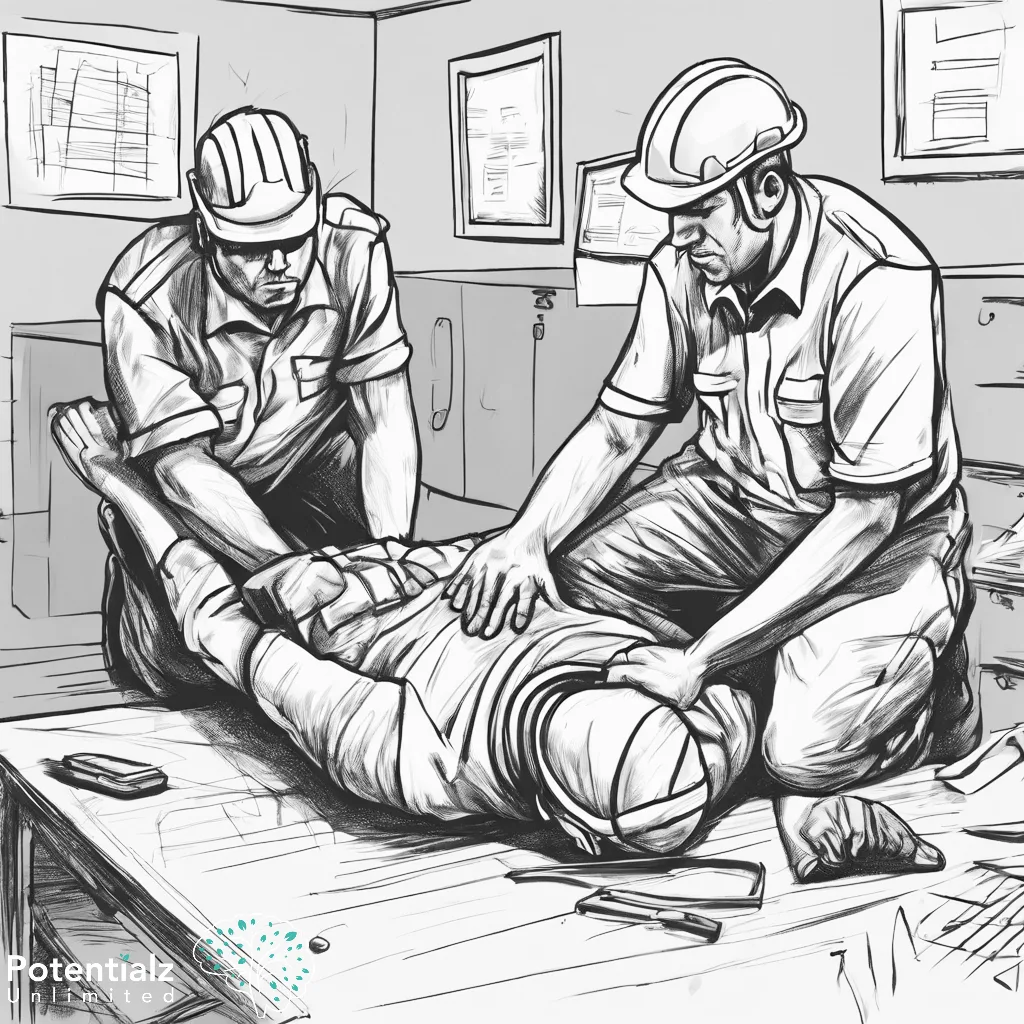
The forklift came around the corner faster than it should have. In the half-second before it happened, time seemed to slow. Then there was noise, pain, and people running. Weeks later, the broken bones were healing well. The X-rays looked good. Everyone kept telling Daniel he was “lucky.”
But Daniel did not feel lucky. He could not sleep. When a truck reversed near his street, his heart raced and his hands shook. He kept replaying the moment in his head. The thought of walking back onto the warehouse floor made him feel sick. His body was mending, but something inside him was not.
If this sounds familiar, you are not weak, and you are not imagining it. A traumatic injury at work or on the road can leave a deep psychological mark, even when the physical wounds heal. As a WorkCover and CTP psychologist in Bella Vista, this is something I see often. This article explains the hidden psychological impact of injury, what the NSW schemes cover, and how therapy supports a safe return to work.
The Hidden Psychological Impact of a Workplace or Motor Injury

When someone is hurt at work or in a car crash, the focus is usually on the body. Scans, surgery, physiotherapy, and pain relief all come first, and that is right. But injuries do not only affect the body. They can shake a person’s sense of safety in the world.
After a serious or frightening injury, it is common to experience:
- Flashbacks or unwanted memories of what happened
- Trouble sleeping, nightmares, or feeling “on edge”
- Anxiety about returning to the place where it happened
- Low mood, irritability, or feeling cut off from others
- Fear of moving, re-injury, or pain getting worse
This matters for more than comfort. The psychological side of injury is one of the strongest predictors of whether a person recovers and returns to work. Mental health conditions also tend to involve much longer time away from work than physical injuries alone. In recent NSW and national data, workers with a psychological injury claim were off work far longer than those with physical claims (Safe Work Australia, 2023). Treating the mind is not a luxury. It is part of recovery.
What WorkCover and CTP Cover for Psychological Treatment in NSW
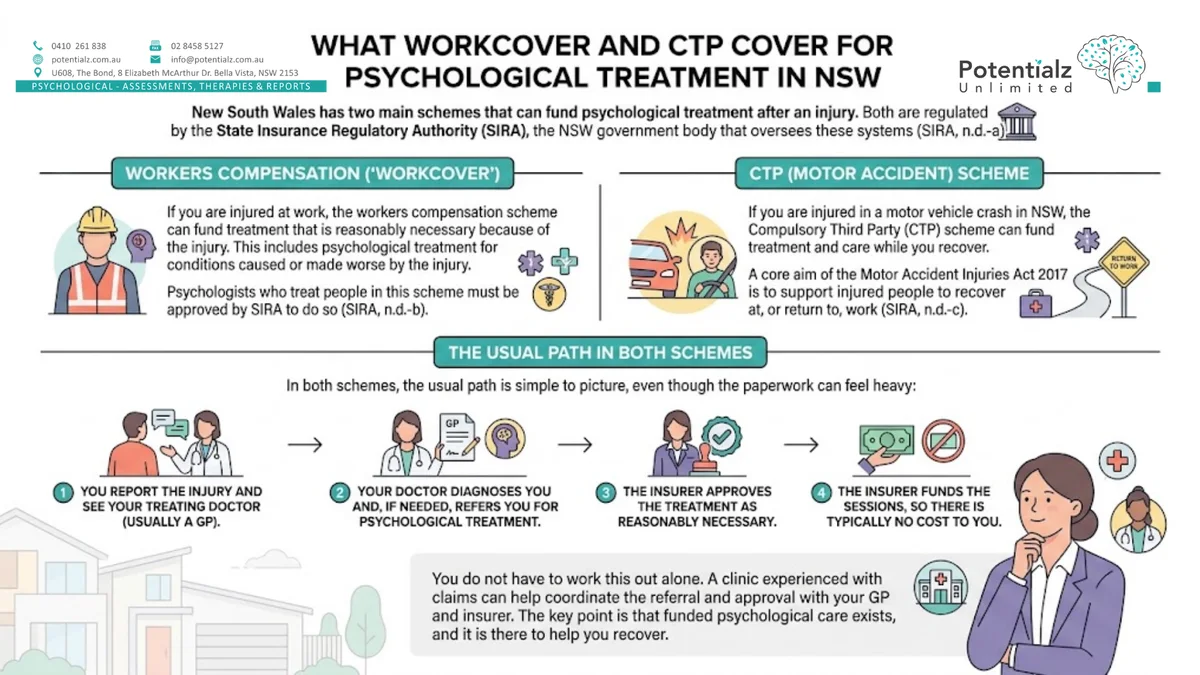
New South Wales has two main schemes that can fund psychological treatment after an injury. Both are regulated by the State Insurance Regulatory Authority (SIRA), the NSW government body that oversees these systems (SIRA, n.d.-a).
Workers compensation (“WorkCover”). If you are injured at work, the workers compensation scheme can fund treatment that is reasonably necessary because of the injury. This includes psychological treatment for conditions caused or made worse by the injury. Psychologists who treat people in this scheme must be approved by SIRA to do so (SIRA, n.d.-b).
CTP (motor accident) scheme. If you are injured in a motor vehicle crash in NSW, the Compulsory Third Party (CTP) scheme can fund treatment and care while you recover. A core aim of the Motor Accident Injuries Act 2017 is to support injured people to recover at, or return to, work (SIRA, n.d.-c).
In both schemes, the usual path is simple to picture, even though the paperwork can feel heavy:
- You report the injury and see your treating doctor (usually a GP).
- Your doctor diagnoses you and, if needed, refers you for psychological treatment.
- The insurer approves the treatment as reasonably necessary.
- The insurer funds the sessions, so there is typically no cost to you.
You do not have to work this out alone. A clinic experienced with claims can help coordinate the referral and approval with your GP and insurer. The key point is that funded psychological care exists, and it is there to help you recover.
Common Conditions After a Traumatic Injury
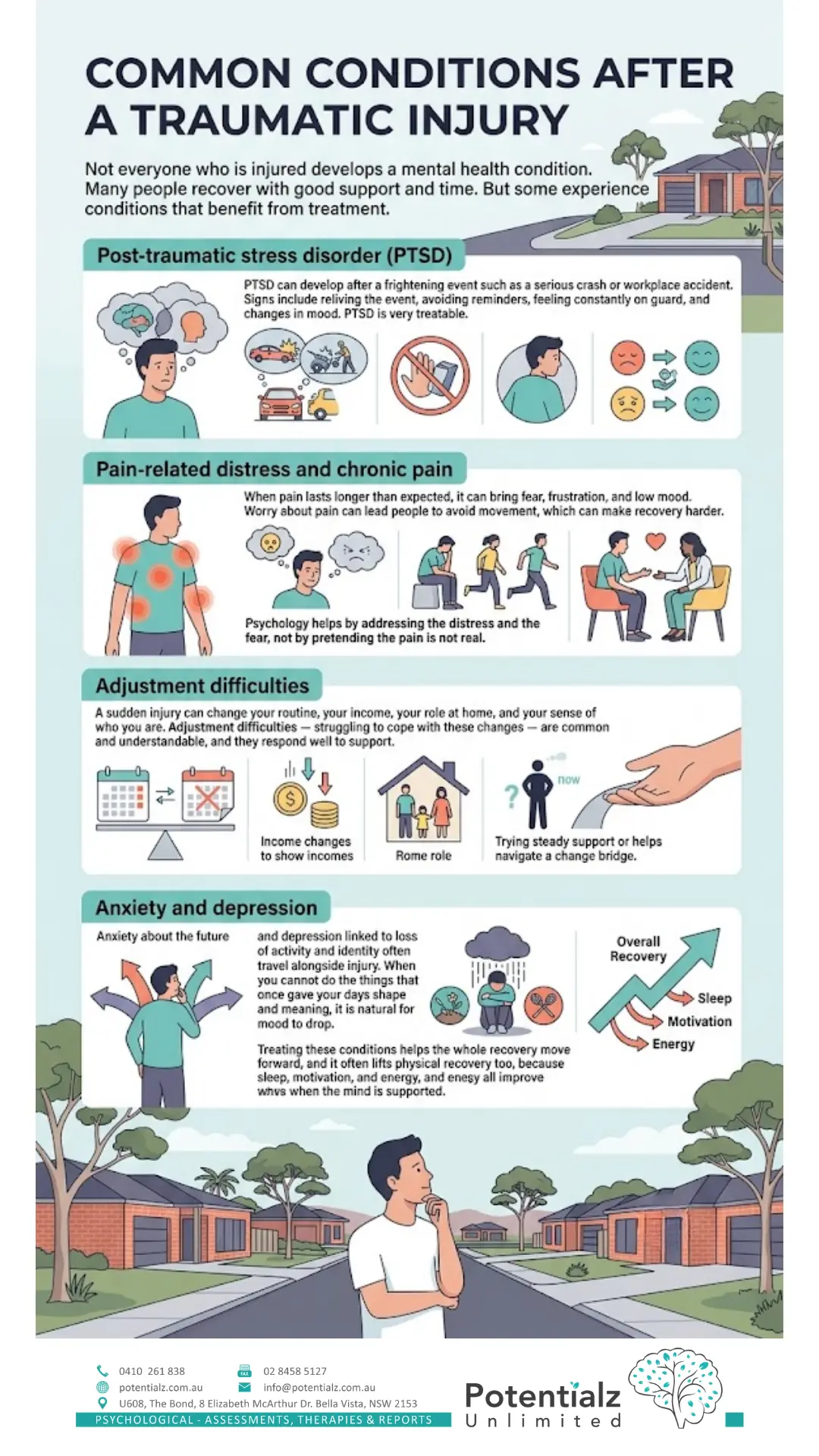
Not everyone who is injured develops a mental health condition. Many people recover with good support and time. But some experience conditions that benefit from treatment.
Post-traumatic stress disorder (PTSD)
PTSD can develop after a frightening event such as a serious crash or workplace accident. Signs include reliving the event, avoiding reminders, feeling constantly on guard, and changes in mood. PTSD is very treatable, and you can read more in our guide on healing from trauma with EMDR therapy.
Pain-related distress and chronic pain
When pain lasts longer than expected, it can bring fear, frustration, and low mood. Worry about pain can lead people to avoid movement, which can make recovery harder. Psychology helps by addressing the distress and the fear, not by pretending the pain is not real.
Adjustment difficulties
A sudden injury can change your routine, your income, your role at home, and your sense of who you are. Adjustment difficulties — struggling to cope with these changes — are common and understandable, and they respond well to support.
Anxiety and depression
Anxiety about the future and depression linked to loss of activity and identity often travel alongside injury. When you cannot do the things that once gave your days shape and meaning, it is natural for mood to drop. Treating these conditions helps the whole recovery move forward, and it often lifts physical recovery too, because sleep, motivation, and energy all improve when the mind is supported.
The Biopsychosocial Model of Return to Work
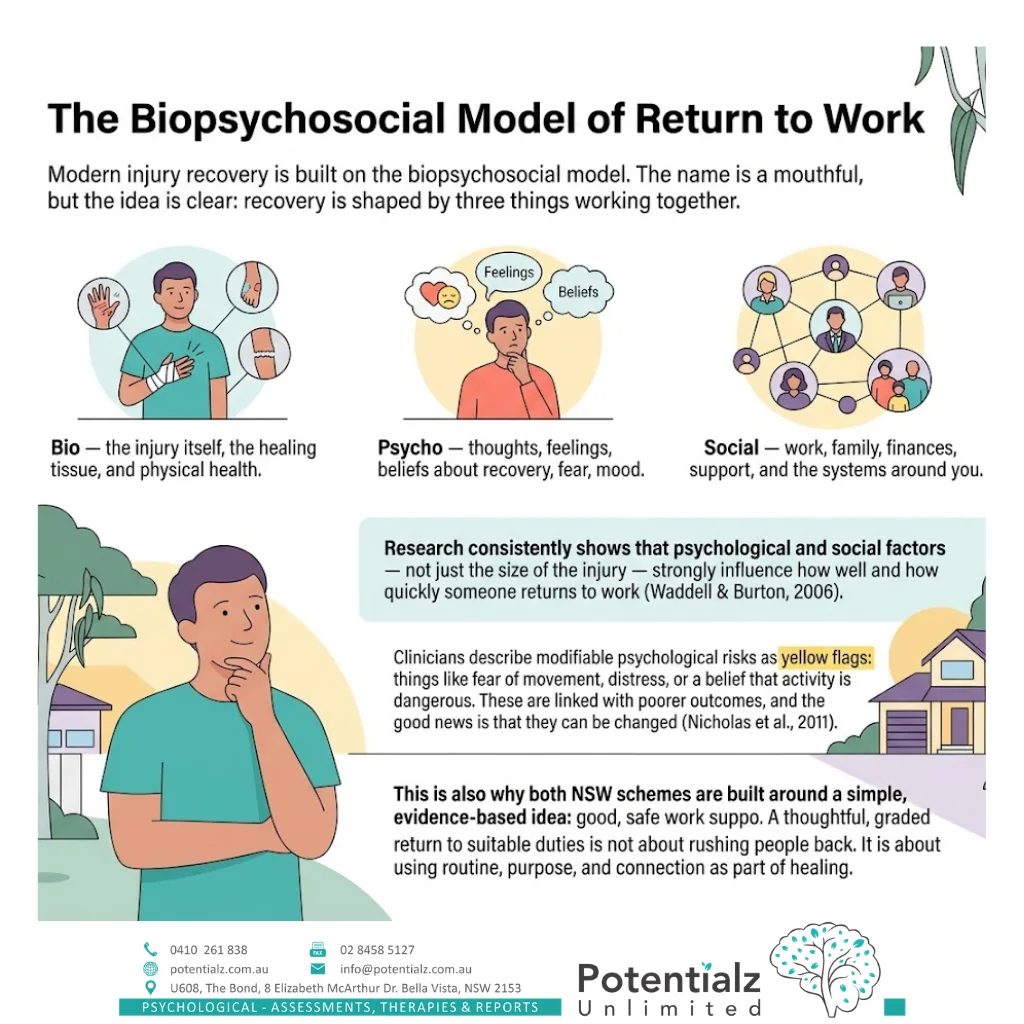
Modern injury recovery is built on the biopsychosocial model. The name is a mouthful, but the idea is clear: recovery is shaped by three things working together.
- Bio — the injury itself, the healing tissue, and physical health.
- Psycho — thoughts, feelings, beliefs about recovery, fear, mood.
- Social — work, family, finances, support, and the systems around you.
Research consistently shows that psychological and social factors — not just the size of the injury — strongly influence how well and how quickly someone returns to work (Waddell & Burton, 2006). Clinicians describe modifiable psychological risks as yellow flags: things like fear of movement, distress, or a belief that activity is dangerous. These are linked with poorer outcomes, and the good news is that they can be changed (Nicholas et al., 2011).
This is also why both NSW schemes are built around a simple, evidence-based idea: good, safe work supports recovery. A thoughtful, graded return to suitable duties is not about rushing people back. It is about using routine, purpose, and connection as part of healing.
How Therapy Helps: EMDR, CBT, and a Graded Return
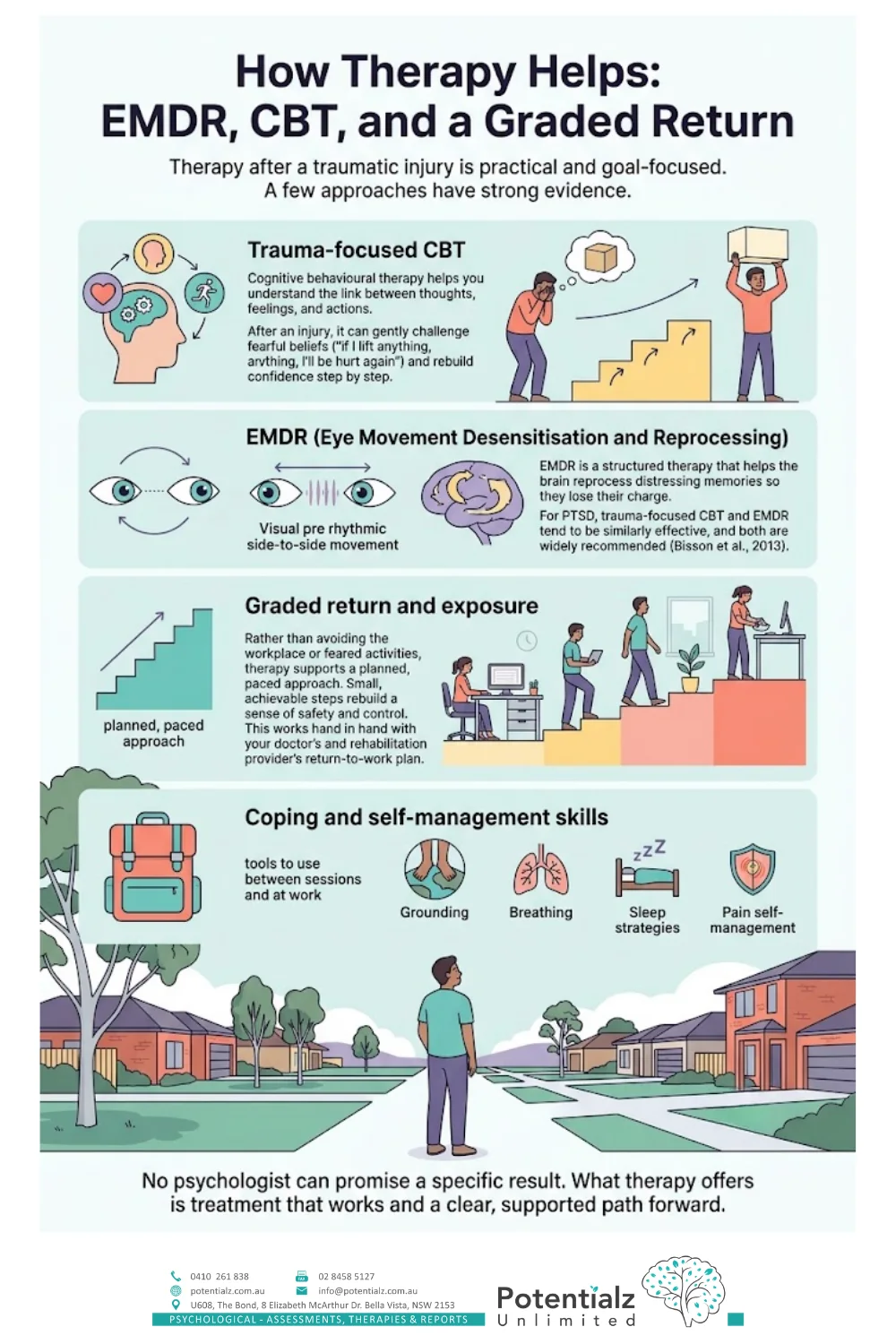
Therapy after a traumatic injury is practical and goal-focused. A few approaches have strong evidence.
Trauma-focused CBT. Cognitive behavioural therapy helps you understand the link between thoughts, feelings, and actions. After an injury, it can gently challenge fearful beliefs (“if I lift anything, I’ll be hurt again”) and rebuild confidence step by step.
EMDR (Eye Movement Desensitisation and Reprocessing). EMDR is a structured therapy that helps the brain reprocess distressing memories so they lose their charge. For PTSD, trauma-focused CBT and EMDR tend to be similarly effective, and both are widely recommended (Bisson et al., 2013). You can learn more from our EMDR psychologist in Bella Vista page.
Graded return and exposure. Rather than avoiding the workplace or feared activities, therapy supports a planned, paced approach. Small, achievable steps rebuild a sense of safety and control. This works hand in hand with your doctor’s and rehabilitation provider’s return-to-work plan.
Coping and self-management skills. Grounding, breathing, sleep strategies, and pain self-management give you tools to use between sessions and at work. Our article on work-related stress and how to manage it covers some of these skills.
No psychologist can promise a specific result. What therapy offers is treatment that works and a clear, supported path forward.
The Psychologist’s Role Alongside the Insurer, Employer, and GP
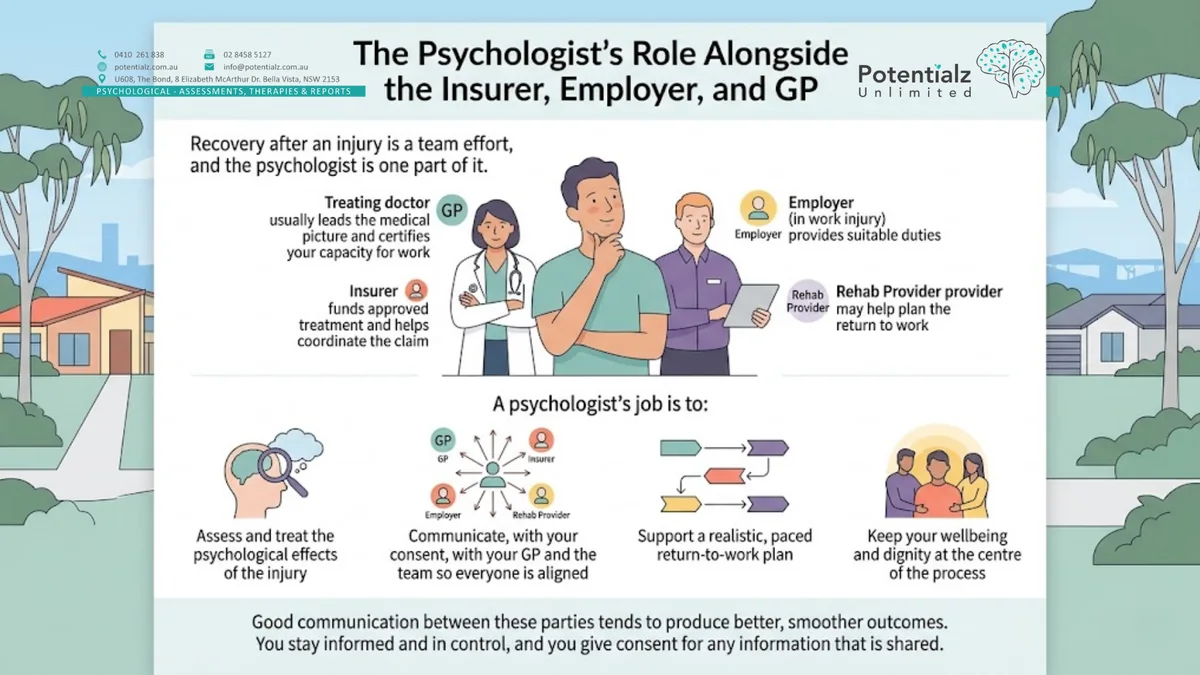
Recovery after an injury is a team effort, and the psychologist is one part of it. Your treating doctor usually leads the medical picture and certifies your capacity for work. The insurer funds approved treatment and helps coordinate the claim. Your employer (in a work injury) provides suitable duties. A rehabilitation provider may help plan the return to work.
A psychologist’s job is to:
- Assess and treat the psychological effects of the injury
- Communicate, with your consent, with your GP and the team so everyone is aligned
- Support a realistic, paced return-to-work plan
- Keep your wellbeing and dignity at the centre of the process
Good communication between these parties tends to produce better, smoother outcomes. You stay informed and in control, and you give consent for any information that is shared.
What to Expect From Therapy
The first session is mostly about understanding your story — what happened, how it has affected you, and what you want to get back to. From there, you and your psychologist agree on goals and an approach.
Sessions are confidential, with the usual limits explained at the start. You will not be pushed to do anything before you are ready. Progress is reviewed together, and the plan is adjusted as you improve. Many people are surprised by how much lighter they feel once the trauma is being treated directly, rather than carried in silence. If you are a man weighing up whether to reach out, our article on men’s mental health and seeking help speaks to that hesitation.
A Local Choice in Bella Vista and the Hills District
Potentialz Unlimited is based in Bella Vista, serving people across the Hills District, including Norwest, Baulkham Hills, Castle Hill, Kellyville, Rouse Hill, and surrounding suburbs. Being treated close to home matters when you are managing appointments, work, and recovery all at once.
Dr Gurprit Ganda is a Clinical Psychologist with more than 25 years of experience and a special focus on trauma, EMDR, and CBT, including work with injury and return-to-work clients. You can meet the team on our our team page. The aim is simple: practical, compassionate care that fits around your life and your claim.
Getting Started With a Claim-Funded Psychologist
Taking the first step can feel daunting, especially when you are already tired and sore. Here is a simple way to begin.
- Talk to your GP. Tell your treating doctor how the injury is affecting you mentally, not just physically. Ask about a referral for psychological treatment.
- Mention your claim. Let your GP and case manager know you would like treatment funded through your WorkCover or CTP claim.
- Contact the clinic. Reach out to us and we will help coordinate the referral and approval, and answer your questions about the process.
- Book a session. Once approved, you can book online at live.potentialz.com.au or contact us directly.
You have already survived the hardest part. Recovery is the next step, and you do not have to take it alone.
Related Reading
More from our blog:
- PTSD: Understanding Trauma’s Lasting Impact and the Treatments That Work
- WorkCover Psychology: Returning to Work After a Workplace Accident or Injury
- Workplace Burnout: Recognising It and Recovering
Therapy services that may help:
References
-
Bisson, J. I., Roberts, N. P., Andrew, M., Cooper, R., & Lewis, C. (2013). Psychological therapies for chronic post-traumatic stress disorder (PTSD) in adults. Cochrane Database of Systematic Reviews, (12), CD003388. https://doi.org/10.1002/14651858.CD003388.pub4
-
Nicholas, M. K., Linton, S. J., Watson, P. J., & Main, C. J. (2011). Early identification and management of psychological risk factors (“yellow flags”) in patients with low back pain: A reappraisal. Physical Therapy, 91(5), 737–753. https://doi.org/10.2522/ptj.20100224
-
Safe Work Australia. (2023). Psychological health and safety in the workplace. https://www.safeworkaustralia.gov.au/safety-topic/managing-health-and-safety/mental-health
-
State Insurance Regulatory Authority. (n.d.-a). About us. NSW Government. https://www.sira.nsw.gov.au/about-us
-
State Insurance Regulatory Authority. (n.d.-b). SIRA allied health practitioner approval for workers compensation. NSW Government. https://www.sira.nsw.gov.au/health-providers/SIRA-allied-health-practitioner-approval-for-workers-compensation
-
State Insurance Regulatory Authority. (n.d.-c). Recovery after a crash. NSW Government. https://www.sira.nsw.gov.au/motor/for-individuals-and-their-families/recovery-after-a-crash
-
Waddell, G., & Burton, A. K. (2006). Is work good for your health and well-being? The Stationery Office. https://www.gov.uk/government/publications/is-work-good-for-your-health-and-well-being
Knowledge Check Quiz
Test what you have just read. Choose your answer for each question, then submit to reveal the answers and your score.
Need Professional Support?
If you're experiencing mental health concerns, our team is here to help.