The Mum in the Carpark
A mother is sitting in the carpark outside her child’s primary school in Bella Vista. School has just finished. Her six-year-old is in the back seat and will not look at her. He has stopped talking about his day. The teacher’s note mentions “big feelings” again. The mum has read articles and spoken to friends and tried every strategy that worked with her older child. None of them is working here.
She types “play therapist near me” into her phone, and she does not quite know what she is looking for.
This article is for her. It is a plain-English guide to how play therapy actually works, who it suits, what the research says, what it costs, and how to tell whether it is the right next step for your child. It comes from the team at Potentialz Unlimited in Bella Vista, and it covers the Hills District — Norwest, Castle Hill, Kellyville, Baulkham Hills and Rouse Hill.
On scope: Our therapeutic play is provided by a Practitioner in Therapeutic Play, who is not an AHPRA-registered psychologist. Where your child also needs psychological assessment, an ADHD or autism diagnostic, or Medicare-rebated psychological treatment, our AHPRA-registered psychologists step in for that part of care.
Why “Play” and “Therapy” Are Not an Odd Pair
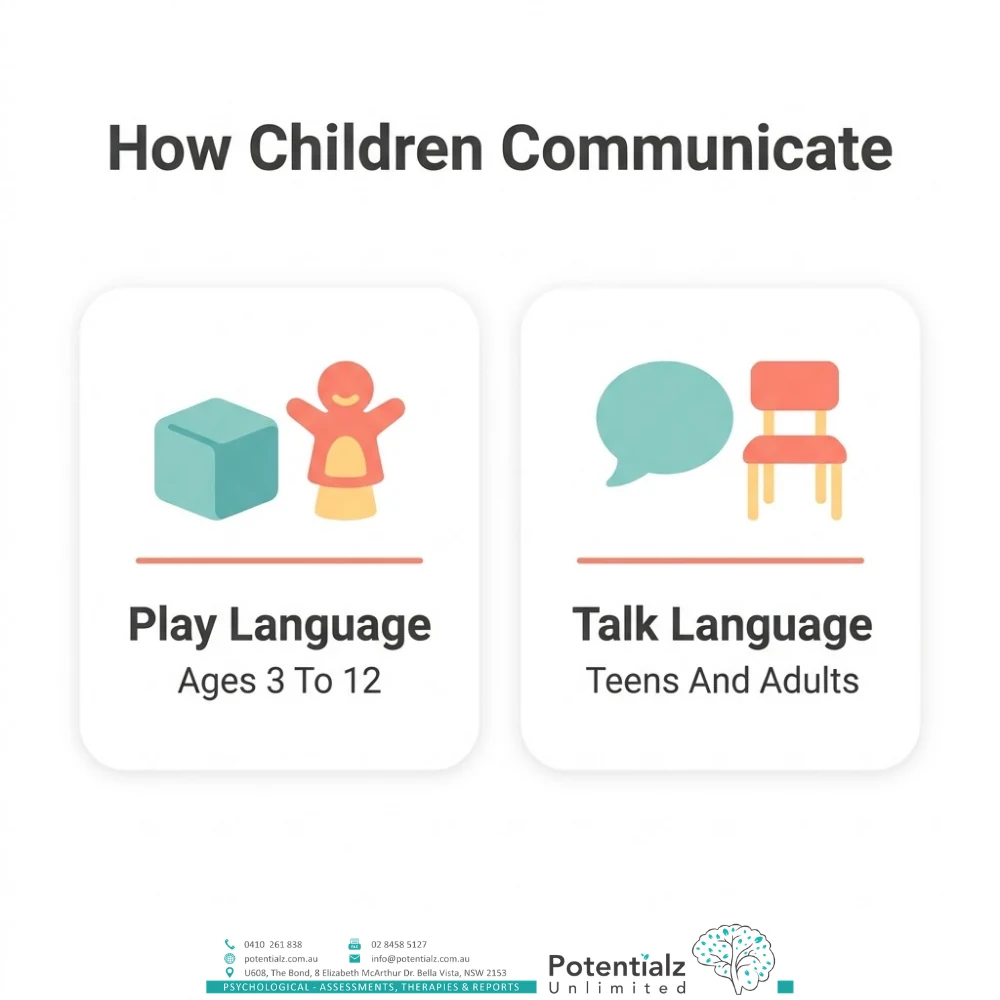
To an adult, “play therapy” can sound like a soft option. The reason it is not is developmental. Children aged three to twelve are not simply smaller adults. Their language is still forming. Their brains have not yet built the parts that let an adult sit in a chair and reflect on their inner life. Jean Piaget showed that children of this age think largely in symbolic and concrete ways rather than in abstract words (Piaget & Inhelder, 1969). The prefrontal cortex, which an adult uses to notice and name their feelings, is still developing well into adolescence (Casey et al., 2008).
A six-year-old asked to describe how they feel often cannot answer. They are not refusing. The route is not open yet.
Play is the route that is open. Virginia Axline, who built child-centred play therapy in the 1940s, described the playroom as a relationship of complete acceptance where a child can safely bring whatever is inside out into view (Axline, 1947). A trained practitioner reads the play rather than directing it. The child uses sand, miniatures, art, puppets or LEGO to externalise what they cannot say.
The research is clearer than many parents expect. A meta-analysis of 93 controlled play therapy studies reported a large overall treatment effect (0.80 standard deviations), with the largest effects when parents were involved in the work (Bratton et al., 2005). A more recent review of child-centred play therapy found a moderate overall effect (0.47 across 52 studies) and larger effects when parents were included in the work (Lin & Bratton, 2015). Child-centred play therapy delivered in schools has produced small but statistically significant improvements in behaviour, emotional difficulties, self-efficacy and academic outcomes (Ray et al., 2015).
What Play Therapy Is Not
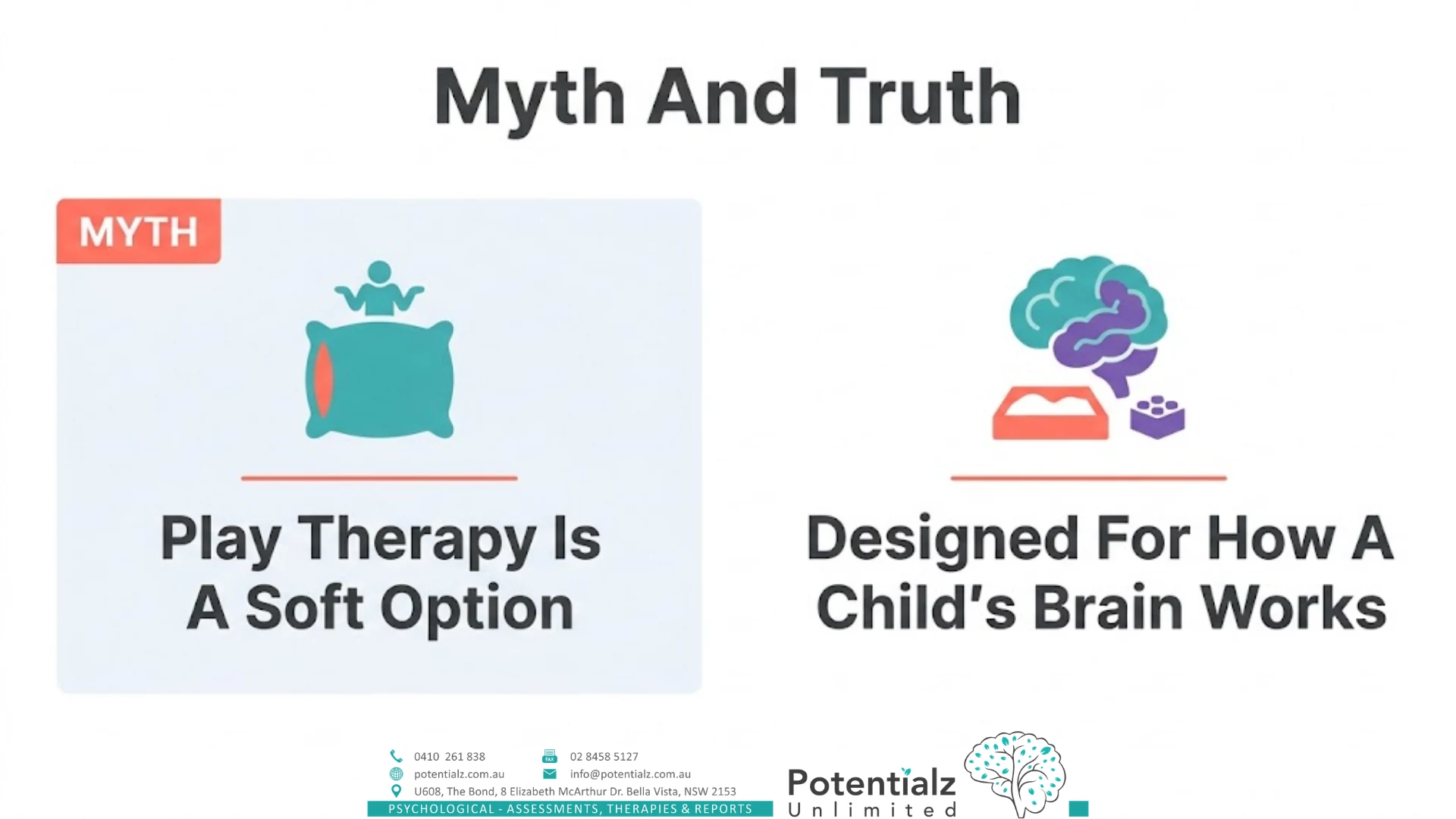
It is not a child sitting on the floor playing while an adult watches. It is not a reward for a bad day at school. It is not a shortcut for parenting advice, although parent coaching often sits alongside it.
It is also not a substitute for a diagnosis or a cognitive assessment. If what you need is a diagnostic answer — about autism, ADHD or a learning difficulty — the right starting point is a child psychologist in Bella Vista or a cognitive assessment. Play therapy can run alongside those, and often does.
What Happens in a First Block
Most families who come to us start with a parent consultation. This is a session with the practitioner, without the child in the room, usually around sixty minutes. We talk through what you have noticed, what has already been tried, what you know about your child’s story, and what you are hoping might change. For many parents this session is useful on its own, because it lays out what is going on in a way that fits what they have been seeing.
If play therapy looks like a sensible next step, the practitioner will recommend a block of sessions. A typical first block is around twelve sessions. The reason is simple. The first few sessions are the child getting to know the room and the practitioner. The middle sessions are where the real work tends to happen. The last sessions prepare the child for ending. A short block of three or four cannot do that work.
Every six weeks or so, you will come in without your child for a parent review. The practitioner shares what they are noticing in the playroom — themes, shifts, questions — and you share what you are noticing at home and at school. You decide together whether to keep going, change direction, or wind up.
Many children end at around twelve to twenty sessions. Some need longer — thirty, forty or more — particularly where trauma, grief or long-standing patterns are involved. The practitioner will be honest with you about what is realistic.
The Modalities, in Plain Words
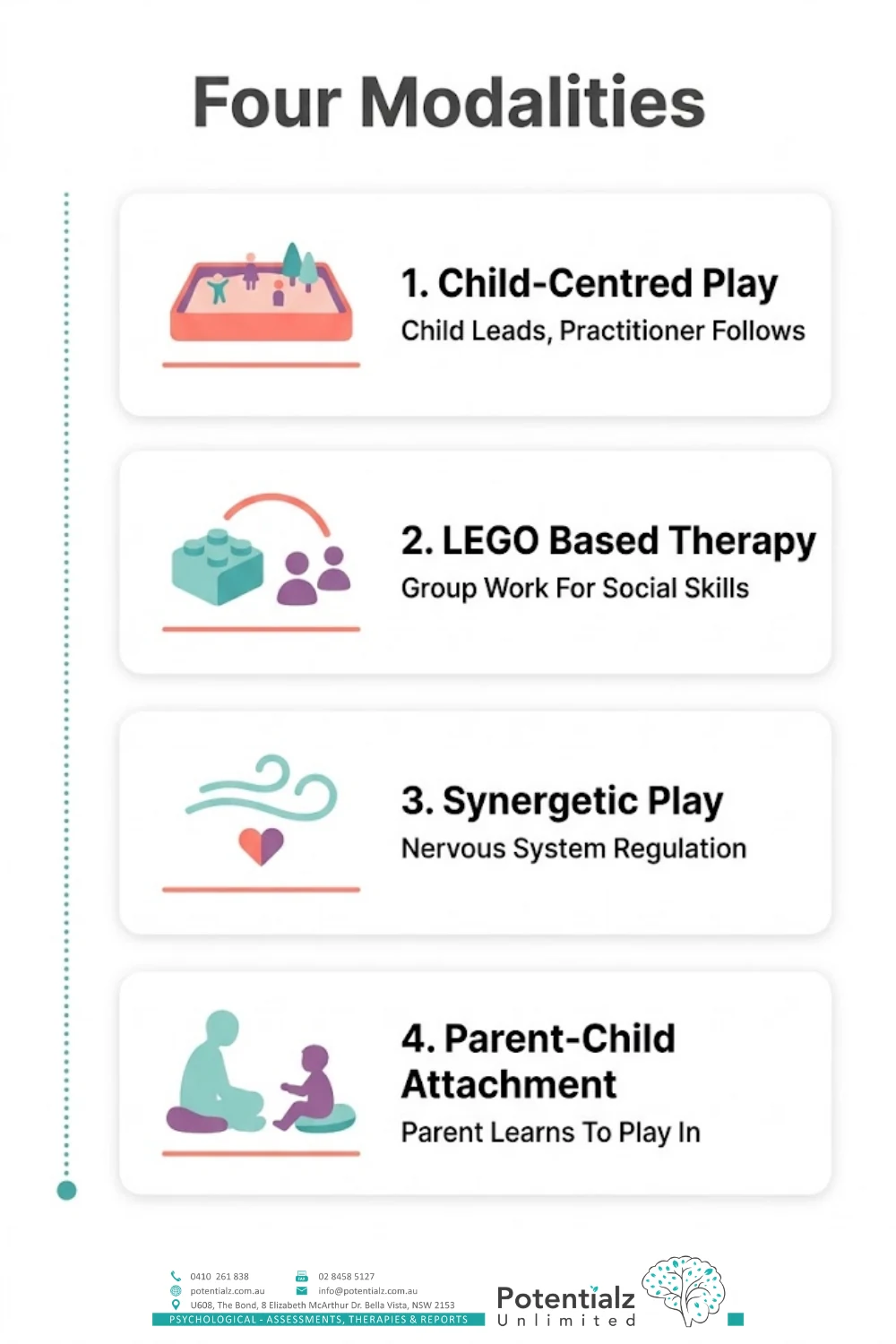
Child-centred play therapy is the base. The playroom is set up, the child chooses, and the practitioner follows. The relationship itself is the vehicle for change. Most of the research base sits here.
LEGO Based Therapy is a group modality developed by Dan LeGoff for children on the autism spectrum and children with social communication difficulties. In a small group, children take on the roles of Engineer, Supplier and Builder to construct a model together. The structure requires turn-taking, joint attention and communication without those being the explicit topic. The approach has evidence for improving social behaviour and peer interaction in autistic children (LeGoff & Sherman, 2006; Owens et al., 2008).
Synergetic Play Therapy, developed by Lisa Dion, integrates neuroscience and nervous system regulation. The approach is designed so that the child’s nervous system can borrow some of that regulation while processing difficult material. It is often chosen for children who hold trauma in their body or whose nervous systems are easily overwhelmed.
Parent-Child Attachment Play brings the parent into part of the work. Rather than the therapist doing the therapy and the parent waiting outside, the parent learns a specific way of being with their child in play. This can repair relationships that have been strained by illness, separation, early trauma or long periods of stress.
A single child does not always need all four. The practitioner recommends the mix that fits.
Who Play Therapy Suits
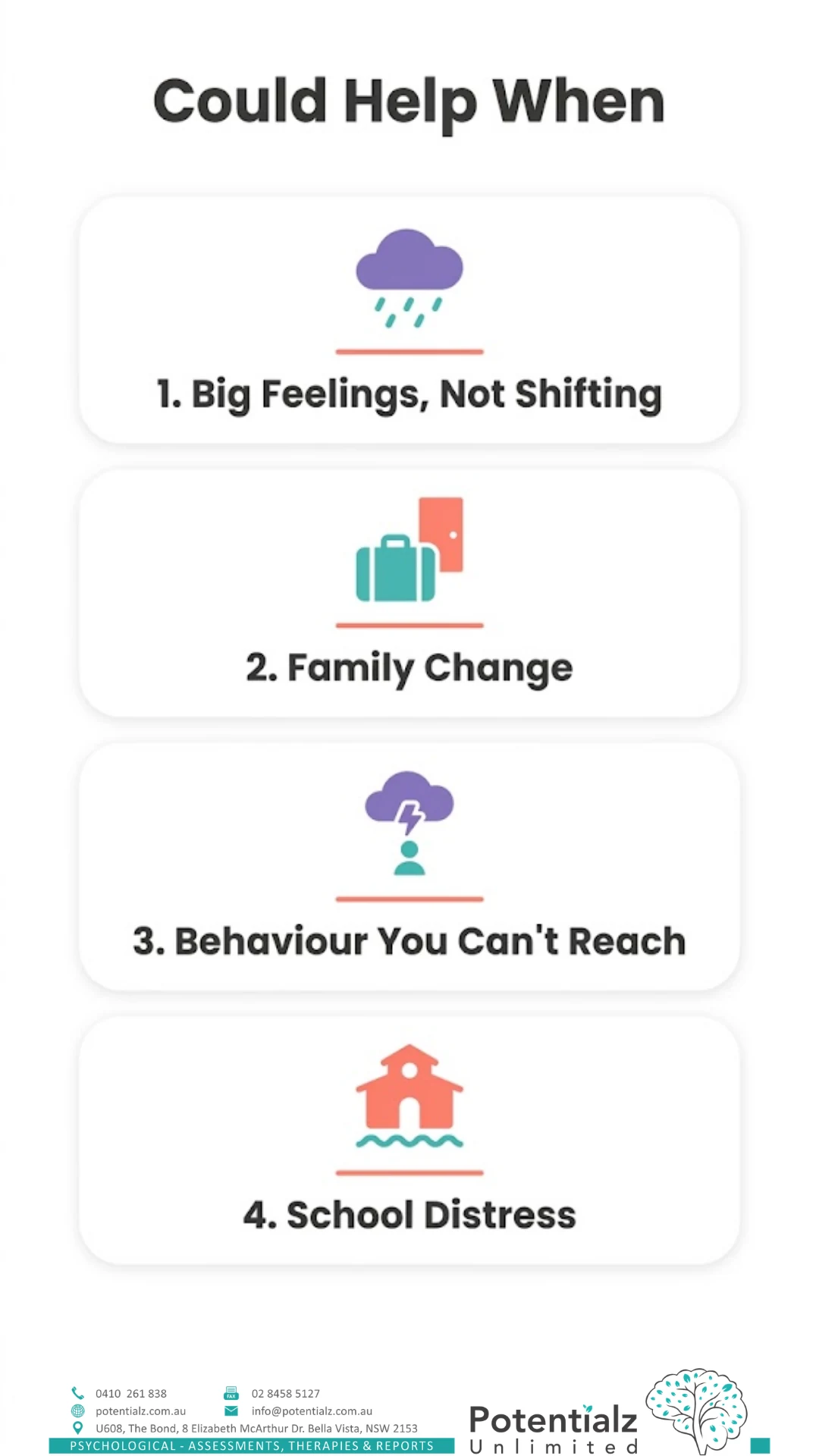
Play therapy is designed for children aged about three to twelve. It is not usually the first choice for teenagers, who are often ready for approaches that blend play with age-appropriate talking. Within the 3–12 window, play therapy is often a good fit for children who:
- Have big feelings — anxiety, anger, grief, fear — that are not shifting with ordinary family support.
- Have been through family change, such as separation, divorce, bereavement, a new baby, moving country or school.
- Are showing behaviour that worries you — defiance, meltdowns, withdrawal, clinginess, aggression — and the usual strategies are not working.
- Are neurodivergent, including autistic children and children with ADHD, and need a space built around how their nervous system actually works.
- Have experienced trauma, including domestic violence, medical trauma, early separation or abuse.
- Are struggling with school in a way that is clearly about feelings rather than ability — school refusal, selective mutism, friendship pain, bullying.
A child does not need a diagnosis to come for play therapy. Many of our families come because something feels off and the usual channels have not given them an answer yet.
When Play Therapy Is Not the Right Door
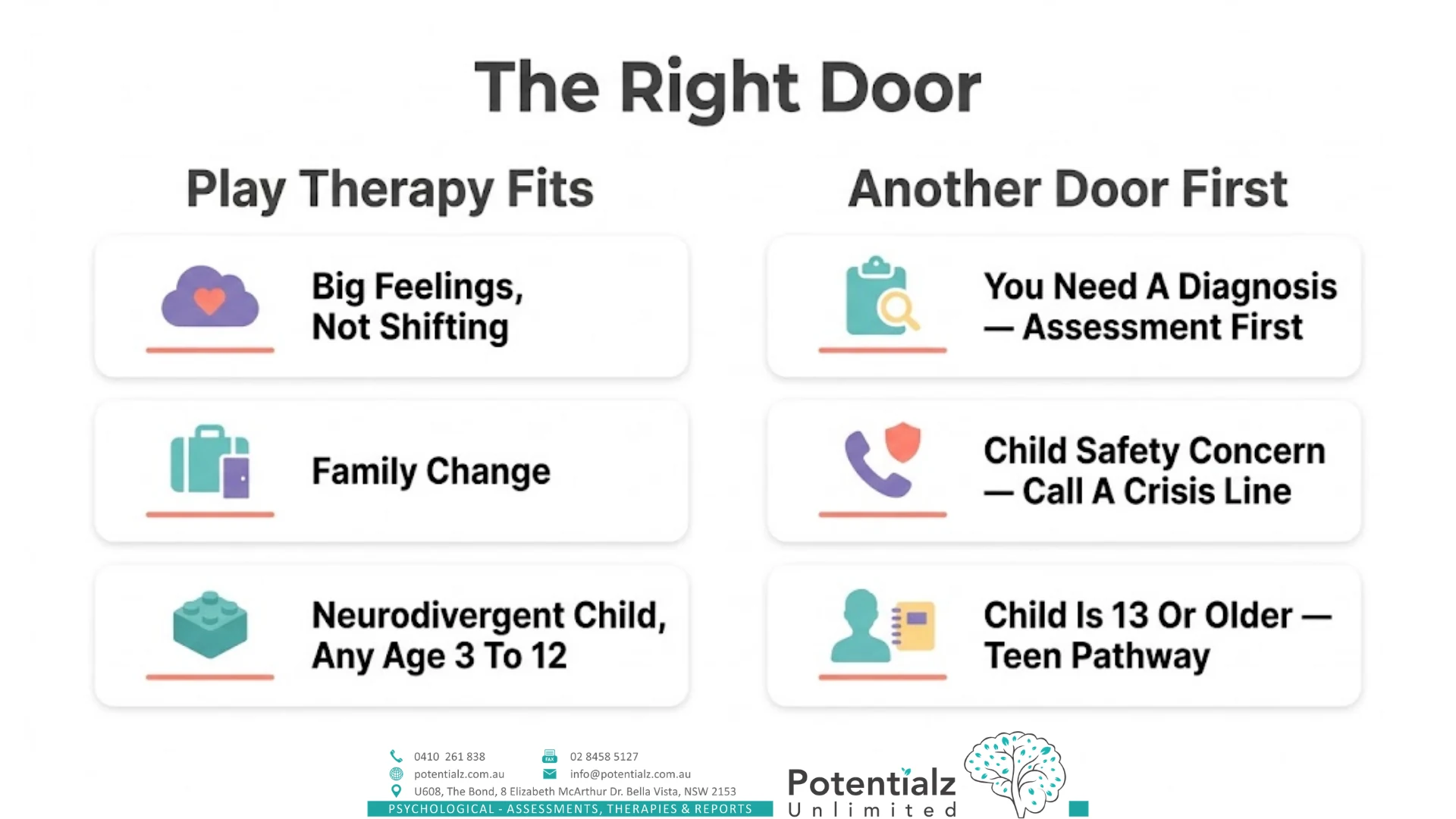
There are times when another door is better first.
- When your most pressing question is “does my child have ADHD or autism or a learning difficulty?” — the right first step is assessment. See ADHD psychology support in Bella Vista and IQ testing near me in Bella Vista.
- When there is active child safety concern. Please contact the NSW Child Protection Helpline on 132 111 or 000 in an emergency.
- When the child is older — around thirteen and above — a child psychologist using a flexible, teen-friendly approach is often a better match. See our guide on teenager refuses therapy and how to encourage engagement.
- When the pattern you are worried about looks more like a parenting mismatch than something in the child, parent coaching alone may do the work.
A good practitioner will tell you honestly if what you are describing is not the right fit for play therapy. If we do not think we are the right people for your child, we will say so and point you somewhere that might fit.
Three Composite Pictures
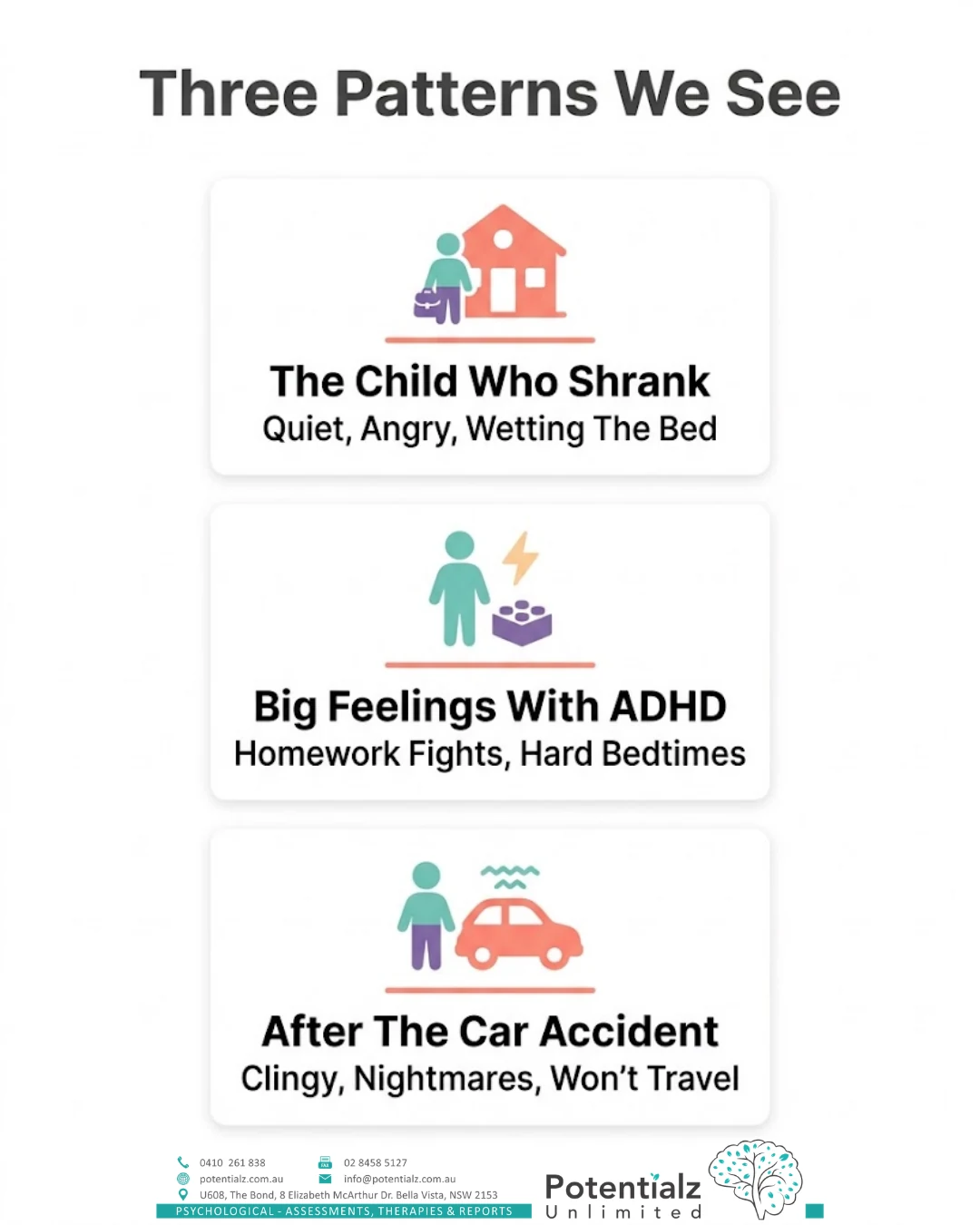
None of these is a real child. Each is a pattern that comes up often.
The six-year-old who started school and shrank. A boy who was bright and chatty at kindy has gone quiet at school. He says little when he comes home. He is angry at bedtime. He has started wetting the bed again. The parent consultation flags that his best friend moved schools and the family moved house in the same term. For some children in this situation, twelve sessions of child-centred play with a focus on separation and belonging, and two parent reviews, can help the child put a shape around the two losses in their own time.
The nine-year-old on the ADHD journey. A girl diagnosed with ADHD last year is doing well on medication for attention but still has very big feelings. Homework becomes a nightly fight. Her younger brother is scared of her. The practitioner uses a mix of child-centred play and LEGO-based group work. In parallel, her parents do parent coaching. Families in this situation often notice, over several months, that the home temperature drops and the child begins to notice her own anger a little earlier — a developmental shift as much as a therapeutic one.
The seven-year-old after a car accident. A child was in a minor car accident with her mum. Both are physically fine. The child has started refusing to be in a car. She is clingy at school drop-off and wakes with nightmares. Synergetic Play Therapy, with the mother included in some sessions, aims to help the child’s nervous system settle. Families in this situation often notice, over a few months, that the symptoms become less intense and the child can tolerate short car trips again.
Every child is different. These composites illustrate the process; they are not a prediction of results for any child. What tends to shift is not described in words during the sessions — it moves through play.
What a Play Therapy Room Actually Looks Like
The room is not a toy shop. It is deliberately set up with the same materials each session, so a child knows what to expect. A typical room has:
- A sand tray with a wide range of miniatures — people, animals, buildings, trees, fences, vehicles — so a child can build a world and tell a story.
- Art materials — paint, pencils, clay, collage — for non-verbal expression.
- Puppets and dolls of different ages, families and feelings.
- Building materials including LEGO, blocks, and construction sets.
- A nurture corner with soft toys, blankets, and sometimes a bottle or baby doll, because many children need to go back and be small for a while before they move forward.
- Space for movement — a safe place to be big, loud, fast, or still.
The practitioner follows the child’s lead. They notice themes rather than interpret them out loud. They set clear limits around safety. Sessions are usually 50 minutes.
What It Costs, and What NDIS or Medicare Can Do
We do not want to put specific figures on a web page that will go out of date, but these are the usual shapes.
- Parent consultation (initial). A standalone first session, around sixty minutes, for the practitioner and parents.
- Play therapy sessions. Fifty-minute sessions, usually weekly to begin with, then spacing out as the child progresses.
- Parent review sessions. Around every six weeks, same length as a session, without the child.
- Package pricing. Ask reception about package pricing and its terms.
On funding:
- Medicare. Play therapy delivered by a Practitioner in Therapeutic Play is not Medicare-rebatable. Medicare rebates for therapy require a GP Mental Health Treatment Plan and sessions with an eligible provider such as an AHPRA-registered psychologist. If Medicare rebate is important, our psychologists offer therapy under that pathway.
- NDIS. Many families use NDIS Capacity Building funding for play therapy. Potentialz Unlimited is not a registered NDIS provider, so we can work with participants whose plans are self-managed or plan-managed, but not agency-managed. Reception can talk through what this means for your plan. For a deeper read, see our guide on NDIS funding for play therapy.
- Private health insurance. Rebates for Practitioner in Therapeutic Play sessions are uncommon — most funds restrict psychology rebates to AHPRA-registered psychologists. Check with your insurer before relying on it.
Reception can give you current session fees and current wait times honestly, over a short phone call. That is usually more useful than a form.
How to Choose a Play Therapist Near You
Three practical questions are usually enough.
What are you qualified in, and when was your last supervision? The title “play therapist” is not legally restricted in Australia. Look for current certification in a recognised modality — PTUK/PTSA, Synergetic Play Therapy, LEGO Based Therapy, Parent-Child Attachment Play — and look for someone who is actively in clinical supervision.
What does your approach look like? A good practitioner can describe their approach without jargon and without over-promising. If a practitioner says they can “fix” your child in a specific number of sessions, be cautious. If they talk about building a relationship, following the child, meeting them at their nervous system, and keeping you in the loop, that is a better sign.
What else is around you? A single practitioner working alone is different from a practitioner inside a multidisciplinary team. At Potentialz Unlimited, play therapy sits alongside clinical psychology, child psychology, assessment and family therapy. If your child needs a different service tomorrow — an ADHD assessment, a trauma therapy for a parent, a cognitive assessment — the same team can usually help, so you do not need to retell the story from the beginning.
Related Reading, by Question
- “Does my child need play or talk?” — Play therapy vs talk therapy for children
- “My child is anxious.” — Anxiety in children and play therapy
- “My child’s behaviour has become unmanageable.” — Big emotions in children and play therapy
- “My child has had a hard time.” — Childhood trauma, adverse experiences, and play therapy
- “My child is autistic.” — Play therapy, autism, and LEGO-based social skills
- “We are going through a family change.” — Family change, divorce, separation and new siblings
- “My child will not go to school.” — School refusal — what is really going on
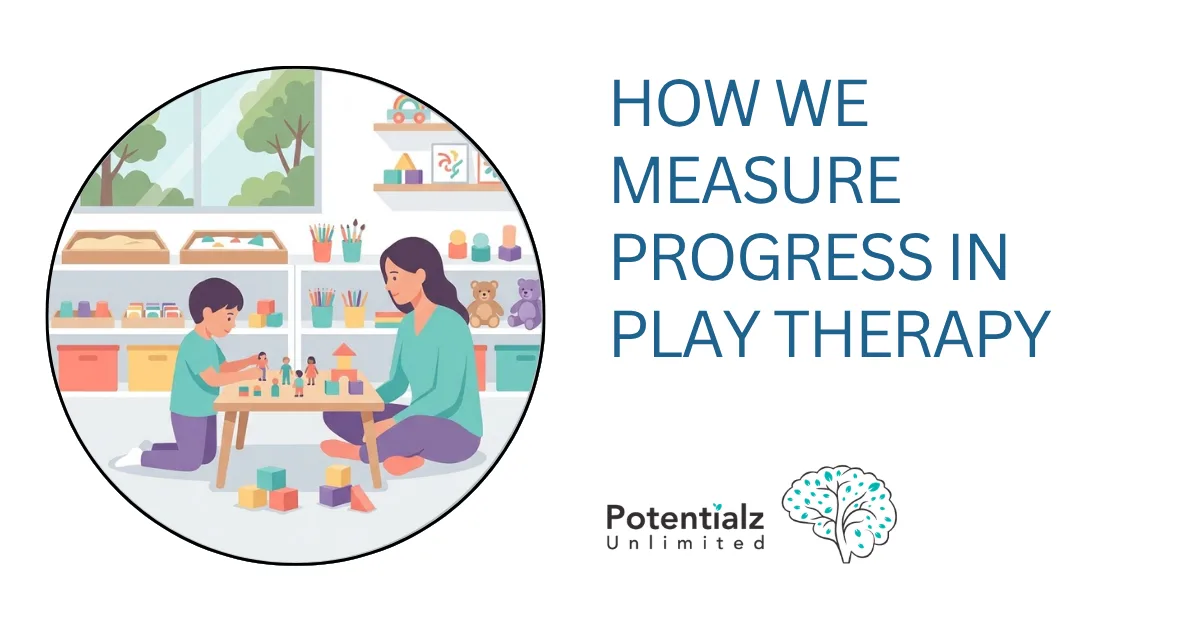
- “How is progress measured?” — Play therapy assessments and measuring progress
Play Therapy in Bella Vista and the Hills District
Potentialz Unlimited is based in Bella Vista, NSW, in Norwest Business Park. We support families from across the Hills District — Norwest, Castle Hill, Kellyville, Baulkham Hills and Rouse Hill — and from further across north-western Sydney.
Play therapy is delivered by our Practitioner in Therapeutic Play, inside a multidisciplinary team of AHPRA-registered psychologists. If your child needs something adjacent — an ADHD assessment, a cognitive assessment, a child psychologist, or support for a parent — the same team can usually help without you having to retell your family’s story elsewhere.
A short phone call with reception is usually the most useful starting point. Reception can talk through your question, the current wait, the fee, and whether a parent consultation is the right first step. You can contact the clinic or book online at live.potentialz.com.au.
Disclaimer
The information in this article is general in nature. It is not clinical advice for your situation. Please speak with a qualified health professional about your own circumstances. If you are in crisis, contact your GP, call Lifeline on 13 11 14, or go to your nearest emergency department.
Crisis and Support Resources
- Lifeline: 13 11 14 (24/7)
- Kids Helpline: 1800 55 1800 (ages 5–25)
- Beyond Blue: 1300 22 4636
- 1800RESPECT (domestic and family violence, sexual assault): 1800 737 732
- NSW Child Protection Helpline: 132 111
- 13YARN (Aboriginal and Torres Strait Islander crisis line): 13 92 76
- Emergency: 000
References
Axline, V. M. (1947). Play therapy: The inner dynamics of childhood. Houghton Mifflin.
Bratton, S. C., Ray, D., Rhine, T., & Jones, L. (2005). The efficacy of play therapy with children: A meta-analytic review of treatment outcomes. Professional Psychology: Research and Practice, 36(4), 376–390. https://doi.org/10.1037/0735-7028.36.4.376
Casey, B. J., Getz, S., & Galvan, A. (2008). The adolescent brain. Developmental Review, 28(1), 62–77. https://doi.org/10.1016/j.dr.2007.08.003
LeGoff, D. B., & Sherman, M. (2006). Long-term outcome of social skills intervention based on interactive LEGO play. Autism, 10(4), 317–329. https://doi.org/10.1177/1362361306064403
Lin, Y., & Bratton, S. C. (2015). A meta-analytic review of child-centered play therapy approaches. Journal of Counseling & Development, 93(1), 45–58. https://doi.org/10.1002/j.1556-6676.2015.00180.x
Owens, G., Granader, Y., Humphrey, A., & Baron-Cohen, S. (2008). LEGO therapy and the social use of language programme: An evaluation of two social skills interventions for children with high functioning autism and Asperger syndrome. Journal of Autism and Developmental Disorders, 38(10), 1944–1957. https://doi.org/10.1007/s10803-008-0590-6
Piaget, J., & Inhelder, B. (1969). The psychology of the child. Basic Books.
Ray, D. C., Armstrong, S. A., Balkin, R. S., & Jayne, K. M. (2015). Child-centered play therapy in the schools: Review and meta-analysis. Psychology in the Schools, 52(2), 107–123. https://doi.org/10.1002/pits.21798
Knowledge Check Quiz
Test what you have just read. Choose your answer for each question, then submit to reveal the answers and your score.
Need Professional Support?
If you're experiencing mental health concerns, our team is here to help.