Key Takeaways
- Pranayama is the yogic science of breath regulation — distinct from casual breathwork by its roots in yogic tradition and its precise understanding of breath as a tool for changing mental and energetic states.
- The neuroscience is clear: conscious breath regulation activates the vagus nerve, improves heart rate variability (HRV), and shifts the nervous system from sympathetic (threat) to parasympathetic (rest and restore) dominance.
- Different techniques serve different purposes: Nadi Shodhana balances, Bhramari calms, Kapalabhati energises (with caution for anxiety), 4-7-8 supports sleep, and box breathing regulates acute stress.
- Research supports pranayama for reducing anxiety, depression, PTSD symptoms, and cortisol levels.
- Breathwork in a clinical context requires guidance — some techniques are contraindicated in certain presentations.
Take a breath right now. A slow one. Exhale a little longer than the inhale.
Did you feel something shift?
That’s not a coincidence. And it’s not just relaxation. That is your nervous system changing state in real time — because you used the one tool you always have with you.
Breath is life. In yoga, we’ve known this for thousands of years. And now neuroscience is catching up, confirming what ancient practitioners understood through observation and practice: the breath is not just a mechanical function. It is a direct pathway into the nervous system, a real-time regulator of emotional state, and one of the most powerful therapeutic tools available to us.
In yoga, we call it pranayama — the art of conscious breath. Prana means life force. Ayama means to extend or expand. So pranayama is literally the practice of expanding your life force through the breath. Ancient wisdom. And now modern neuroscience confirms it: slow, deep breathing activates your body’s natural calming system and lowers stress hormones. The ancients were onto something profound.
This post is for anyone who wants to understand what pranayama actually is, what the science says, which techniques are useful for which presentations, and when working with a clinician who integrates breathwork makes sense.
What Is Pranayama — And How Does It Differ from General Breathwork?
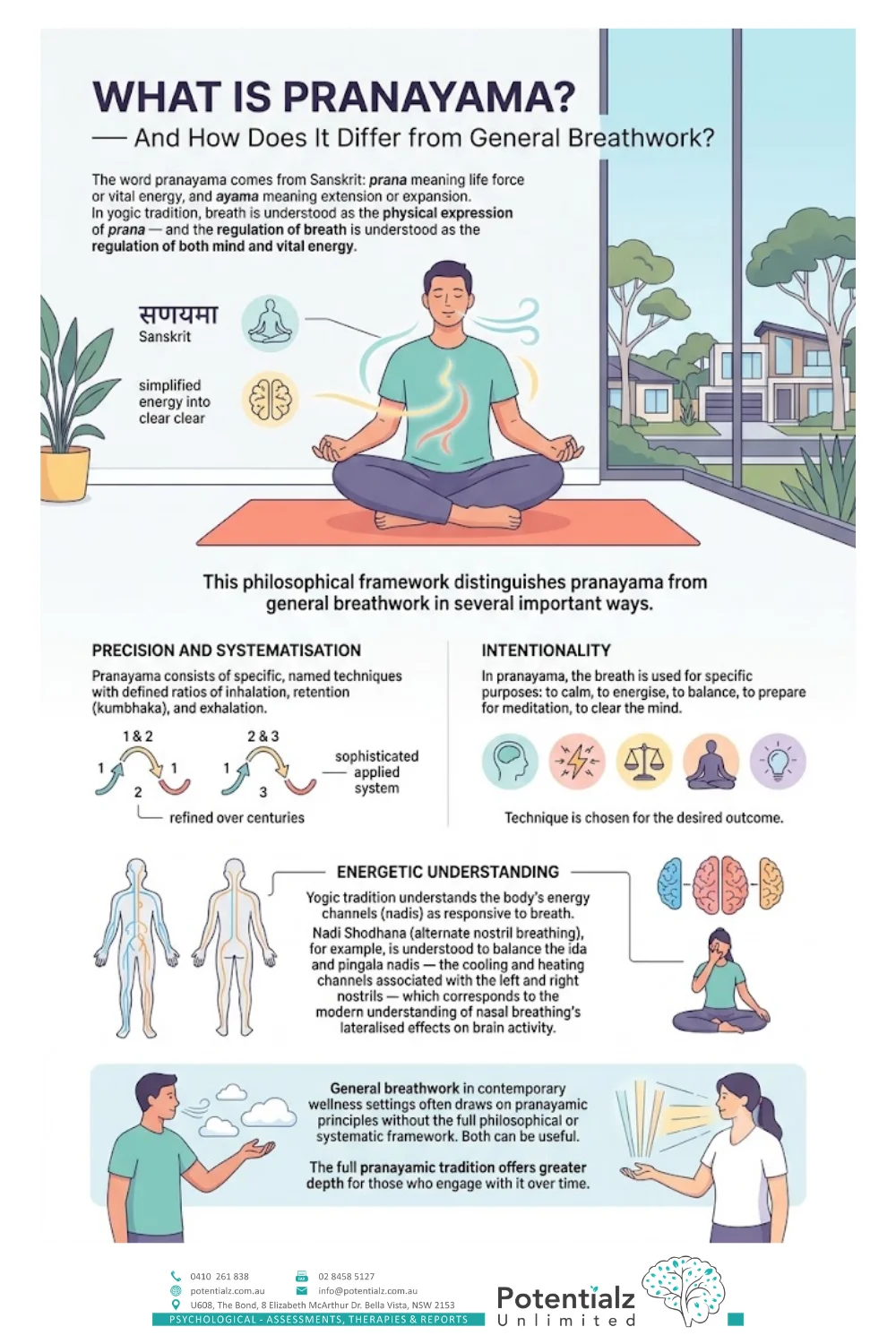
The word pranayama comes from Sanskrit: prana meaning life force or vital energy, and ayama meaning extension or expansion. In yogic tradition, breath is understood as the physical expression of prana — and the regulation of breath is understood as the regulation of both mind and vital energy.
This philosophical framework distinguishes pranayama from general breathwork in several important ways.
Precision and systematisation. Pranayama consists of specific, named techniques with defined ratios of inhalation, retention (kumbhaka), and exhalation. These ratios have been developed and refined over centuries and are understood to produce specific physiological and psychological effects. This is not casual breathing awareness — it is a sophisticated applied system.
Intentionality. In pranayama, the breath is used for specific purposes: to calm, to energise, to balance, to prepare for meditation, to clear the mind. The technique is chosen for the desired outcome, not applied generically.
Energetic understanding. Yogic tradition understands the body’s energy channels (nadis) as responsive to breath. Nadi Shodhana (alternate nostril breathing), for example, is understood to balance the ida and pingala nadis — the cooling and heating channels associated with the left and right nostrils — which corresponds to the modern understanding of nasal breathing’s lateralised effects on brain activity.
General breathwork in contemporary wellness settings often draws on pranayamic principles without the full philosophical or systematic framework. Both can be useful. The full pranayamic tradition offers greater depth for those who engage with it over time.
The Neuroscience: Why Breath Changes the Brain
Have you ever noticed how your body changes when you feel truly safe? Your shoulders drop. Your jaw unclenches. Your breathing deepens. That’s not imagination — that’s your nervous system shifting into a state of genuine safety.
Now here’s something remarkable. You can create that shift intentionally — through the breath. Here’s why.
The Vagus Nerve and Vagal Tone
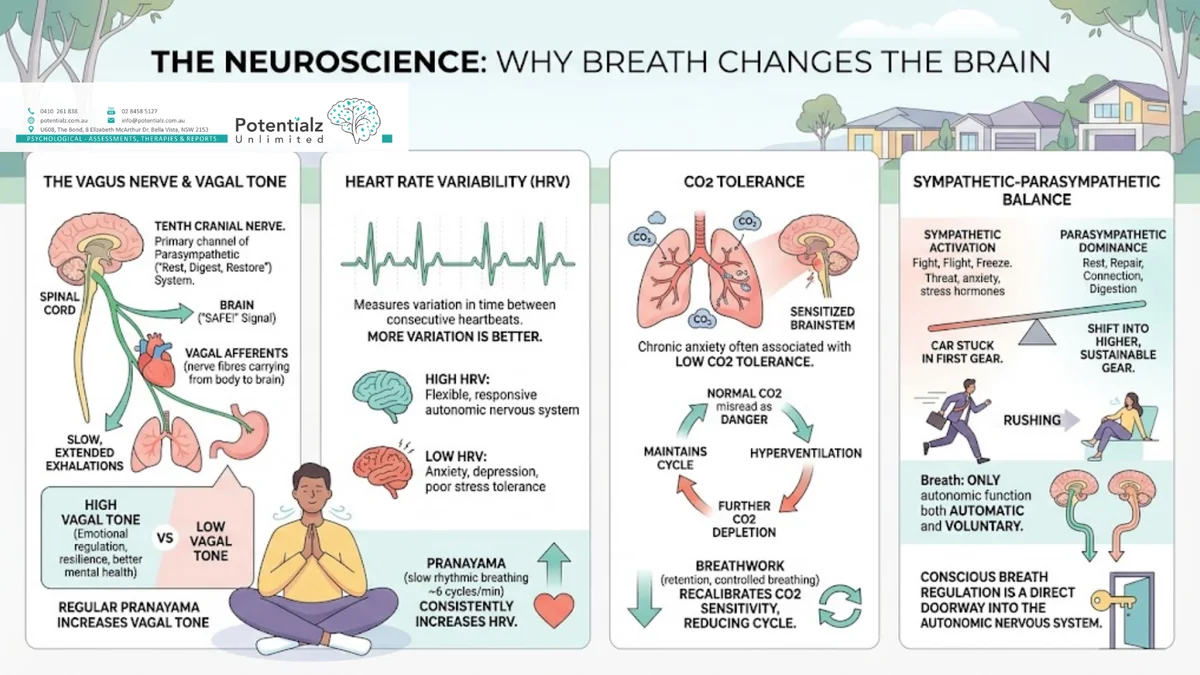
The vagus nerve is the tenth cranial nerve and the primary channel of the parasympathetic nervous system — the “rest, digest, and restore” system. It runs from the brainstem through the chest and abdomen, innervating the heart, lungs, and digestive organs. Crucially, it responds to the pace and depth of breathing.
Slow, extended exhalations activate vagal afferents — nerve fibres that carry signals from the body to the brain — and signal to the brain that the organism is safe and can downregulate its threat response. This is the physiological basis of why slow breathing calms anxiety: it directly tells the nervous system to switch modes.
Vagal tone refers to the baseline activity level of the vagus nerve. Higher vagal tone is associated with greater emotional regulation, resilience to stress, social engagement capacity, and better overall mental health. Regular pranayama practice increases vagal tone — meaning it creates a lasting shift in the nervous system’s baseline, not just an in-the-moment calming effect.
Heart Rate Variability (HRV)
HRV measures the variation in time between consecutive heartbeats. Counterintuitively, more variation is better — high HRV indicates a flexible, responsive autonomic nervous system capable of modulating its state in response to changing demands. Low HRV is associated with anxiety, depression, cardiovascular disease, and poor stress tolerance.
Pranayama, particularly slow rhythmic breathing at around six breath cycles per minute, consistently increases HRV in research studies. This represents not just a feeling of calm but a measurable physiological shift.
CO2 Tolerance
Much chronic anxiety is associated with low CO2 tolerance — a sensitised respiratory response that misinterprets normal CO2 levels as danger, triggering hyperventilation that then depletes CO2 further, maintaining a cycle of physiological anxiety. Breathwork practices involving breath retention (kumbhaka) and controlled breathing help recalibrate CO2 sensitivity, reducing this anxiety-perpetuating cycle.
Sympathetic-Parasympathetic Balance
The autonomic nervous system operates on a spectrum between sympathetic activation (fight, flight, freeze — associated with threat, anxiety, and stress hormones) and parasympathetic dominance (rest, repair, connection, digestion). Modern life for many people is chronically sympathetically dominant — perpetual low-grade threat activation that never fully resolves.
Think of it this way: your nervous system is like a car stuck in first gear. Pranayama is how you shift into a higher, more sustainable gear. The breath is unique among autonomic functions in that it is the only one that operates both automatically and under voluntary control. This dual pathway means conscious breath regulation is a direct doorway into the autonomic nervous system — a level of agency over your physiology that few other practices can match.
Specific Techniques and Their Clinical Applications
Nadi Shodhana — Alternate Nostril Breathing
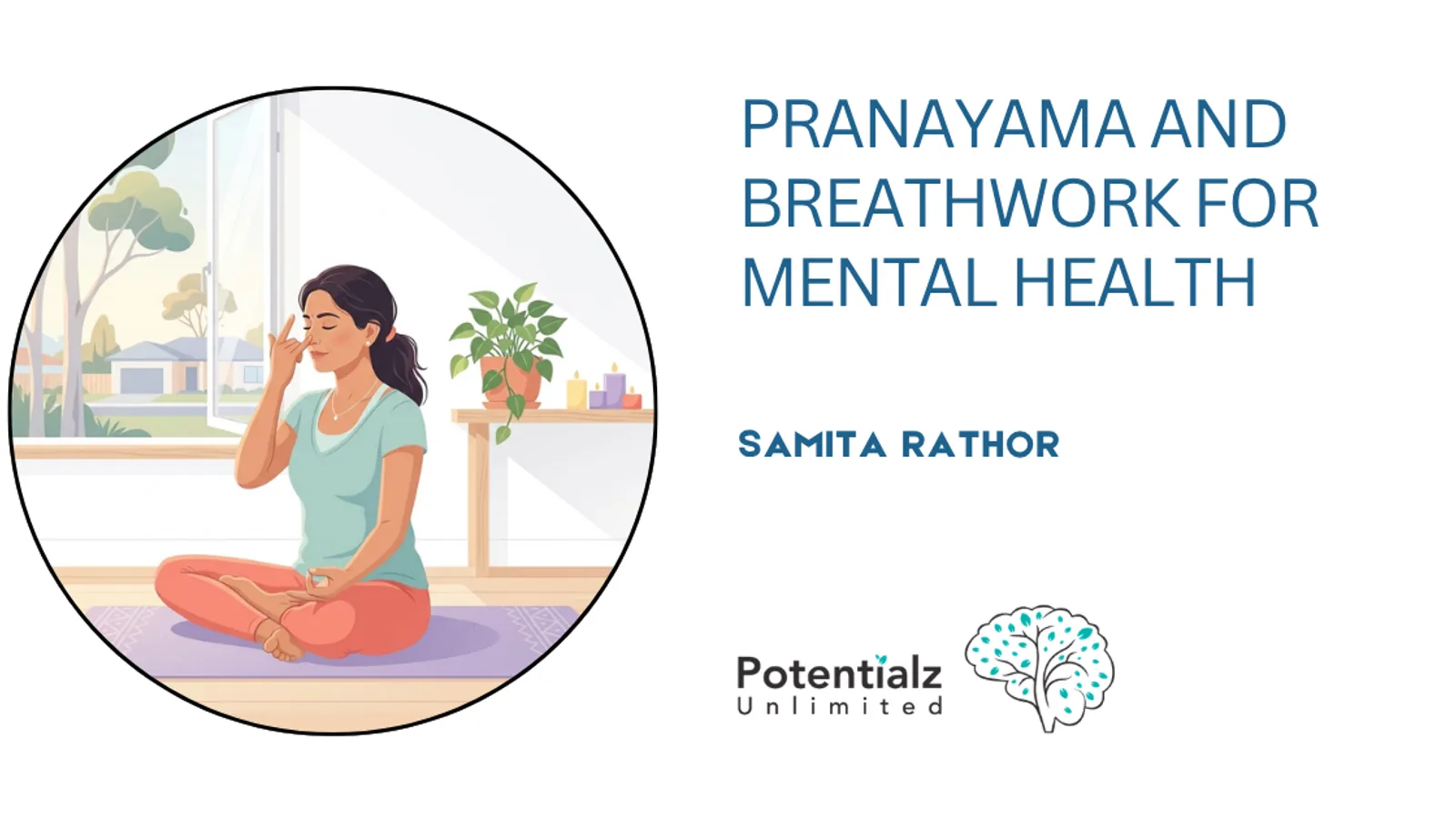
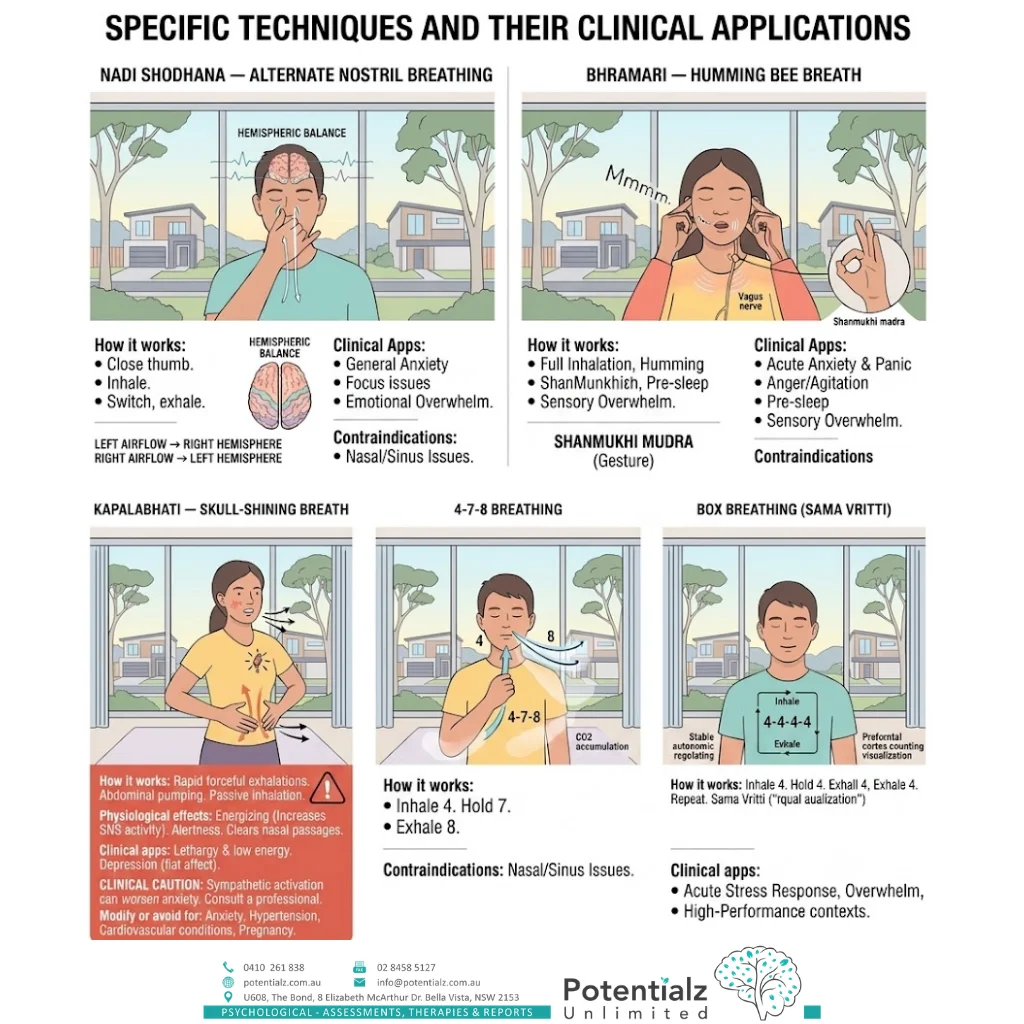
How it works: Use the right thumb to close the right nostril and inhale through the left. Close both nostrils briefly. Release the right nostril and exhale through the right. Inhale through the right. Close both. Release the left and exhale. This is one cycle. Typical practice: 5–10 minutes.
Physiological effects: Nadi Shodhana creates balanced activation of both cerebral hemispheres by alternating the primary nostril of breathing. Research using EEG demonstrates that nasal airflow lateralises cortical activity — left nostril breathing activates the right hemisphere; right nostril breathing activates the left. Alternating between them produces a state of hemispheric coherence associated with calm, clear thinking.
Clinical applications: Anxiety (general), pre-exam or pre-performance preparation, difficulty concentrating, agitation, emotional overwhelm. One of the most accessible and universally appropriate techniques.
Contraindications: Generally safe across presentations. May need adaptation for those with nasal obstruction or significant sinus issues.
Bhramari — Humming Bee Breath
How it works: Inhale fully. On exhalation, make a continuous humming sound — like a bee — with the mouth closed. Optionally use Shanmukhi mudra: index fingers over ears, thumbs over the tragus (the small flap in front of the ear canal) — to internalise the sound. Repeat for 5–10 cycles.
Physiological effects: The humming vibration stimulates the vagus nerve directly via acoustic resonance. Research shows Bhramari significantly reduces blood pressure, heart rate, and cortisol levels, and rapidly shifts subjective state from agitation to calm. Nitric oxide production in the sinuses is increased by humming, which has additional cardiovascular benefits.
Clinical applications: Acute anxiety, panic, anger or agitation, pre-sleep settling, sensory overwhelm. It is also one of several tools in the holistic management of anger. Particularly effective for teenagers and children due to its somewhat playful quality. Useful for trauma clients who find silence uncomfortable — the sound provides an internal object of focus.
Contraindications: Contraindicated in ear infections. Otherwise widely safe.
Kapalabhati — Skull-Shining Breath
How it works: Begin with a normal inhalation, then produce a series of rapid, forceful exhalations by sharply pumping the abdomen inward, each followed by a passive inhalation. Typically 20–30 pumps followed by a rest and natural breathing. This is an energising, stimulating practice.
Physiological effects: Kapalabhati rapidly increases sympathetic nervous system activity, elevates heart rate, increases alertness, and clears the nasal passages. It is described in yogic tradition as a kriya (cleansing practice) as much as a pranayama.
Clinical applications: Low energy, lethargy, depression with flat affect, before physical activity or demanding cognitive tasks. Useful when the presentation requires activation rather than calming.
Clinical caution: Kapalabhati is contraindicated or requires significant modification for clients with anxiety disorders, hypertension, cardiovascular conditions, epilepsy, recent abdominal surgery, or pregnancy. In an anxiety presentation, the sympathetically activating effects of Kapalabhati can worsen the very state the client is seeking to manage. This is exactly why clinical guidance matters — what helps in one context can actively harm in another.
4-7-8 Breathing
How it works: Inhale through the nose for a count of four. Hold for a count of seven. Exhale through the mouth with a slight whooshing sound for a count of eight. Repeat four cycles. If the extended hold is difficult, shorter ratios can be used.
Physiological effects: The extended exhalation (longer than the inhalation) maximally activates the parasympathetic system. The extended breath hold allows CO2 to accumulate slightly, promoting a gentle, natural relaxation and supporting the shift toward parasympathetic dominance.
Clinical applications: Pre-sleep. One of the most effective non-pharmacological tools for sleep onset difficulties, particularly anxiety-driven insomnia. Also useful after a stressful event or difficult conversation.
Contraindications: Breath retention should be avoided during pregnancy. May cause lightheadedness in those with low blood pressure — the technique should be done seated or lying down.
Box Breathing (Sama Vritti)
How it works: Inhale for four counts. Hold for four counts. Exhale for four counts. Hold for four counts. Repeat. This equal-ratio technique is also known as sama vritti (“equal fluctuation”) in pranayamic tradition.
Physiological effects: Equal-ratio breathing produces a stable, balanced autonomic state. The pauses introduce moments of stillness that train voluntary regulation of the respiratory reflex. Used extensively in military, emergency service, and high-performance sport contexts precisely because it works in acute high-stress situations.
Clinical applications: Acute stress response, pre-performance anxiety, moments of overwhelm. The structure itself is regulating — the counting occupies the prefrontal cortex and interrupts ruminative threat-focused thinking.
Contraindications: Generally safe. Modify or avoid breath retention for those with panic disorder whose symptoms include breath-related fear.
What the Research Says
The research base for pranayama in mental health is substantial and growing.
A systematic review examining 15 studies found that slow-paced breathing practices reliably reduced subjective anxiety, improved HRV, and produced favourable autonomic nervous system changes. Effects were present after both single sessions and regular practice.
Regarding pranayama for clinical populations: researchers Brown and Gerbarg documented significant PTSD symptom reduction through coherent breathing combined with other yogic practices in tsunami survivors and disaster-affected communities. Multiple controlled trials have demonstrated that yoga and pranayama together produce outcomes comparable to antidepressant medication for mild to moderate depression in adult samples.
A systematic review of pranayama trials found consistent evidence of improved physiological and psychological outcomes across anxiety, stress, asthma, cardiovascular function, and cognitive performance. The authors concluded that pranayama produces demonstrable benefits through identifiable physiological mechanisms and should be considered a legitimate adjunct in health and mental health care.
Ancient wisdom. Modern proof. Both pointing in the same direction.
How Samita Integrates Pranayama into Counselling Sessions
At Potentialz Unlimited, pranayama and breathwork are not offered as a separate wellness class — they are integrated into counselling sessions as therapeutic tools, selected for each client’s specific presentation and needs.
In practice, this might look like:
- Beginning a session with 5 minutes of Nadi Shodhana to help a client with generalised anxiety arrive fully in the room and settle their nervous system before we begin verbal work
- Teaching Bhramari to a client with panic disorder as a physiological interrupt they can use when they feel an attack beginning
- Using 4-7-8 breathing in a session with a client whose sleep disruption is driving their depressive symptoms, and providing a home practice plan
- Introducing box breathing to a professional client managing occupational stress, as a portable technique that can be practised discreetly during a working day
- Exercising caution and selecting calming rather than activating techniques for clients with severe anxiety, and deferring Kapalabhati entirely for clients with panic presentations
I always introduce breathwork with psychoeducation — explaining the physiological mechanism — so clients understand why it works. This psychoeducation itself has therapeutic value. When you understand why your body responds the way it does, you stop catastrophising normal physiological arousal. And that is one of the most important steps in breaking the anxiety cycle.
When Breathwork Needs Clinical Guidance
Some breathwork practices that have gained popularity in wellness settings are not uniformly safe. Extended breath holding, hyperventilation protocols, and high-intensity breathwork carry genuine risks for people with:
- Cardiovascular conditions
- Seizure disorders
- Severe anxiety or panic disorder
- Trauma histories (certain breathwork practices can trigger dissociation or flashbacks)
- Pregnancy
Even gentler pranayamic practices benefit from individual clinical guidance, because what is regulating for one person can be destabilising for another. The difference between a breathing practice that helps and one that harms can be subtle. A clinician trained in both breathwork and mental health is best placed to navigate it.
If you are unsure, please ask before beginning any intensive breathwork practice.
How Potentialz Can Help
At Potentialz Unlimited, I integrate pranayama and breathwork into individual counselling sessions as part of a holistic, evidence-informed approach. Whether you are managing anxiety, stress, depression, or sleep difficulties, breathwork offers a set of tools that can make a meaningful difference — alongside other therapeutic modalities tailored to your needs.
For those experiencing anxiety specifically, our anxiety support services provide additional information about the range of approaches available. Sessions are available face-to-face in Bella Vista or via Telehealth across NSW.
To book, visit live.potentialz.com.au or call 0410 261 838.
Please note: Samita Rathor is a holistic counsellor and yoga therapist, not an AHPRA-registered psychologist. Counselling sessions with Samita are not Medicare-rebatable. For clinical anxiety or trauma where CBT, ACT, or EMDR is indicated, our psychology colleagues at Potentialz can help — see Sleep and Mental Health and The Complex Dance of Anxiety and Sleep Disturbances.
If your low mood or worry ever brings thoughts of not wanting to be here, please reach out for urgent support now: call Lifeline on 13 11 14, or in an emergency call 000.
References
Brown, R. P., & Gerbarg, P. L. (2005). Sudarshan Kriya yogic breathing in the treatment of stress, anxiety, and depression: Part I — neurophysiologic model. Journal of Alternative and Complementary Medicine, 11(1), 189–201. https://doi.org/10.1089/acm.2005.11.189
Descilo, T., Vedamurtachar, A., Gerbarg, P. L., Nagaraja, D., Gangadhar, B. N., Damodaran, B., Adelson, B., Braslow, L. H., Marcus, S., & Brown, R. P. (2010). Effects of a yoga breath intervention alone and in combination with an exposure therapy for post-traumatic stress disorder and depression in survivors of the 2004 South-East Asia tsunami. Acta Psychiatrica Scandinavica, 121(4), 289–300. https://doi.org/10.1111/j.1600-0447.2009.01466.x
Jerath, R., Crawford, M. W., Barnes, V. A., & Harden, K. (2015). Self-regulation of breathing as a primary treatment for anxiety. Applied Psychophysiology and Biofeedback, 40(2), 107–115. https://doi.org/10.1007/s10484-015-9279-8
Porges, S. W. (2011). The polyvagal theory: Neurophysiological foundations of emotions, attachment, communication, and self-regulation. W. W. Norton.
Zaccaro, A., Piarulli, A., Laurino, M., Garbella, E., Menicucci, D., Neri, B., & Gemignani, A. (2018). How breath-control can change your life: A systematic review on psycho-physiological correlates of slow breathing. Frontiers in Human Neuroscience, 12, 353. https://doi.org/10.3389/fnhum.2018.00353
Knowledge Check Quiz
Test what you have just read. Choose your answer for each question, then submit to reveal the answers and your score.
Need Professional Support?
If you're experiencing mental health concerns, our team is here to help.