Key Takeaways
- Generalised Anxiety Disorder (GAD) is defined by chronic, excessive worry across multiple life domains — not a specific fear, but a persistent “what if” state of mind — present most days for at least six months.
- Many people with GAD do not seek help because they have lived with worry for so long they assume it is simply part of who they are.
- GAD is fundamentally driven by intolerance of uncertainty — the inability to tolerate not knowing how things will turn out — rather than by specific triggers.
- People with GAD often hold the meta-belief that worry is useful and protective, which paradoxically maintains the problem.
- CBT for GAD directly targets worry beliefs, distinguishes productive problem-solving from unproductive worry, and builds tolerance for uncertainty.
- ACT and mindfulness approaches teach clients to observe worry thoughts without being controlled by them, and to live according to values rather than anxiety.
- Medicare rebates of up to 10 individual psychology sessions per calendar year are available via a GP Mental Health Care Plan referral.
Worry Is Not the Same as Being Careful
Every psychologist has a handful of clinical moments that stay with them. One that I return to often is the client — a highly capable professional, dedicated parent, meticulous in every area of their life — who came to see me after years of what they described as “just being a worrier.” They had never considered that this was something they needed help for. They worried about their children, their finances, their health, their ageing parents, their job security, whether they had said the wrong thing in a meeting, whether the world was getting more dangerous. They woke early with their mind already running. They felt a persistent, unlocatable tension in their body most days. They were exhausted, but could not fully relax.
“I thought this was just how I was wired,” they told me.
In my twenty years as a psychologist, I have heard some version of this more times than I can count. Generalised Anxiety Disorder is one of the most underdiagnosed anxiety conditions precisely because the people who have it so often interpret it as a personality trait rather than a treatable clinical condition.
This post is for anyone who has suspected that their worry has gone beyond what is normal or helpful — and who wants to understand what is actually happening and what can be done about it.
What Generalised Anxiety Disorder Actually Is
Generalised Anxiety Disorder, known as GAD, is defined in the DSM-5-TR as excessive anxiety and worry — apprehensive expectation — occurring more days than not for at least six months, about a number of events or activities.
The word “generalised” is key. Unlike phobias, which involve fear of a specific object or situation, or panic disorder, which involves intense but episodic fear responses, GAD is diffuse. The person worries across multiple domains simultaneously: health, finances, family, work, global events, minor daily matters. The worry jumps from topic to topic and resists reassurance. Solving one worry does not bring relief — it simply creates space for the next one.
The DSM-5-TR diagnostic criteria for GAD require:
- Excessive anxiety and worry about multiple events or activities, occurring more days than not for at least six months
- The person finds it difficult to control the worry
- Three or more of the following six symptoms (only one is required for children):
- Restlessness or feeling keyed up or on edge
- Being easily fatigued
- Difficulty concentrating, or mind going blank
- Irritability
- Muscle tension
- Sleep disturbance (difficulty falling or staying asleep, or unsatisfying sleep)
- The anxiety causes significant distress or functional impairment
What strikes me about this list is how physical it is. Muscle tension, fatigue, sleep disruption — these are not imagined. The chronic physiological arousal of GAD takes a genuine toll on the body. Many of my GAD clients arrive having already been to their GP multiple times for the headaches, the tight shoulders, the gut symptoms — and having received a clean bill of physical health. It is not in their head. It is in their nervous system, maintaining a state of near-constant preparedness for a threat that never quite arrives.
When Does Worry Cross the Clinical Threshold?
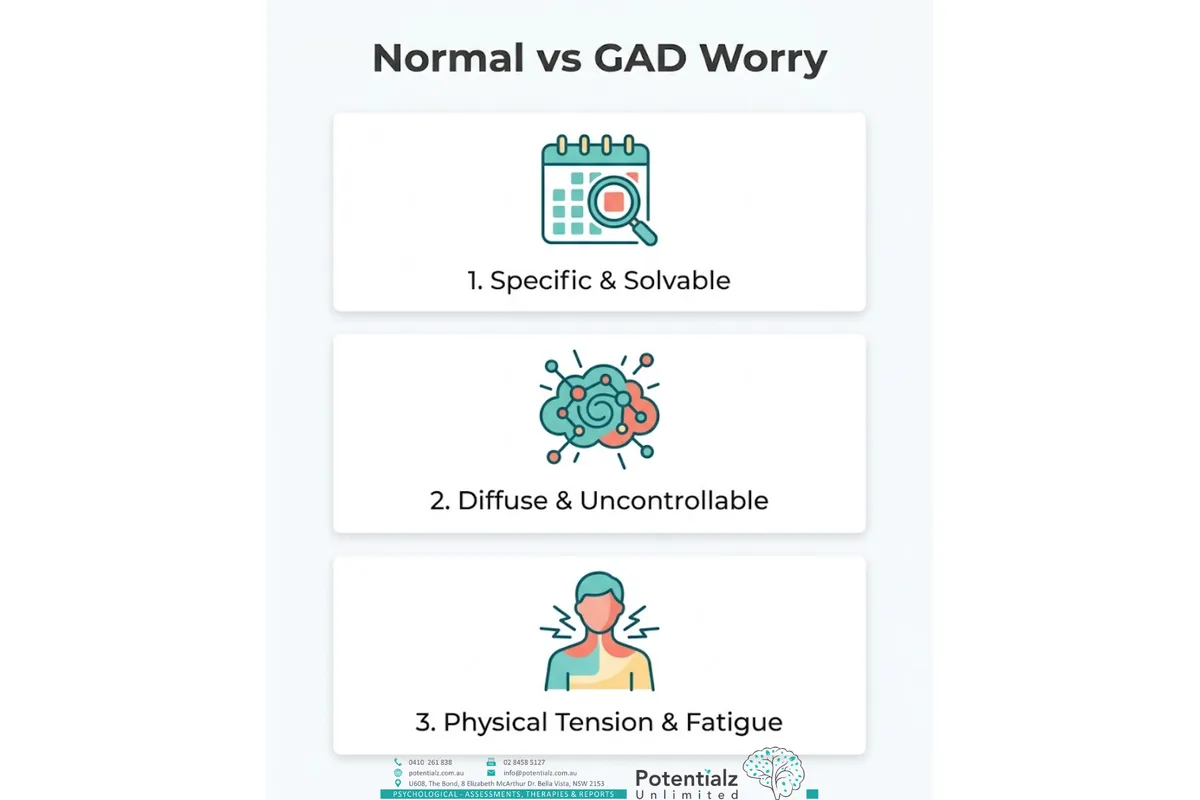
This is one of the questions I am asked most often: “Is my worry normal, or is it GAD?”
It is a fair question, because worry is a universal human experience. Everyone worries. Worry is not inherently pathological. Some amount of forward-thinking concern about the future is adaptive — it helps us plan, prepare, and respond to genuine threats. The question is whether the worry has become excessive, uncontrollable, and impairing.
Here are the key distinctions I use in my clinical assessment:
Normal worry:
- Is proportionate to the actual probability or severity of the feared outcome
- Tends to be triggered by a specific concern and resolves when the concern is addressed
- Does not significantly interfere with sleep, concentration, or relationships
- Does not consume large amounts of the person’s mental bandwidth each day
GAD-level worry:
- Is disproportionate to the actual likelihood or impact of feared outcomes
- Moves from topic to topic and does not resolve even when problems are addressed
- Persists most days for weeks or months
- Significantly affects sleep, concentration, physical tension, and daily functioning
- Is experienced by the person as difficult or impossible to control
- Has been present for so long that the person may have normalised it entirely
What I see consistently in clinical practice is that people with GAD are not overestimating the probability of bad things happening — they are underestimating their ability to cope if bad things do happen. The worry is not really about the feared event. It is about the uncertainty itself.
The Intolerance of Uncertainty Model: Why “What If” Never Stops
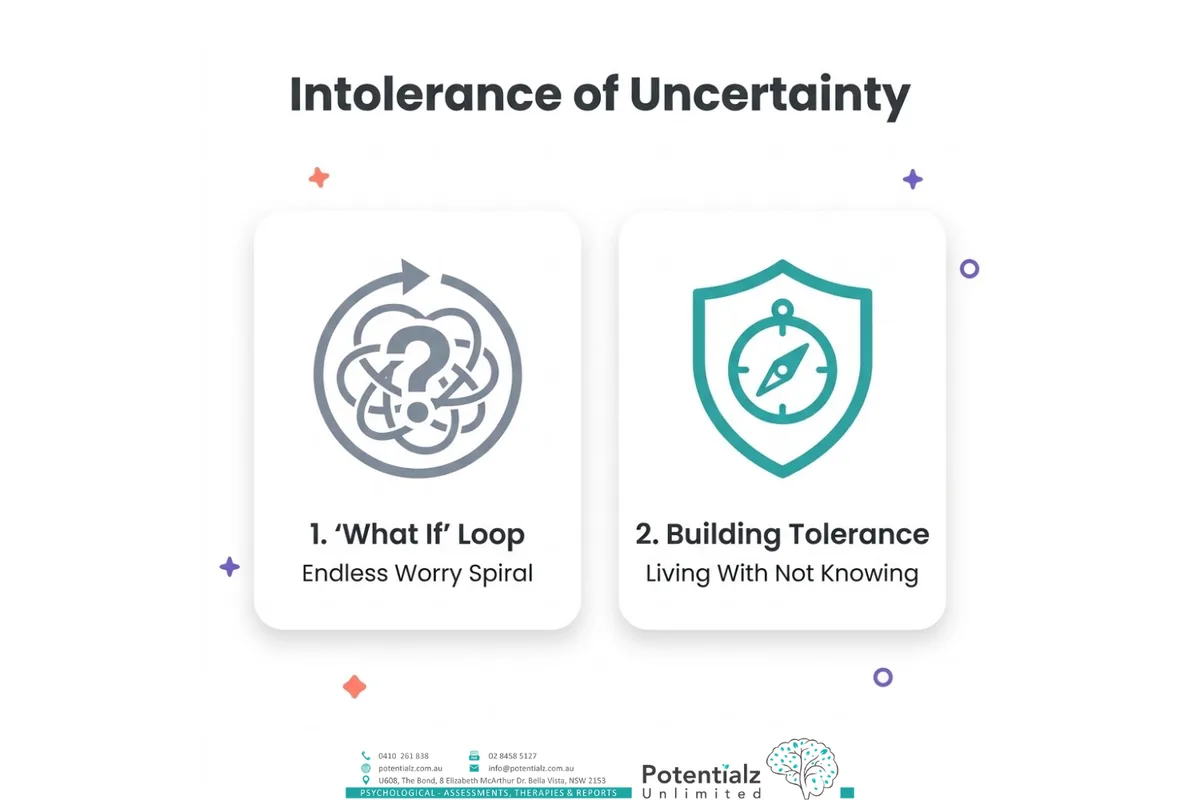
The most clinically useful model for understanding GAD — one I draw on extensively in my practice — is the intolerance of uncertainty (IU) model, developed by Michel Dugas and colleagues.
The central insight of this model is that GAD is not fundamentally about specific fears. It is about an underlying difficulty tolerating the experience of not knowing. People with high intolerance of uncertainty find uncertainty itself aversive, threatening, and intolerable — regardless of the probability of a negative outcome. Even a small chance of a bad outcome is experienced as unbearable. The mind responds by generating worry as a kind of compensatory activity: “If I think about all the possible bad things that might happen, I won’t be caught off guard.”
This explains several features of GAD that otherwise seem puzzling:
Why reassurance does not work. If a friend reassures you that your cough is probably nothing, you feel momentarily better — and then a new “what if” appears. Reassurance provides temporary certainty, which is why it creates temporary relief. But it does not address the underlying intolerance of uncertainty.
Why good news does not last. The person gets a clear medical test result, and they feel relieved — briefly. Then the mind finds a new area of uncertainty to fixate on.
Why worry jumps from topic to topic. It is not really about the specific content of the worry. It is about the state of not knowing that the worry is trying to resolve.
Understanding this model changes treatment. The goal is not to reassure away the worry, or to problem-solve every feared scenario. The goal is to build the person’s capacity to tolerate uncertainty — to be able to say “I don’t know how this will turn out, and I can live with that.”
The Worry Paradox: Why GAD Persists
Here is something that initially surprises many of my clients: people with GAD very commonly hold positive beliefs about worry. Not just “I worry a lot” — but “My worry is useful. It keeps me prepared. It shows I care. It protects the people I love.”
Researchers call these positive metacognitive beliefs about worry. They include ideas such as:
- “If I worry about the worst case, I’ll be ready for it.”
- “Worrying helps me avoid making mistakes.”
- “Not worrying would mean I don’t care about my family.”
- “If something goes wrong and I didn’t worry about it, it’s my fault.”
These beliefs are the hidden engine of GAD. They mean that the person is not just experiencing worry involuntarily — they are, at some level, choosing to worry because they believe it is protective. And as long as the belief holds, there is no motivation to disengage from the worry cycle.
A moment that comes up often in my clinical work is when a client with GAD realises, usually with some surprise, that their worry has never once prevented a bad thing from happening. It has never solved a problem that was not already solvable through direct action. It has produced years of anxiety and physical tension and sleep disruption, and in return it has delivered nothing. The bad things that happened, happened regardless of how much they worried. And the feared outcomes that never occurred would not have occurred regardless of whether they worried or not.
This is a significant clinical moment. It opens the door to genuinely questioning whether worry is worth its costs.
CBT for GAD: What Treatment Involves
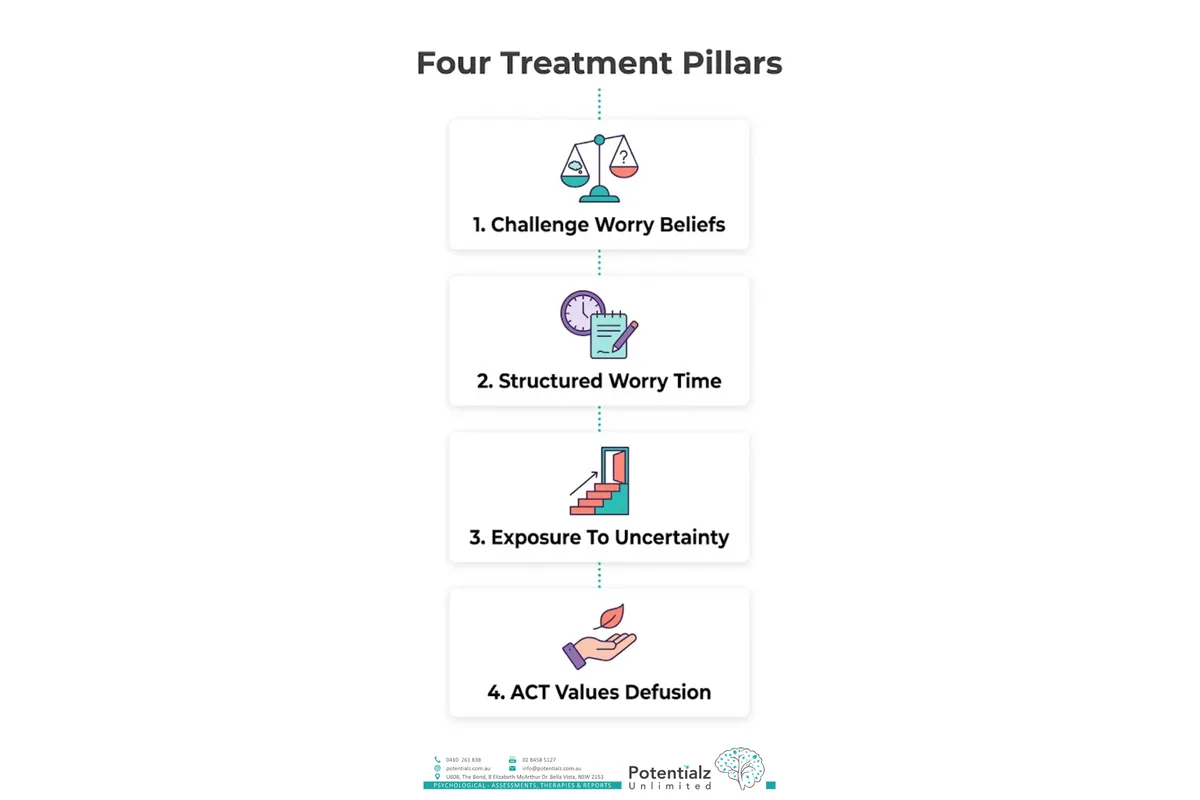
Cognitive Behavioural Therapy is the gold-standard treatment for GAD. A substantial body of research supports its effectiveness, including multiple randomised controlled trials. Here is what CBT for GAD actually looks like in practice.
Psychoeducation
Understanding what GAD is, what maintains it, and how worry works is itself therapeutic. Many clients experience significant relief from simply having a framework that makes sense of years of confusing symptoms. The intolerance of uncertainty model resonates with almost every GAD client I have worked with.
Identifying and Challenging Worry Beliefs
We examine both positive beliefs about worry (worry is protective, useful, or shows I care) and negative beliefs about worry (worry is uncontrollable, dangerous, or a sign something is wrong with me). Both types maintain the problem, though in different ways. Using structured thought records and Socratic questioning, we test these beliefs against the available evidence.
Structured Worry Time
One technique that can be surprisingly effective early in treatment is postponing worry. The person designates a specific fifteen-to-twenty minute period each day as their “worry time.” When worries arise outside this period, they note them briefly and postpone them until worry time. This does two things: it demonstrates that worry can be controlled to some degree (undermining the belief that it is completely uncontrollable), and it reduces the total amount of time the person spends in a worried state.
Problem-Solving vs Worry
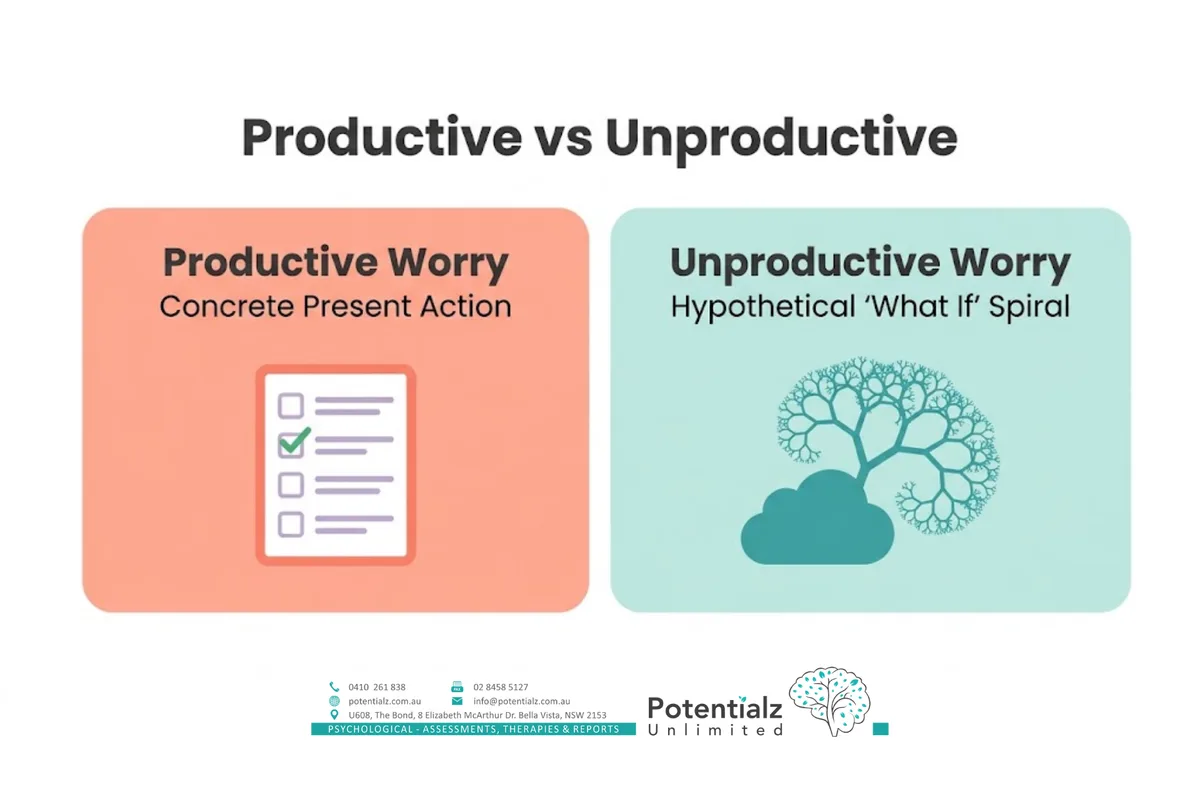
GAD clients often conflate worrying with solving problems. CBT teaches a critical distinction: productive worry is worry about a concrete problem that is currently occurring and that can be addressed by a specific action right now. Unproductive worry is worry about hypothetical future events or situations that cannot currently be acted upon. The treatment strategy for each is different. For productive worries, we apply structured problem-solving. For unproductive hypothetical worries, we practice stepping back from the “what if” spiral rather than engaging with it.
Graded Exposure to Uncertainty
Because GAD is fundamentally about intolerance of uncertainty, treatment includes gradually increasing the person’s exposure to uncertain situations without seeking reassurance or performing safety behaviours. This might start with very small experiments — making a decision without seeking reassurance, not checking something that you would normally check — and gradually building up. The goal is not to manufacture certainty, but to build the lived experience that uncertainty is survivable.
ACT for GAD: A Different Angle
Acceptance and Commitment Therapy offers a complementary approach to GAD that I find particularly valuable for clients who have already tried to reason their way out of anxiety without lasting success.
The ACT framework does not aim to reduce worry or to challenge worry thoughts directly. Instead, it invites the person to change their relationship to those thoughts. Through a process called cognitive defusion, the client learns to observe worry thoughts as mental events — transient, not necessarily accurate, not requiring action — rather than being fused with them and treating them as facts.
ACT also addresses a central feature of GAD: that anxiety has become the governing principle of the person’s life. They make decisions based on what reduces anxiety rather than what aligns with their values. They avoid social situations because of social anxiety. They over-prepare for events they actually value attending. They hold back from commitments because of what might go wrong. ACT calls this living an anxiety-driven life rather than a values-driven life. Clarifying what genuinely matters to the person — relationships, creativity, contribution, personal growth — and then taking steps in those directions despite anxiety, is a core part of ACT treatment for GAD.
The Role of Mindfulness
Mindfulness — specifically, mindfulness as a clinical skill rather than a wellness practice — is a useful component in GAD treatment. The skill of deliberately directing attention to the present moment, and observing mental content (including worry thoughts) without immediately engaging with it, trains the mind to step back from the “what if” spiral.
What I emphasise with my clients is that the goal of mindfulness in a clinical context is not to achieve a calm, empty mind. That is not achievable and not the aim. The goal is to develop the capacity to notice that you are caught in a worry loop, and to have a choice about whether to engage with it or redirect your attention. That capacity — the pause between impulse and response — is what we are building.
The Physical Reality of GAD
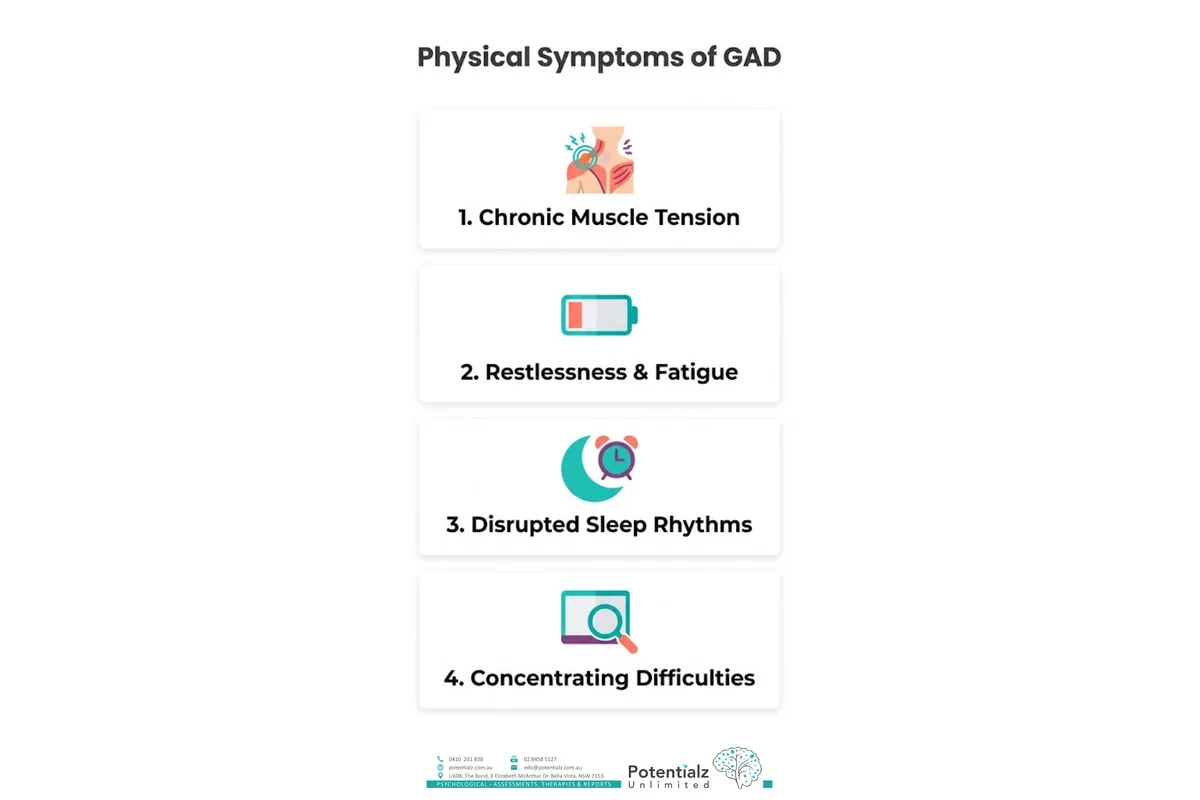
I want to be direct about this because it matters: the physical symptoms of GAD are real. Muscle tension, headaches, chronic fatigue, sleep disruption, gastrointestinal distress, increased startle response — these are physiological consequences of sustained nervous system arousal. They are not imagined, not exaggerated, and not hypochondria. The body has been maintaining a state of preparedness for a prolonged period, and this has physical costs.
For many of my clients, especially those from cultural backgrounds where mental health help-seeking carries stigma, understanding that GAD has a genuine physical basis is important. It is not a weakness of character. The body is responding predictably to a mind that has been treating ordinary uncertainty as an emergency signal.
GAD in Culturally and Linguistically Diverse Communities
In my work with migrant and refugee communities — and in my private practice — I have noticed that cultural context shapes both what people worry about and their relationship to worry itself.
In many South Asian and East Asian cultural contexts, worry about the wellbeing of family members — children’s academic performance, elderly parents’ health, the family’s financial stability — carries a moral weight that makes it feel not only normal but obligatory. Not worrying would feel like failing to care. This cultural overlay can make it harder to recognise when worry has become clinical, and harder still to seek help for it.
Additionally, in communities where mental health stigma remains significant, presenting with “just worry” can feel trivial or self-indulgent. It is neither.
I offer sessions in English, Hindi, Marathi and Punjabi, and I bring cultural sensitivity to my work with clients from South Asian and other CALD backgrounds. The experience of GAD may be shaped differently by culture, but the underlying mechanisms — and the effective treatments — are consistent.
If You Are in Crisis Right Now
Chronic anxiety can, at times, tip into acute distress or thoughts of not wanting to be here. If you are struggling right now, please reach out today. Lifeline is available 24/7 on 13 11 14, and Beyond Blue is on 1300 22 4636. If you are in immediate danger or thinking of ending your life, call 000 or go to your nearest emergency department. You are not a burden for asking.
How I Can Help
At Potentialz Unlimited in Bella Vista, I work with adults and adolescents experiencing GAD using an evidence-based combination of CBT, ACT, and mindfulness-based approaches. Treatment is individualised — I do not apply a one-size-fits-all protocol, because the specific maintaining factors differ from person to person.
My services are available under Medicare (with a GP Mental Health Care Plan referral — up to 10 individual rebated sessions per calendar year), WorkCover NSW (for anxiety conditions arising from workplace circumstances), NDIS (where psychology is included in the participant’s plan), and Employee Assistance Programmes (EAP) for eligible employees.
Telehealth appointments are available for clients who prefer them or cannot attend in person.
If you have been living with chronic worry — if you recognise the “what if” thinking, the physical tension, the exhaustion, the feeling that you cannot switch off — please do not wait until you are in crisis to seek support. Early intervention produces better outcomes. See your GP, ask about a Mental Health Care Plan, and contact the clinic or book directly at live.potentialz.com.au.
Related Reading
More from our blog:
- Perinatal Anxiety: Managing Worry During Pregnancy and Early Parenthood
- Social Anxiety Disorder: Symptoms, Causes & Treatment
- Mental Health in Older Adults: Why Ageing Doesn’t Mean Accepting Depression and Anxiety
Therapy services that may help:
References
American Psychiatric Association. (2013). Diagnostic and statistical manual of mental disorders (5th ed.). American Psychiatric Publishing.
Borkovec, T. D., Hazlett-Stevens, H., & Diaz, M. L. (1999). The role of positive beliefs about worry in generalized anxiety disorder and its treatment. Clinical Psychology and Psychotherapy, 6(2), 126–138.
Dugas, M. J., Gagnon, F., Ladouceur, R., & Freeston, M. H. (1998). Generalized anxiety disorder: A preliminary test of a conceptual model. Behaviour Research and Therapy, 36(2), 215–226. https://doi.org/10.1016/S0005-7967(97)00070-3
Hayes, S. C., Strosahl, K. D., & Wilson, K. G. (2012). Acceptance and commitment therapy: The process and practice of mindful change (2nd ed.). Guilford Press.
Ladouceur, R., Dugas, M. J., Freeston, M. H., Léger, E., Gagnon, F., & Thibodeau, N. (2000). Efficacy of a cognitive-behavioral treatment for generalized anxiety disorder: Evaluation in a controlled clinical trial. Journal of Consulting and Clinical Psychology, 68(6), 957–964. https://doi.org/10.1037/0022-006X.68.6.957
Roemer, L., Orsillo, S. M., & Salters-Pedneault, K. (2008). Efficacy of an acceptance-based behavior therapy for generalized anxiety disorder: Evaluation in a randomized controlled trial. Journal of Consulting and Clinical Psychology, 76(6), 1083–1089. https://doi.org/10.1037/a0012720
Wells, A. (1997). Cognitive therapy of anxiety disorders: A practice manual and conceptual guide. Wiley.
Knowledge Check Quiz
Test what you have just read. Choose your answer for each question, then submit to reveal the answers and your score.
Need Professional Support?
If you're experiencing mental health concerns, our team is here to help.