Key Takeaways
- Yoga therapy is not a normal yoga class. It is planned just for you. A trained expert leads it, on purpose, to help with mental health problems.
- Research suggests yoga therapy may lower anxiety and depression. It can calm your body’s stress system. It can help your nervous system relax, too.
- Yoga tools work in different ways. These include pranayama (breathing exercises), restorative yoga (gentle rest poses), yoga nidra (a guided deep-rest practice), and slow, mindful movement.
- Yoga therapy works best next to counselling or therapy. It should not replace mental health care. It adds to it.
- At Potentialz Unlimited in Bella Vista, our counsellors combine yoga therapy with counselling. This gives you whole-person support for anxiety and depression.
Introduction
Have you noticed that anxiety doesn’t just live in your mind? It also lives in your body. Maybe you feel it as a tight chest. Tense shoulders. Short, shallow breaths. You may not even notice you’re holding them.
Depression isn’t only about your thoughts, either. It can feel like heavy arms and legs. Getting out of bed can feel impossible. You may feel cut off from your own body. Life can feel flat, just under the surface.
Anxiety and depression both affect the body. Not just the mind. This is where yoga therapy can help.
Many people think yoga is “good for stress.” But yoga therapy is not like a weekly yoga class in a group. It is planned just for you, and a trained expert leads it. It uses yoga tools — breath, movement, mindfulness, and deep rest — to help with your mental, emotional, and physical health.
Over the past 20 years, research on yoga therapy has grown a lot. It used to be seen as a nice extra. Now more experts see it as a real, useful tool. This is especially true when it works alongside counselling or therapy.
This article explains what yoga therapy is. It covers what the research shows. It covers which practices work best. And it explains how our counsellors use yoga therapy at Potentialz Unlimited in Bella Vista.
What Is Yoga Therapy — And How Is It Different from a Yoga Class?
A normal yoga class is usually for a group. It follows a set routine. The goal is fitness, flexibility, or rest. A yoga therapy session is different. It is planned just for you, based on real health knowledge, and aimed at a clear goal. A trained yoga therapist leads it. This person knows the body, how it works, the mind, and how yoga can help with health problems.
The International Association of Yoga Therapists (IAYT) says yoga therapy is “the professional application of the principles and practices of yoga to promote health and wellbeing within a therapeutic relationship.” In plain terms, that means three things: the therapist is properly trained, the yoga is used on purpose, and there is a real, caring bond between therapist and client.
Yoga therapists do extra training in how to use yoga for health. Many also hold other skills, such as counselling, physiotherapy, nursing, or psychology. At Potentialz Unlimited, our counsellors bring this yoga therapy training together with training as Clinical Counsellors & Psychotherapists. They also study the Science of Living in depth. These skills are not kept apart. They work together in every session.
When yoga therapy is added to counselling, it becomes a powerful extra tool. It can reach parts of your life that talking alone may not fully reach.
Yoga Therapy for Anxiety: What the Research Shows
Anxiety disorders are very common in Australia. About 16.8% of adults have one in any 12-month period (AIHW, 2023). To see how yoga therapy helps, it helps to know what happens in your body during anxiety.
The HPA Axis and the Stress Response
The hypothalamic-pituitary-adrenal (HPA) axis is your body’s main stress system. Think of it as your body’s alarm system. When you sense danger — real or imagined — this alarm switches on. It releases stress hormones called cortisol and adrenaline. In people with anxiety, this alarm often stays on too long. This can cause ongoing tension. It can cause feeling on edge all the time. It can cause poor sleep. It leaves you in a tiring, low-level state of stress that never quite switches off.
Yoga therapy may help calm this alarm system. A large review of studies by Pascoe et al. (2017) found that yoga lowered cortisol levels, stress, and anxiety. This held true across many groups of people. Benefits showed up right after just one session. They also built up over time. This means yoga therapy may help you feel calm right now. It may also help in the long run.
Parasympathetic Activation and Vagal Tone
Your body has two main nervous system settings. One is “fight or flight.” It switches on when you feel stressed or in danger. The other is “rest and digest.” This is your calm, relaxed setting, sometimes called the parasympathetic system. In anxiety, “fight or flight” tends to take over. Yoga therapy can help switch on “rest and digest” instead. It does this through slow breathing, gentle movement, and rest practices.
Heart rate variability (HRV) shows how well your body can move between these two settings. This is a sign of a healthy nervous system, sometimes called good vagal tone. Yoga tends to raise HRV. Research by Streeter et al. (2017) found that yoga raised levels of a calming brain chemical called GABA. It also improved HRV, compared with a walking exercise group. A higher HRV is linked to more emotional strength and lower anxiety.
Pranayama: Breathing as a Clinical Tool
Pranayama means yoga breathing exercises. It is one of the easiest tools in yoga therapy for anxiety. Our counsellors use it often. The evidence is strong, and it works fast.
Some techniques help the most. These include slow belly breathing, alternate nostril breathing (nadi shodhana), and long, slow out-breaths. These techniques calm the vagus nerve — a nerve that runs from your brain to your body and helps calm your whole nervous system. A study by Brown, Gerbarg, and Muench (2013) found that a breathing program led to big drops in anxiety and PTSD symptoms. This held true across many groups of people.
You can use your breath anywhere, at any time. You don’t need equipment. You don’t need a studio. This makes pranayama a very handy tool for daily life.
Yoga Therapy for Depression: What the Research Shows
Affective disorders, the group that includes depression, affect approximately 7.5% of Australian adults in any 12-month period (AIHW, 2023). Depression is not just low mood. It can mean pulling away from others. It can mean low motivation. It can mean poor sleep and appetite. It can mean less joy in life. For many people, it also brings a heavy or numb feeling in the body. Talking alone does not always reach this feeling.
Behavioural Activation Through Movement
Behavioural activation means doing things that matter to you, even when you don’t feel like it. This pushes back against the urge to withdraw that depression brings. It is one of the best-proven ways to treat depression. Yoga gives you a simple, easy way to stay active. It also offers extra benefits beyond normal exercise.
A review by Cramer et al. (2013) looked at 23 controlled studies of yoga for depression. It found real drops in depression symptoms. This held true across many groups of people. The review said yoga can be a safe, useful addition to standard depression care.
Neuroplasticity and the Mind-Body Connection
Depression is linked to lower brain flexibility, known as neuroplasticity. This means the brain finds it harder to change, grow, and build new links. Exercise, mindfulness, and yoga can each help boost this brain flexibility. They do this by raising levels of a brain protein called BDNF, which helps brain cells survive and grow.
Research by Tolbaños-Roche et al. (2021) found that yoga — combining movement, breathing, and meditation — led to real, measurable brain changes linked to mood. This suggests yoga therapy does more than change behaviour. It may also work at a deeper, brain-chemistry level. It may help the brain manage emotions and recover from stress.
Restorative Yoga and Yoga Nidra for Depression
Restorative yoga uses gentle, supported poses held for a long time. This helps you deeply relax. It suits the tiredness and body-heaviness that often comes with depression. It does not need high energy or fitness. It meets your body right where it is.
Yoga nidra means “yogic sleep” in Sanskrit. It is a guided practice done lying down. It brings you to a state between awake and asleep. Your body rests as if asleep. A thin thread of awareness stays present the whole time. Research by Datta et al. (2017) found that yoga nidra reduced symptoms of anxiety and depression. Many practitioners also see it as a deeply restful tool for mood problems.
How Yoga Therapy Integrates with Counselling
To be clear: yoga therapy does not replace counselling, psychotherapy, or psychiatric care. If you have moderate to severe depression or anxiety, you still need proper mental health support. This may include medication, talked through with your GP or psychiatrist.
What yoga therapy offers is a well-proven extra tool. It can reach parts of your life that talking alone may not fully reach.
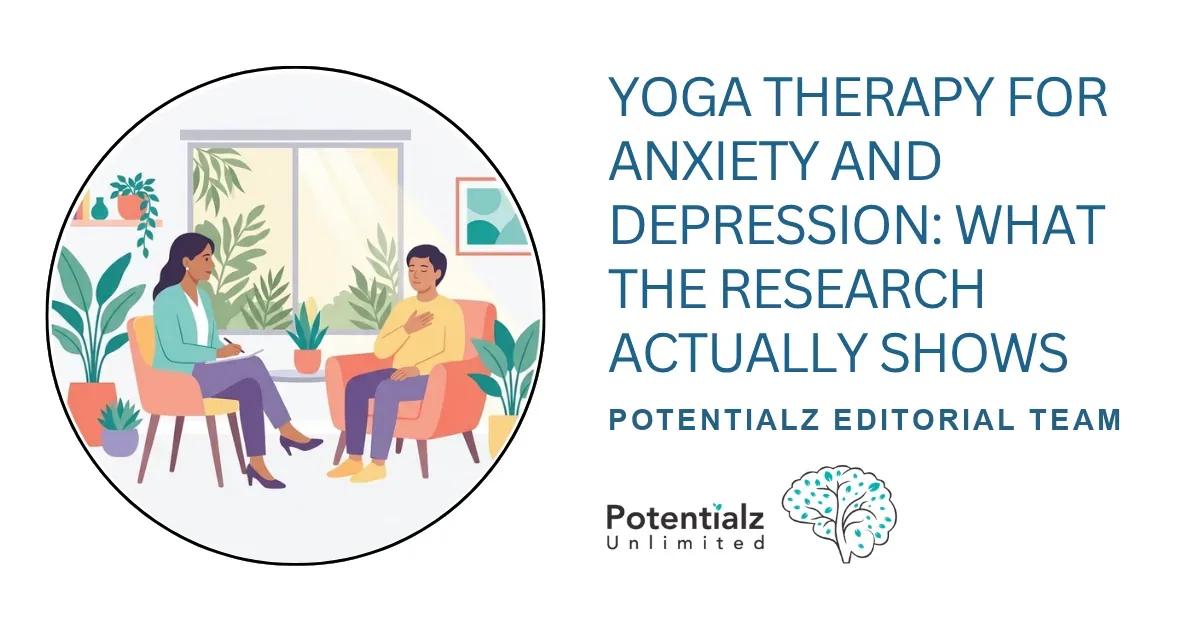
In a combined session at Potentialz, yoga therapy tools are used inside a real counselling relationship. They are not a stand-alone wellness activity. They are used as a clinical tool, on purpose, with clear intent.
In practice, this might look like:
- Starting a session with a short breathing practice, to calm your nervous system before you begin talking.
- Noticing body feelings while you explore hard emotions — asking where in the body a feeling sits.
- Teaching yoga nidra as a home practice, if you have sleep problems linked to depression.
- Using gentle, mindful movement to help you reach emotions that feel “stuck” and hard to put into words.
- Introducing restorative yoga poses as a way to manage stress between sessions.
If you are also looking for anxiety support with a psychological focus, our anxiety support page has more information. Our guides on pranayama and breathwork for mental health and yoga nidra for stress and sleep may also help.
Yoga Therapy Training and Practice at Potentialz
At Potentialz Unlimited, yoga therapy training is not a side extra. It is a core part of our counselling work.
Our counsellors study the Science of Living in depth. This covers yogic ideas, yoga as a healing system, pranayama, and meditation. They also bring years of hands-on experience across many cultures and countries. This shapes a way of working that is grounded in real psychology, and truly focused on the whole person. It means working with the body, not against it. It means knowing what becomes possible when you stop fighting yourself and start listening.
For clients from CALD (culturally and linguistically diverse) communities — including South Indian communities who may already know yogic practices and Ayurvedic ideas about health — this matters even more. Our counsellors can talk about these traditions in your own cultural context, and in your own language. This adds a depth of understanding that can be hard to find elsewhere.
Who Might Benefit from Yoga Therapy as Part of Counselling?
Yoga therapy added to counselling may help you if you:
- Feel anxiety — general anxiety, social anxiety, health anxiety, or anxiety you notice mostly in your body.
- Are managing mild to moderate depression, especially with body symptoms like heaviness, tiredness, or feeling disconnected from your body.
- Have been through trauma and find that some feelings seem “stuck” in the body, hard to reach through words alone.
- Want to build a self-care practice you can use between sessions.
- Are drawn to mind-body approaches and like the idea of breathwork, movement, or yoga.
- Come from a cultural background where yogic or Ayurvedic ideas about health feel familiar and valued.
To be clear: yoga therapy should not be used alone for severe depression, active thoughts of suicide, or complex mental health conditions. In these cases, it can support proper clinical care. But it cannot replace it.
How Potentialz Can Help
At Potentialz Unlimited, yoga therapy is combined with counselling and psychotherapy. It is not a separate class or wellness service. It is a clinical tool, used within a real professional bond.
If you are dealing with anxiety, depression, or both, and you want support for your whole self — not just your thoughts — our counsellors would love to talk with you. See the full range of therapies offered at Potentialz to learn how counselling and yoga therapy work together.
Sessions are available at Unit 608, 8 Elizabeth Macarthur Drive, Bella Vista NSW 2153, Monday to Friday 10am–7pm, with Saturday and after-hours appointments available. Telehealth sessions by phone or Zoom are available if you prefer to connect from home.
To book your first appointment:
- Book online: live.potentialz.com.au
- Call: 0410 261 838
- Visit: potentialz.com.au
No referral is required.
References
Australian Institute of Health and Welfare. (2023). Prevalence and impact of mental illness. https://www.aihw.gov.au/mental-health/overview/prevalence-and-impact-of-mental-illness
Cramer, H., Lauche, R., Langhorst, J., & Dobos, G. (2013). Yoga for depression: A systematic review and meta-analysis. Depression and Anxiety, 30(11), 1068–1083. https://doi.org/10.1002/da.22166
Pascoe, M. C., Thompson, D. R., Jenkins, Z. M., & Ski, C. F. (2017). Mindfulness mediates the physiological markers of stress: Systematic review and meta-analysis. Journal of Psychiatric Research, 95, 156–178. https://doi.org/10.1016/j.jpsychires.2017.08.004
Streeter, C. C., Gerbarg, P. L., Whitfield, T. H., Owen, L., Johnston, J., Silveri, M. M., Gensler, M., Faulkner, C. L., Mann, C., & Jensen, J. E. (2017). Treatment of major depressive disorder with Iyengar yoga and coherent breathing: A randomized controlled dosing study. Journal of Alternative and Complementary Medicine, 23(3), 201–207. https://doi.org/10.1089/acm.2016.0140
Brown, R. P., Gerbarg, P. L., & Muench, F. (2013). Breathing practices for treatment of psychiatric and stress-related medical conditions. Psychiatric Clinics of North America, 36(1), 121–140. https://doi.org/10.1016/j.psc.2013.01.001
Disclaimer
Our counsellors are Clinical Counsellors & Psychotherapists and PACFA Clinical Registrants (Psychotherapy and Counselling Federation of Australia). They are not registered psychologists under AHPRA. The information in this post is general in nature and does not constitute clinical advice. Yoga therapy is offered as an adjunct to, not a replacement for, professional mental health treatment. If you are experiencing significant symptoms of anxiety or depression, please speak with your GP or a qualified mental health professional.
Crisis Resources
- Lifeline: 13 11 14 (24/7)
- Beyond Blue: 1300 22 4636
- Suicide Call Back Service: 1300 659 467
- SANE Australia: 1800 18 7263
- Emergency: 000
Knowledge Check Quiz
Test what you have just read. Choose your answer for each question, then submit to reveal the answers and your score.
Need Professional Support?
If you're experiencing mental health concerns, our team is here to help.