Three Words That Get Mixed Up — and Why It Matters
In the room, I hear these three words used almost interchangeably. “I’ve been so anxious this week.” “I’m just stressed.” “That was traumatic.”
They feel the same, in the moment. A racing heart. A tight chest. A mind that will not settle. And yet, in clinical terms, anxiety, stress, and trauma are three quite different things — with different causes, different courses, and, importantly, different treatments that actually work.
This is a plain-language guide to those differences. Not so you can diagnose yourself — that is a job for a professional — but so that when you speak to your GP or a psychologist in Bella Vista, you can describe what is really happening. Which, in my experience, is often the first step to getting the right kind of help.
Stress: A Response to What Is Happening Now
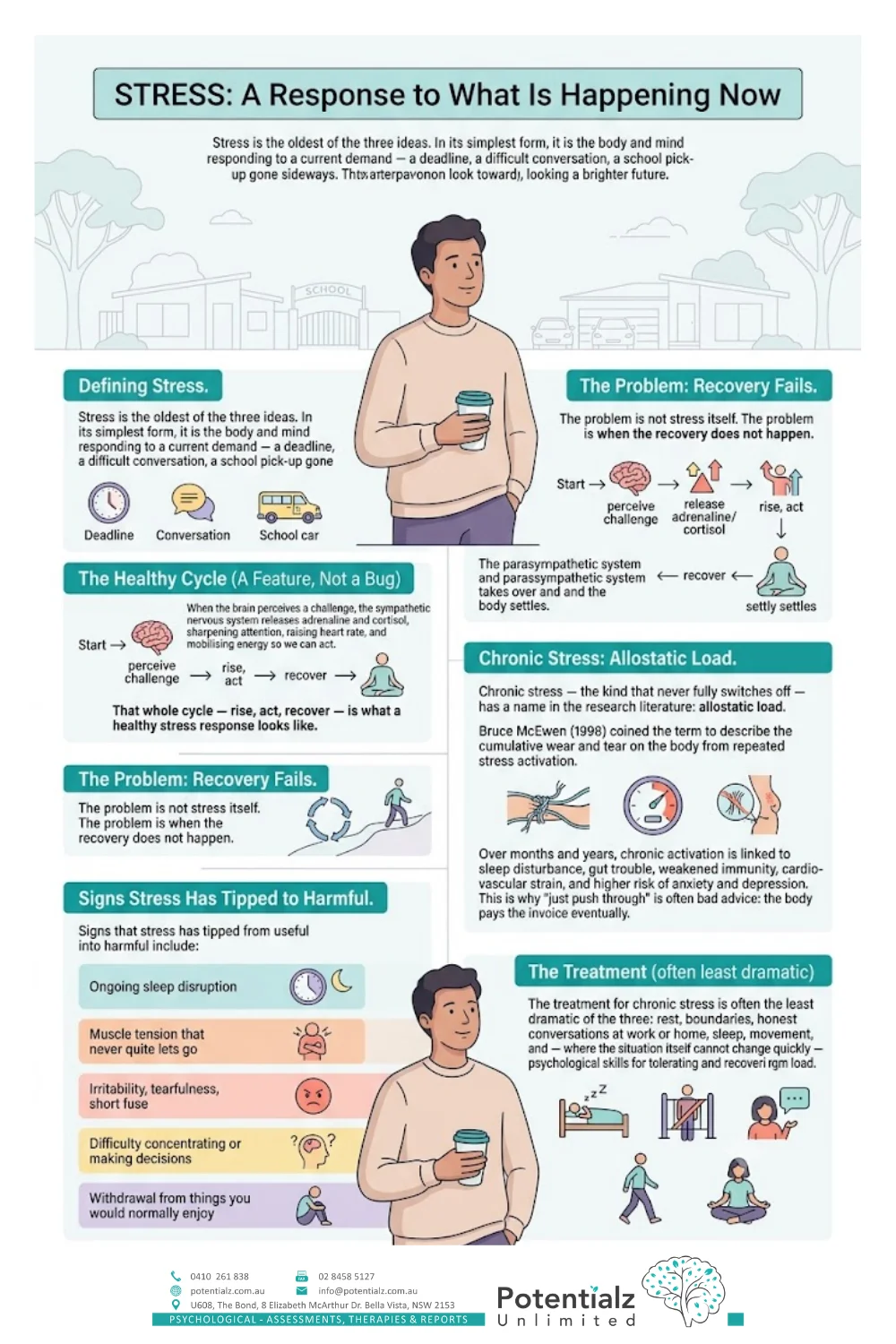
Stress is the oldest of the three ideas. In its simplest form, it is the body and mind responding to a current demand — a deadline, a difficult conversation, a school pick-up gone sideways.
The stress response is not a bug. It is a feature. When the brain perceives a challenge, the sympathetic nervous system releases adrenaline and cortisol, sharpening attention, raising heart rate, and mobilising energy so we can act. When the demand passes, the parasympathetic system takes over and the body settles. That whole cycle — rise, act, recover — is what a healthy stress response looks like.
The problem is not stress itself. The problem is when the recovery does not happen.
Chronic stress — the kind that never fully switches off — has a name in the research literature: allostatic load. Bruce McEwen (1998) coined the term to describe the cumulative wear and tear on the body from repeated stress activation. Over months and years, chronic activation is linked to sleep disturbance, gut trouble, weakened immunity, cardiovascular strain, and higher risk of anxiety and depression. This is why “just push through” is often bad advice: the body pays the invoice eventually.
Signs that stress has tipped from useful into harmful include:
- Ongoing sleep disruption
- Muscle tension that never quite lets go
- Irritability, tearfulness, or a shorter fuse than usual
- Difficulty concentrating or making decisions
- Withdrawal from things you would normally enjoy
The treatment for chronic stress is often the least dramatic of the three: rest, boundaries, honest conversations at work or home, sleep, movement, and — where the situation itself cannot change quickly — psychological skills for tolerating and recovering from load. For work-related patterns specifically, our guide to work-related stress and how to manage it walks through what actually helps.
Anxiety: A Response to a Future That May Not Come
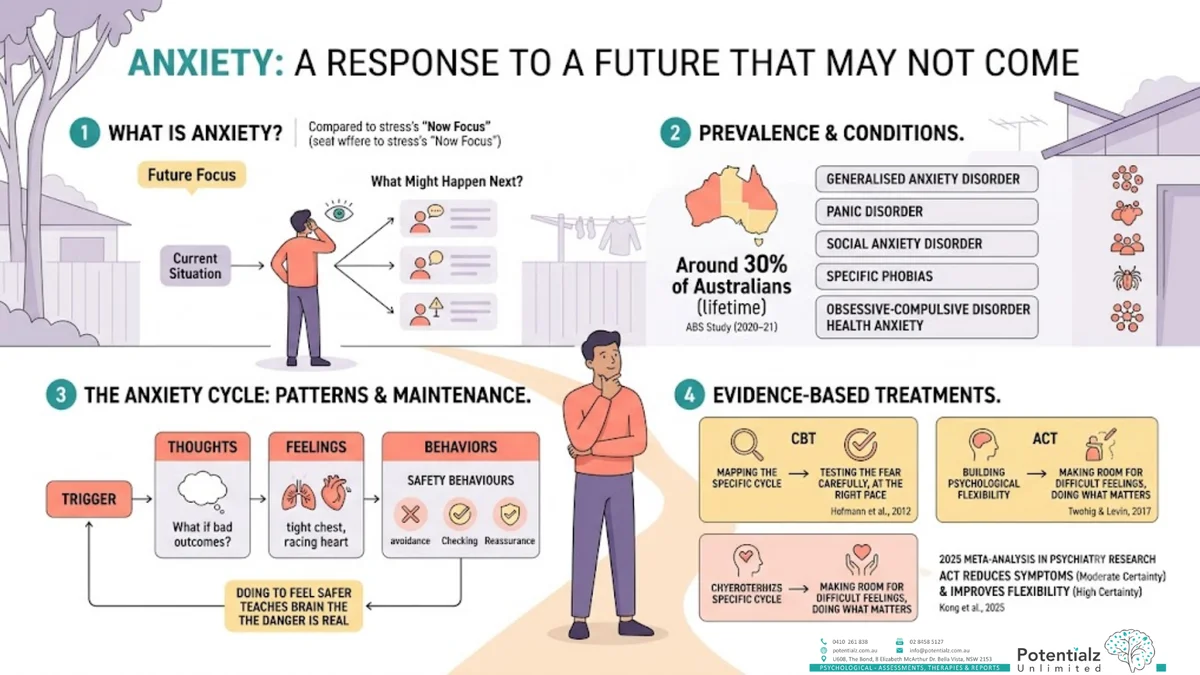
Anxiety looks similar to stress from the outside — the tight chest, the racing heart, the busy mind. But its inner architecture is different. Where stress is usually about now, anxiety is usually about what might happen next.
A person with anxiety is not just responding to a current threat. Their nervous system is scanning for a future one, and often finding it whether or not it is actually there. That is why anxiety persists even when the objective situation is safe.
The ABS National Study of Mental Health and Wellbeing (2020–21) found that around 30% of Australians will experience an anxiety disorder in their lifetime, making it the most common mental health condition in the country. Anxiety disorders include generalised anxiety disorder, panic disorder, social anxiety disorder, specific phobias, and, in a related family, obsessive-compulsive disorder and health anxiety.
The common thread across these presentations is a pattern of:
- Excessive worry that is hard to switch off
- Anticipating threat — replaying possible bad outcomes
- Physical arousal — the sympathetic system stuck partly on
- Safety behaviours — checking, seeking reassurance, avoiding — that reduce anxiety in the short term but keep the pattern alive in the long term
The last point is the most important clinically. Anxiety is not maintained by weakness or wrong thinking. It is maintained by what we do to feel safer. Avoiding the meeting eases anxiety in the moment — and teaches the brain the meeting was dangerous. Checking your body eases fear in the moment — and teaches the brain that the sensation was proof of danger.
Cognitive behavioural therapy (CBT) is the first-line, evidence-based treatment for most anxiety disorders. It works by mapping the specific cycle of triggers, thoughts, feelings, and behaviours that maintains a person’s anxiety, and then — carefully, at the right pace — testing the fear rather than accommodating it (Hofmann et al., 2012). Acceptance and commitment therapy (ACT) takes a different but complementary route: rather than arguing with anxious thoughts, ACT builds psychological flexibility — the ability to make room for difficult feelings while still doing what matters (Twohig & Levin, 2017). A 2025 meta-analysis in Psychiatry Research found ACT reduces anxiety symptoms with moderate certainty and improves psychological flexibility with high certainty (Kong et al., 2025).
For a broader entry point, our post on when to seek help for managing anxiety walks through the practical decision.
Trauma: A Response to What Has Already Happened
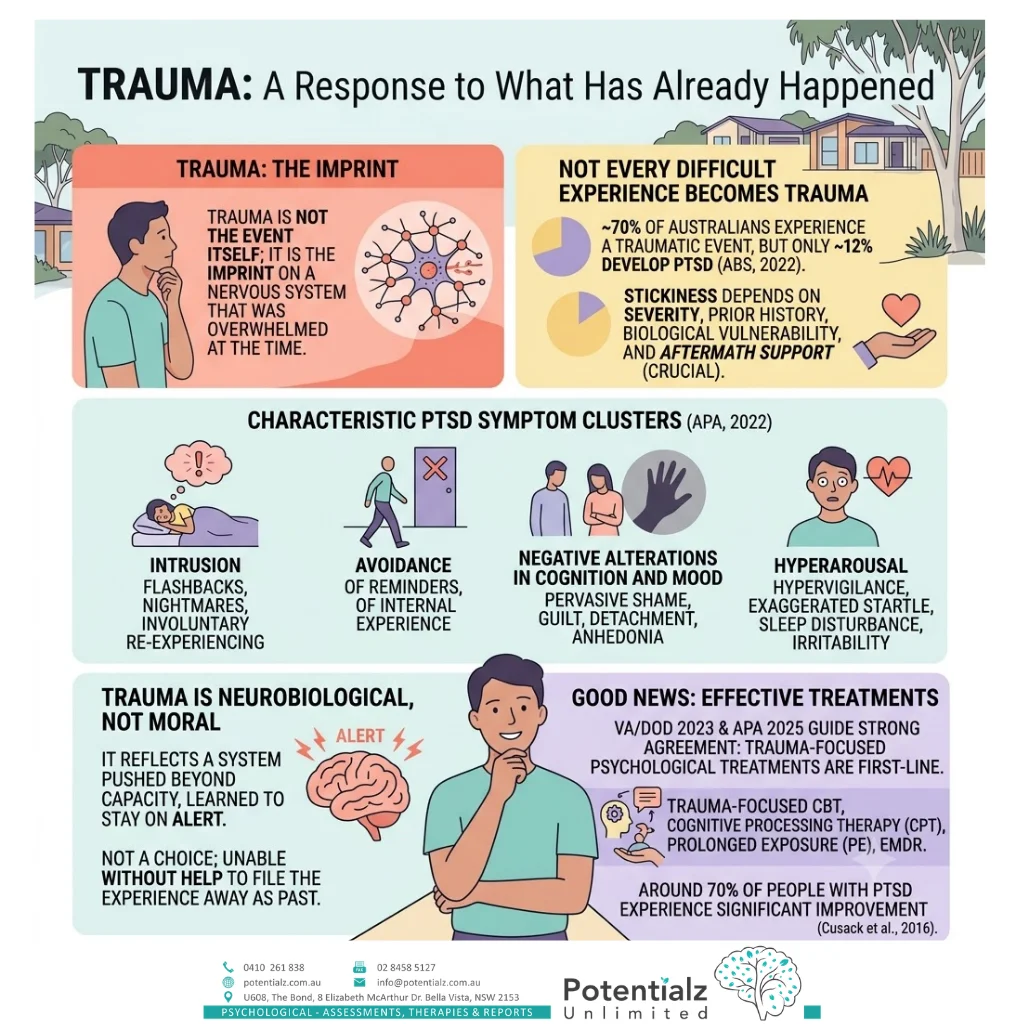
Trauma is the third pattern, and it is the one most often misunderstood. Trauma is not the event itself; it is the imprint the event leaves in a nervous system that was overwhelmed at the time.
Not every difficult experience becomes trauma. Around 70% of Australians will experience at least one traumatic event in their lifetime, but only around 12% will develop PTSD (ABS, 2022). Whether trauma “sticks” depends on the severity and nature of the event, prior history, biological vulnerability, and — crucially — the support and safety available in the aftermath.
PTSD is diagnosed when the response has not resolved within a month, and when characteristic symptoms cluster in four ways (American Psychiatric Association, 2022):
- Intrusion — flashbacks, nightmares, involuntary re-experiencing
- Avoidance — of reminders, of internal experience
- Negative alterations in cognition and mood — pervasive shame, guilt, detachment, anhedonia
- Hyperarousal — hypervigilance, exaggerated startle, sleep disturbance, irritability
Trauma is neurobiological, not moral. It reflects a nervous system that was pushed beyond its capacity to cope, and that has learned to stay on alert in case the danger returns. This is why it responds so poorly to advice like “just move on” — the system is not choosing to remember; it is unable, without help, to file the experience away as past.
The good news is that trauma responds unusually well to the right treatment. The 2023 VA/DOD Clinical Practice Guidelines and the 2025 APA guidelines are in strong agreement: trauma-focused psychological treatments are first-line. These include Trauma-Focused CBT, Cognitive Processing Therapy (CPT), Prolonged Exposure (PE), and EMDR (Eye Movement Desensitisation and Reprocessing). Around 70% of people with PTSD experience significant improvement with these treatments (Cusack et al., 2016). Colleagues at our practice have written a full clinical explanation in PTSD: Understanding Trauma’s Lasting Impact and the Treatments That Work and a dedicated guide to EMDR therapy for trauma and PTSD.
Where the Three Overlap — and Why That Matters
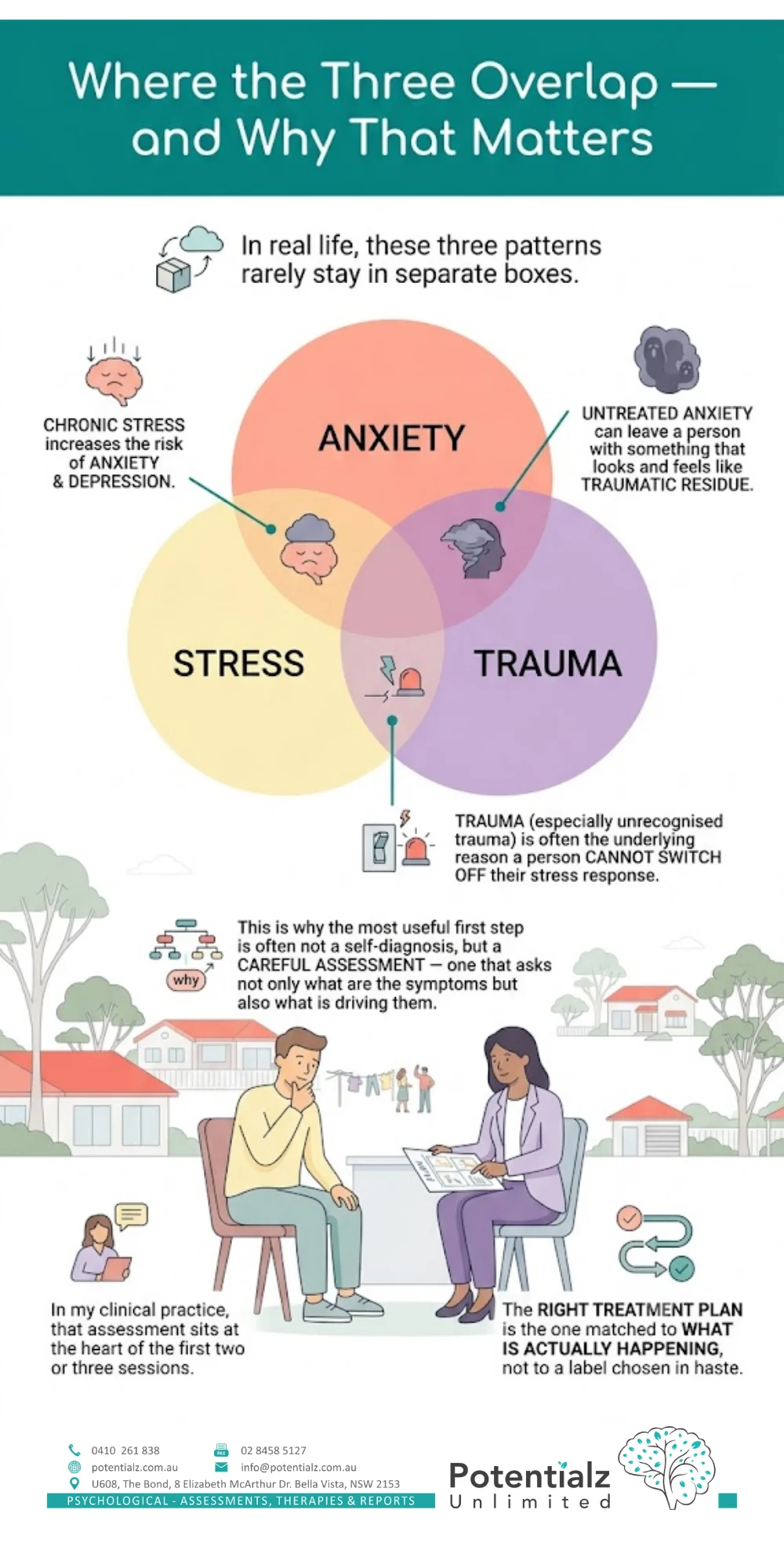
In real life, these three patterns rarely stay in separate boxes. Chronic stress increases the risk of anxiety and depression. Untreated anxiety can leave a person with something that looks and feels like traumatic residue. Trauma, especially unrecognised trauma, is often the underlying reason a person cannot switch off their stress response.
This is why the most useful first step is often not a self-diagnosis, but a careful assessment — one that asks not only what are the symptoms but also what is driving them. In my clinical practice, that assessment sits at the heart of the first two or three sessions. The right treatment plan is the one matched to what is actually happening, not to a label chosen in haste.
What Helps: A Practical Summary
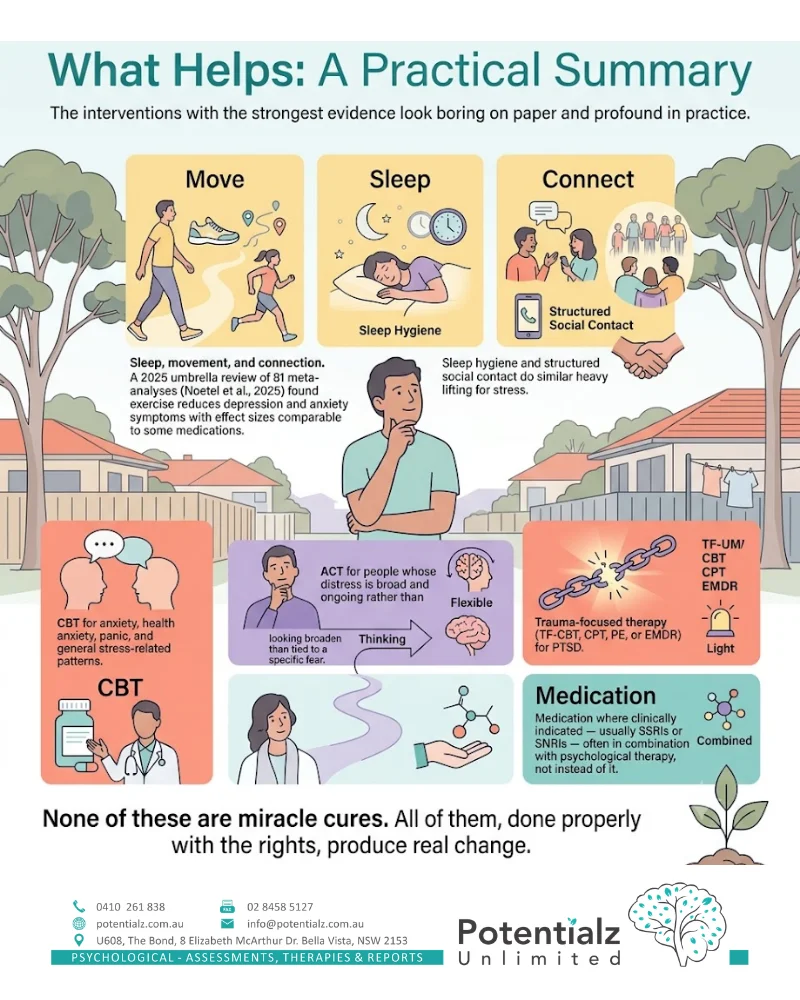
The interventions with the strongest evidence look boring on paper and profound in practice.
- Sleep, movement, and connection. A 2025 umbrella review of 81 meta-analyses (Noetel et al., 2025) found exercise reduces depression and anxiety symptoms with effect sizes comparable to some medications. Sleep hygiene and structured social contact do similar heavy lifting for stress.
- CBT for anxiety, health anxiety, panic, and general stress-related patterns.
- ACT for people whose distress is broad and ongoing rather than tied to a specific fear.
- Trauma-focused therapy (TF-CBT, CPT, PE, or EMDR) for PTSD.
- Medication where clinically indicated — usually SSRIs or SNRIs — often in combination with psychological therapy, not instead of it.
None of these are miracle cures. All of them, done properly with the right person, produce real change.
How Potentialz Unlimited Can Help
Potentialz Unlimited is based in Bella Vista, NSW, and serves individuals and families across the Hills District — Norwest, Castle Hill, Kellyville, Baulkham Hills, Rouse Hill, and Glenhaven.
I am Dr Gurprit Ganda, a Clinical Psychologist with over 25 years of experience across anxiety, chronic stress, and complex trauma. I use CBT and ACT for anxiety and stress-related presentations, and EMDR alongside trauma-focused CBT for PTSD. Sessions available in English, Hindi, Punjabi, and Urdu. Medicare rebates available with a GP Mental Health Care Plan, and WorkCover NSW funds treatment for workplace-related trauma. You can contact the clinic or book directly at live.potentialz.com.au.
If your low mood or worry ever brings thoughts of not wanting to be here, please reach out for urgent support now: call Lifeline on 13 11 14, or in an emergency call 000.
Video Scripts
[8-SEC VIDEO 1] Visual: Three overlapping circles on screen, one labelled “stress”, one “anxiety”, one “trauma”. Text overlay: “Different roots. Different treatments.” End card: “Potentialz Unlimited — Bella Vista”
[8-SEC VIDEO 2] Visual: A calendar rolling forward; a person looking calmer week by week. Text overlay: “Around 70% of people with PTSD improve with proper treatment.” End card: “potentialz.com.au”
[8-SEC VIDEO 3] Visual: Person taking a deep breath, chest rising and softening. Text overlay: “Stress rises. Stress recovers. Anxiety forgets the recover part.” End card: “Book at live.potentialz.com.au”
[8-SEC VIDEO 4] Visual: A mind full of thought bubbles quietening. Text overlay: “CBT · ACT · EMDR — pick the right tool for the right problem.” End card: “Potentialz Unlimited”
[30-SEC VIDEO 1] Opening: Person at a desk, shoulders up around their ears. Voiceover: “Stress is your body responding to what is happening now. Anxiety is your body responding to what might happen next. Trauma is your body still responding to something that already ended.” Cut to: therapy room. “Three patterns. Three different treatment paths. All well-supported by evidence.” End card: “Potentialz Unlimited | live.potentialz.com.au”
[30-SEC VIDEO 2] Opening: Stats graphic showing ABS lifetime prevalence figures. Voiceover: “Around 30% of Australians will experience an anxiety disorder in their lifetime. Around 12% develop PTSD after trauma. Chronic stress affects almost everyone at some stage.” Cut to: warm clinical setting. “The most important step is not a diagnosis you give yourself — it is an assessment that matches the right treatment to what is really happening.” End card: “Potentialz Unlimited | Bella Vista”
[2-MIN VIDEO] (0:00–0:15) A busy household, a phone buzzing, a person with a hand on their chest. Voiceover: “Three of the most common words in mental health — anxiety, stress, and trauma. In the room, they get used almost interchangeably. But clinically, they are three quite different things.” (0:15–0:45) “Stress is your body responding to a current demand. It is meant to rise, and it is meant to recover. When it never fully recovers, we call that chronic stress — and the wear and tear it leaves on the body is called allostatic load.” (0:45–1:15) “Anxiety is different. Anxiety anticipates. It is a nervous system scanning for a future threat, whether or not one is coming. About 30% of Australians live with an anxiety disorder at some point in their lives. And the pattern is kept alive not by weakness, but by the things we do to feel safer — avoiding, checking, seeking reassurance.” (1:15–1:45) “Trauma is the after-effect of an overwhelming event. Not everyone who experiences trauma develops PTSD — but for those who do, the nervous system stays on alert as if the danger were still present.” (1:45–2:00) “The good news: all three respond to evidence-based treatment. CBT and ACT for anxiety and stress. Trauma-focused CBT, CPT, PE, and EMDR for PTSD. At Potentialz Unlimited in Bella Vista, we start with a careful assessment — because the right help begins with the right question. Book at live.potentialz.com.au.” End card.
Related Reading
More from our blog:
- PTSD: Understanding Trauma’s Lasting Impact and the Treatments That Work
- Managing Stress & Anxiety in Bella Vista: How Therapy Helps
- Understanding EMDR Therapy: A Comprehensive Guide to Healing Trauma
Therapy services that may help:
References
American Psychiatric Association. (2022). Diagnostic and statistical manual of mental disorders (5th ed., text rev.). https://doi.org/10.1176/appi.books.9780890425787
Australian Bureau of Statistics. (2022). National study of mental health and wellbeing 2020–21. ABS. https://www.abs.gov.au/statistics/health/mental-health
Cusack, K., Jonas, D. E., Forneris, C. A., Wines, C., Sonis, J., Middleton, J. C., Feltner, C., Brownley, K. A., Olmsted, K. R., Greenblatt, A., Weil, A., & Gaynes, B. N. (2016). Psychological treatments for adults with posttraumatic stress disorder: A systematic review and meta-analysis. Clinical Psychology Review, 43, 128–141. https://doi.org/10.1016/j.cpr.2015.10.003
Hofmann, S. G., Asnaani, A., Vonk, I. J. J., Sawyer, A. T., & Fang, A. (2012). The efficacy of cognitive behavioral therapy: A review of meta-analyses. Cognitive Therapy and Research, 36(5), 427–440. https://doi.org/10.1007/s10608-012-9476-1
Kong, Q., Yan, S., Huang, K., Han, B., Han, R., Jiao, Y., Yang, H., Pu, Y., Li, S., & Jia, Y. (2025). The efficacy of acceptance and commitment therapy (ACT) for depression: A systematic review and meta-analysis. Psychiatry Research, 352, 116701. https://doi.org/10.1016/j.psychres.2025.116701
McEwen, B. S. (1998). Stress, adaptation, and disease: Allostasis and allostatic load. Annals of the New York Academy of Sciences, 840(1), 33–44. https://doi.org/10.1111/j.1749-6632.1998.tb09546.x
Noetel, M., Sanders, T., Gallardo-Gómez, D., Taylor, P., del Pozo Cruz, B., van den Hoek, D., Smith, J. J., Mahoney, J., Spathis, J., Moresi, M., Pagano, R., Pagano, L., Vasconcellos, R., Arnott, H., Varley, B., Parker, P., Biddle, S., & Lonsdale, C. (2025). Effect of exercise on depression and anxiety symptoms: Systematic umbrella review with meta-meta-analysis. Retrieved from https://pubmed.ncbi.nlm.nih.gov/41667154/
Twohig, M. P., & Levin, M. E. (2017). Acceptance and commitment therapy as a treatment for anxiety and depression: A review. Psychiatric Clinics of North America, 40(4), 751–770. https://doi.org/10.1016/j.psc.2017.08.009
Social Media Promotion
Facebook: Three of the most common words in mental health — anxiety, stress, and trauma — get used almost interchangeably. In the room, they feel similar. Racing heart. Tight chest. A mind that will not settle.
But they are three quite different things.
Stress is a response to what is happening now. Anxiety is a response to what might happen next. Trauma is a response to something that already ended, but that the nervous system has not yet been able to file as “past.”
Each has its own treatment path — well-tested, evidence-based, and increasingly effective. CBT and ACT for anxiety and chronic stress. Trauma-focused CBT, CPT, PE, and EMDR for PTSD.
The most important first step is not a self-diagnosis — it is an assessment that matches the right treatment to what is actually happening.
Full article: https://www.potentialz.com.au/post/understanding-anxiety-stress-and-trauma-a-comprehensive-guide/
Instagram: Stress. Anxiety. Trauma.
Same racing heart. Same tight chest. Three quite different roots.
🔹 Stress = your body responding to now 🔹 Anxiety = your body responding to what might happen next 🔹 Trauma = your body still responding to something that already ended
Different roots. Different treatments. All well-supported by evidence.
The most important first step is not a diagnosis — it is an assessment.
Save this for someone who thinks they should “just push through.”
🔗 Link in bio
#AnxietyRelief #StressManagement #TraumaRecovery #CBT #EMDR #BellaVistaPsychologist #HillsDistrict #ClinicalPsychology
Alt text: A clinical psychologist’s guide to anxiety, stress, and trauma
Pinterest: Pin title: Anxiety vs Stress vs Trauma: A Clinical Psychologist’s Guide Pin description: Anxiety, stress, and trauma are often used interchangeably — but they have different causes, different courses, and different evidence-based treatments. Learn how a clinical psychologist tells them apart, why CBT is first-line for anxiety, how ACT builds psychological flexibility, and why trauma-focused therapies (TF-CBT, CPT, PE, EMDR) are the strongest-evidence treatments for PTSD. Practical, compassionate guidance from Bella Vista. Board: Anxiety Support & CBT Link: https://www.potentialz.com.au/post/understanding-anxiety-stress-and-trauma-a-comprehensive-guide/
LinkedIn: In clinical practice, three of the most commonly conflated words are stress, anxiety, and trauma.
They feel similar in the body.
They mean quite different things in the mind.
Stress is a response to a current demand — meant to rise, meant to recover. When it never recovers, we call that chronic stress, and the physiological cost has a name: allostatic load (McEwen, 1998).
Anxiety is not about the present. Anxiety anticipates. Around 30% of Australians will experience an anxiety disorder in their lifetime (ABS, 2020–21).
Trauma is the imprint of an event that overwhelmed the nervous system’s capacity to cope. Around 70% of Australians experience at least one traumatic event; around 12% develop PTSD.
The clinical implication:
The right treatment does not follow from the presenting symptoms alone.
It follows from a careful assessment of what is driving them.
CBT and ACT for anxiety and chronic stress.
Trauma-focused CBT, Cognitive Processing Therapy, Prolonged Exposure, and EMDR for PTSD.
Roughly 70% of people with PTSD improve significantly with appropriate treatment (Cusack et al., 2016).
For colleagues in general practice, allied health, or WorkCover case management — a careful first assessment saves months of misdirected therapy.
Full article: https://www.potentialz.com.au/post/understanding-anxiety-stress-and-trauma-a-comprehensive-guide/
#ClinicalPsychology #AnxietyDisorders #PTSD #CBT #EMDR #MentalHealth
Google Business Profile: Anxiety, stress, and trauma often get spoken about as if they were the same thing. Clinically, they are not — and the right treatment depends on which one is really at play. At Potentialz Unlimited in Bella Vista, Dr Gurprit Ganda (Clinical Psychologist, 25+ years) offers careful assessment and evidence-based treatment: CBT and ACT for anxiety and chronic stress, and EMDR alongside trauma-focused CBT for PTSD. Medicare rebates and WorkCover funding available. Book online or call 0410 261 838.
Button: Learn more → https://www.potentialz.com.au/post/understanding-anxiety-stress-and-trauma-a-comprehensive-guide/
Knowledge Check Quiz
Test what you have just read. Choose your answer for each question, then submit to reveal the answers and your score.
Need Professional Support?
If you're experiencing mental health concerns, our team is here to help.